

Our management
UNICEF Innocenti's senior management team

Director
Regina De Dominicis is the Director of the UNICEF Office of Strategy and Evidence – Innocenti in Florence, Italy, leading a multidisciplinary team advancing change for children through research, strategy and foresight. She is also the Designated UNICEF Lead in Italy, fostering engagement with the Italian government and institutions, UN entities and diplomatic missions present in the country. Prior to this role, she was UNICEF Regional Director for Europe and Central Asia, UNICEF Representative to the United Nations in Geneva, and Special Coordinator for the Refugee and Migrant Response in Europe.
Over an international career spanning more than 25 years, she has held senior leadership positions in UNICEF including Representative in Türkiye, where she led UNICEF’s largest programme in the Europe and Central Asia region, as well as Representative in Serbia and Morocco.
Before joining UNICEF, Ms. De Dominicis spent a decade with the European Commission and the European Agency for Reconstruction, managing humanitarian and development programmes focused on strengthening the rule of law, democracy, civil society, public administration, and education systems. She began her career in Canada as a public relations officer specializing in corporate social responsibility.
An Italian national, Ms. De Dominicis holds a master’s degree in European Studies from the College of Europe in Bruges, Belgium, and a bachelor’s degree in Political Science and International Relations from LUISS University in Rome, Italy. She holds several specialisations in geopolitics, strategic planning, leadership & change management, and art business, from the Institut des Sciences Politiques d'Aix en Provence, Gordon Institute of Business Science, and Sotheby's Institute of Art.
Deputy Director, Data and Analytics
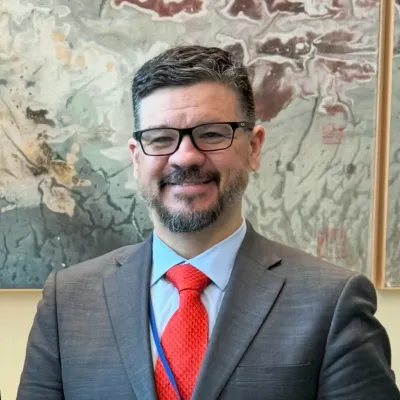
João Pedro Azevedo is the Chief Statistician of UNICEF, where he leads the organization’s global statistical and data work, strengthening the production, analysis, and use of data to inform policies and accelerate results for children worldwide.
He also serves as Deputy Director in the UNICEF Office of Strategy and Evidence – Innocenti, where he leads the organization’s Data and Analytics work at headquarters and advances the integration of statistics, analytics, and evidence into strategic decision-making.
Mr. Azevedo brings more than 18 years of experience in international development, as well as experience in the Brazilian public sector at both federal and state levels. Prior to joining UNICEF, he held several senior positions at the World Bank, including Lead Economist in the Poverty and Equity Global Practice, where he served as Global Lead for Welfare Measurement and Statistical Capacity for Results and co-led the Global Solution Group on these topics. He also worked in the Education Global Practice as Lead Economist, EdTech Fellow, and Education Statistics Coordinator.
Earlier in his career, he served as Superintendent of Monitoring and Evaluation at the Secretariat of Finance of the State of Rio de Janeiro and as a Research Fellow at the Institute of Applied Economic Research (IPEA) within Brazil’s Ministry of Planning. He also served as Chair of the Latin American and Caribbean Network on Inequality and Poverty.
Mr. Azevedo has published widely on poverty and inequality measurement, education and learning outcomes, and the development of statistical systems. His work focuses on strengthening official statistics and advancing the production and use of data and evidence to inform public policy. He also contributes to the Stata, R, and Python open-source communities through the development of software tools that support reproducible research and facilitate access to development data.
He is an elected Member of the International Statistical Institute (ISI).
Mr. Azevedo is a Brazilian national and holds a PhD in Economics from Newcastle University. He is married and has twin daughters.

Deputy Director, Programme Effectiveness
Andrea Suley serves as Deputy Director of Programme Effectiveness in UNICEF’s Office of Strategy and Evidence – Innocenti, based in Florence, Italy. She leads a multidisciplinary team responsible for overseeing UNICEF’s Strategic Plan and providing organizational leadership on strategy, performance management and programmatic risk management, including safeguarding. Her portfolio strengthens planning, implementation, monitoring, partnerships and quality assurance across all UNICEF country programmes. Through evidence-driven and adaptive approaches, her team promotes agile decision-making, streamlined systems and organizational learning to help UNICEF anticipate risks, respond to shocks and deliver results for children at scale — particularly in complex and fragile settings.
Previously, Andrea served as Senior Advisor in Washington, DC USA, where she led UNICEF’s partnerships with International Financial Institutions. She also served as Deputy Representative in South Sudan (2018–2021), overseeing programme design, implementation, risk management, monitoring and reporting for one of UNICEF’s largest and most complex country programmes. At UNICEF Headquarters in New York USA (2014–2018), she led global guidance and systems support for programme implementation and introduced an enhanced framework for UNICEF’s engagement with implementing partners.
Prior to joining UNICEF, Andrea worked in Ernst & Young’s Risk and Performance Improvement Practice and held roles in Canada’s energy and public sectors. A Canadian national, she brings more than 26 years of experience across the public and private sectors, including 12 years with UNICEF.

Deputy Director a.i., Research and Foresight
Ramya Subrahmanian serves as the Deputy Director ad interim of Research and Foresight in UNICEF’s Office of Strategy and Evidence – Innocenti, based in Florence, Italy. Ramya also leads the gender equality, child rights and protection research, overseeing a portfolio that includes research on gender, care, social and family policy; violence against children and women, migration and displacement, child marriage, child labour, and children’s care reform.
She is an international gender equality and child rights expert with over thirty years’ experience working with NGOs, within academia and with the UN. Previously she was Executive Director of Know Violence in Childhood, a global learning initiative that collaborated with 140 researchers on the evidence on effective strategies to prevent violence against children. Prior to that, she has worked as a Social Policy specialist at UNICEF India and has been a Research Fellow at the Institute of Development Studies, University of Sussex where she also co-directed and taught the MA Programme in Gender and Development. She has a PhD in Development Studies and a Masters in Gender and Development.

Associate Director
Maria Luisa Fornara is the Associate Director of UNICEF Innocenti – Global Office of Research and Foresight.
Previously she served as UNICEF Representative in Mozambique. Prior to serving in Mozambique, she was UNICEF Representative in Haiti, a role which she took up in 2018, leading and managing the Haiti Country Programme in both humanitarian and development settings. From 2015 to 2018, Ms. Fornara served as UNICEF Representative in Peru, where she managed the design and implementation of the 2017-2021 Country Programme, with a particular focus on the most vulnerable children, particularly from indigenous populations.
From 2009 to 2015, she served as UNICEF Representative in Tunisia, a period during which Tunisia was transitioning towards democracy. In this position, Ms. Fornara contributed to the strengthened focus of national efforts on public policies of promotion and protection of the rights of Tunisian children.
Prior to serving as Representative, Ms. Fornara was UNICEF Deputy Representative in Tunisia and Serbia. She has a wide range of work experience in international cooperation; she was a programme officer at UNDP, a consultant for the World Bank in Lebanon, and a researcher at the United Nations Interregional Crime and Justice Research Institute (UNICRI).
She holds a master’s degree in Social Sciences from the École Pratique des Hautes Études (1994), a diploma in Public Policies and Promotion of Child Rights from Maastricht University in the Netherlands (2007), and has completed studies and specializations from Oxford Policy Management and the Institute of the World Bank.

Associate Director
Carina Kabajunga Wangwe joined UNICEF in January 2025 as Chief Data Officer. In this role, she provided strategic and technical leadership to ensure the responsible and safe use of data, analytics, and digital technologies across UNICEF’s global, regional, and country operations. Her work supports efforts to minimize risks and potential harms associated with data and technology, strengthening the organization’s ability to deliver results for children while safeguarding their rights.
With over 20 years of experience in data governance, Carina has held leadership roles in international organizations, including the Commonwealth Secretariat, and worked across academia, public institutions, and the private sector in the United Kingdom, Tanzania, and Uganda. A champion for equitable and inclusive data practices, she co-founded one of the few collectives dedicated to advancing data from and about the Global South, amplifying underrepresented voices in global decision-making.
Carina’s expertise in data governance, technology, and cybersecurity has earned her global recognition, including awards for innovation and excellence.
She holds a Bachelor’s degree in Computer Science and Mathematics from the University of Dar es Salaam, a Master’s degree from the University of Edinburgh, and a Doctorate from the University of South Africa.