AI for children
Project | Toward AI policies and systems that uphold child rights
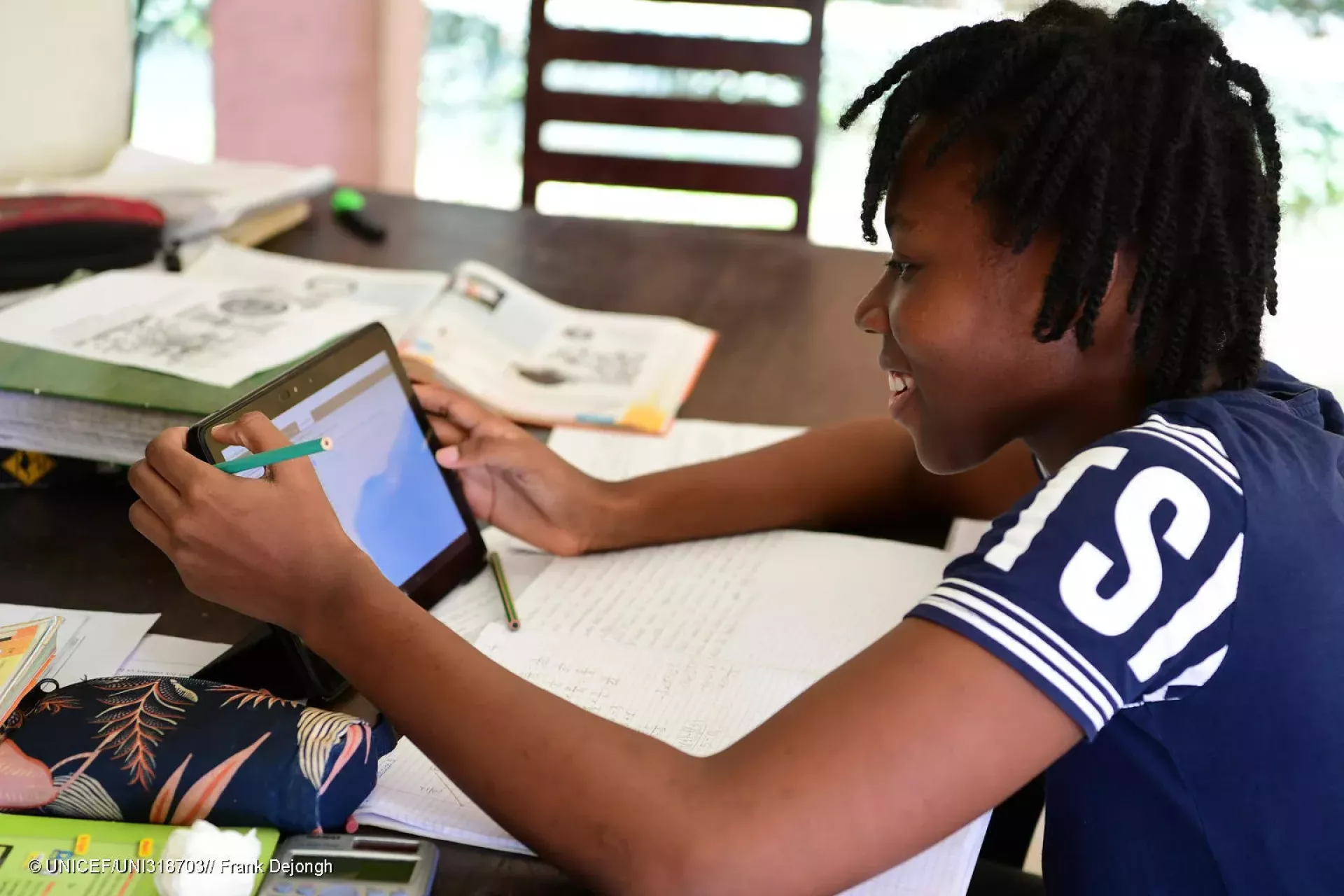
Artificial intelligence (AI) is reshaping childhood at an unprecedented pace. Once operating mostly behind the scenes, AI is now front and centre in the apps, platforms and devices that children use every day. Algorithms recommend what videos to watch, what news to read and who to connect with – and increasingly, generative AI systems are creating the very content children consume, even positioning themselves as ‘friends’. From supporting learning to completing homework, AI is becoming an active presence in children’s lives.
Recent evidence highlights rapid adoption, such as more than a third of 9- to 11-year-olds in Argentina turning to ChatGPT for information. Yet, uptake is uneven. UNICEF research with 12,000 children and their parents/caregivers shows significant divides, particularly across the global South, in access, usage patterns, trust and exposure to risks.
This acceleration brings opportunities to harness – such as improving accessibility for children with disabilities – and urgent risks to address, from AI-generated disinformation to harmful deepfakes and exploitative content. At the same time, children remain largely excluded from shaping the very systems that affect them, especially those in low-resource settings. What’s more, while children are at the forefront of AI use, evidence is lacking on how it affects their social, emotional and cognitive development.
UNICEF is leading global efforts for AI to be designed and governed in the best interests of every child. Through research, policy guidance and advocacy, we are working to urgently close the participation and evidence gaps, and to place children’s rights at the heart of the AI age.
AI guidance
UNICEF’s guidance offers practical recommendations for governments and industry to support child-centred AI policies and systems. It was updated in 2025 to reflect the rapidly changing AI policy and technology landscape.

Project highlights
Advisory groups
We are grateful for the ongoing input of our expert advisory group members who are helping to shape the project and policy guidance.
Advisory groups
| Dr Mhairi Aitken | Senior Ethics Fellow, Public Policy Programme, The Alan Turing Institute |
| Maria Luciana Axente | Data and AI Leadership Committee, Tech UK |
| Dr Mathilde Cerioli | Chief Scientist, everyone.ai |
| Dr Thompson Chengeta | Professor of International Law and AI Technologies, Liverpool John Moores University |
| Dr Virginia Dignum | Professor of Responsible Artificial Intelligence, Umeå University |
| Aki Enkenberg | Chief Senior Specialist, Ministry of Foreign Affairs, Government of Finland |
| Dr Eleonore Fournier-Tombs | Head of Anticipatory Action and Innovation, UNU Centre for Policy Research. |
| Dr Barbara Glover | Programme Officer & AI Taskforce Lead, African Union Development Agency-NEPAD |
| Dr Isabella Henriques | CEO, Alana Institute |
| Armando Guio Español | Executive Director, Global Network of Internet & Society Centers (NoC) |
| Moira Patterson | Global Market Affairs & Standards Partnerships Director, IEEE |
| Abril Perazzini | UNICEF Youth Foresight Fellow Alumni |
| Kartik Sawhney | I-STEM; Graduate Student, Stanford University |
| Dr Jongwon Seo | Director, Korea Education and Research Information Service (KERIS) |
| Liz Thomas | Director of Public Policy, Digital Safety, Microsoft |
| Dr Yi Zeng | Professor and Director, Brain-inspired Cognitive AI Lab, Institute of Automation, Chinese Academy of Sciences |
| Maria Axente | Responsible AI and AI for Good Lead, PwC UK |
| Alexandre Barbosa | Head of the Regional Center for Studies on the Development of the Information Society (Cetic.br/NIC.br) |
| Seth Bergeson | Fellow, Artificial Intelligence and Machine Learning, World Economic Forum |
| Sandra Cortesi | Director of Youth and Media, Berkman Klein Center for Internet & Society, Harvard University |
| Virginia Dignum | Professor of Responsible Artificial Intelligence, Umeå University |
| Kay Firth-Butterfield | Head of Artificial Intelligence and Machine Learning, World Economic Forum |
| Urs Gasser | Executive Director, Berkman Klein Center for Internet & Society, Harvard University |
| John C. Havens | Executive Director, IEEE Global Initiative on Ethics of Autonomous & Intelligent Systems |
| Shafika Isaacs | Independent Digital Learning Specialist and Associate Professor of Practice, University of Johannesburg |
| Baroness Beeban Kidron | Founder, 5Rights Foundation; House of Lords |
| Jussi Kivipuro | Development Director, UNICEF Finland |
| Alpesh Shah | Senior Director, IEEE Standards Association |
Pioneering AI and children
From 2019 to 2021, UNICEF worked with experts and children from around the world to gain regional perspectives on AI systems and children. Our analysis from then found that most national AI strategies and major ethical guidelines made only cursory mention of children and their specific needs. For country policies, references to children were most often in the context of preparing them to work in an AI-centric economy. But as children increasingly used or were affected by AI systems in everyday situations, the lack of attention on the opportunities and risks that AI systems hold for children was growing.
To help fill this gap, we set out to develop guidance to help support and promote children's rights in AI policies and practices, for which we:
Consulted widely
- Expert consultations in North America, Europe, Africa, Latin America and the Caribbean, and virtually, due to the Covid pandemic, for East Asia and the Pacific.
- Consultations with 245 adolescents in the USA, Brazil, Chile, South Africa and Sweden.
- A global public survey.
Pilot tested the draft guidance
After the consultations we developed a draft guidance and invited governments and the business sector to pilot it in their field and openly share their findings about how it was used, and what worked and what did not, so that their real experiences could improve the document. Eight case studies capture the approaches taken, lessons learned and insights that informed the global effort towards AI policies and systems that support children’s development.
Convened the first Global Forum on AI for Children
UNICEF held this virtual event in November – December 2021 to discuss practical approaches to child-centred AI policies and systems. The event gathered children’s rights and technology experts, policymakers, practitioners and researchers, as well as children active in the AI space.
In this early phase we were supported by and partnered with the Government of Finland, and collaborated with the IEEE Standards Association, the Berkman Klein Centre for Internet & Society, the World Economic Forum, the 5Rights Foundation and other organizations.
This work was initially made possible by funding and technical support from the Ministry of Foreign of Affairs, Finland. We are grateful for their continued partnership and commitment to child rights.