

Exploring civic education
How can children be better prepared to understand and engage with the complex social, civil and political issues of today?
Teachers and parents around the world have found themselves grappling with how to discuss major events with children – from mass protests and elections to wars and humanitarian crises. How can children be better prepared to understand and engage with the complex social, civil and political issues of today? In a world of misinformation and political polarization, how can children be critically informed to participate in issues that impact their lives?
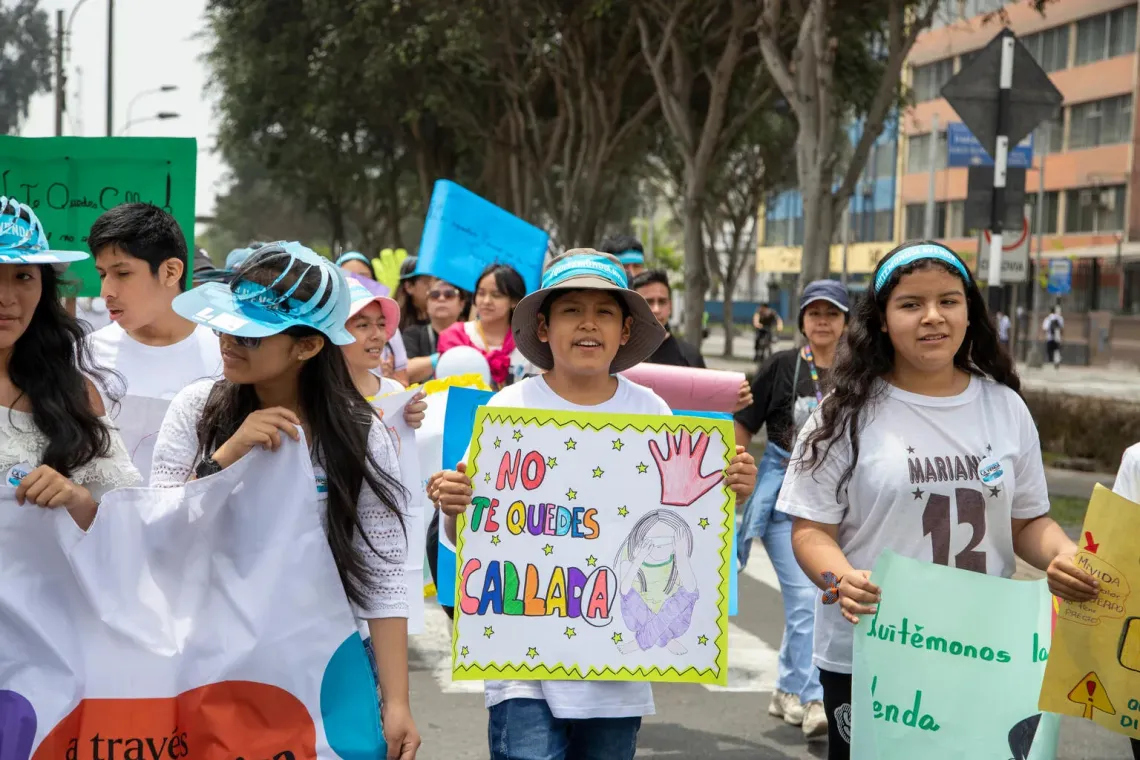
These questions sit at the heart of civic education. Discussing it proves even more important at a time when young people show high levels of concern about issues like climate change and social justice while also reporting feeling disconnected from traditional political processes. This gap between interest and efficacy suggests both the importance of civic education and the need to rethink how it is traditionally understood.
This explainer examines how civic education can develop children and youth’s knowledge, skills and attitudes for meaningful participation in civic life, while exploring evidence about what approaches work best and implications for organizations such as UNICEF.
What is civic education?
The Convention on the Rights of the Child states that education should prepare children for a “responsible life in a free society” while developing respect for human rights, cultural identities, and fostering peace and tolerance among different groups. In addition, the United Nations Committee on the Rights of the Child has emphasized the role of civic education in its elaboration of adolescent rights, noting that civic and human rights education are essential tools for developing active citizenship and supporting adolescents to advocate for their rights.
There are many definitions of civic education, which is also referred to as ‘voter education’ or ‘citizenship education’, often interchangeably.
"How can children be better prepared to understand and engage with the complex social, civil and political issues of today?"
In general terms, civic education “aims to promote and shape civic engagement by developing citizens’ competencies (for example, attitudes, skills, and knowledge) needed for participation in community, government, and politics”. In its most basic form, civic education involves teaching about political institutions and processes, and citizens’ rights and responsibilities. This includes understanding how government works, electoral processes, the rule of law, the mechanisms of decision-making, as well as social and political principles and values.
In today’s complex world, however, many argue that contemporary civic education should go beyond this traditional model to encompass a broader range of competencies needed for effective citizenship. This would include skills such as critical thinking, media and information literacy which are essential for navigating an information-rich environment. It would also include skills for respectful dialogue in diverse societies, and understanding global interconnections. Indeed, SDG indicator 4.7.1 aims to measure the extent to which “global citizenship education and education for sustainable development, including gender equality and human rights, are mainstreamed in national education policies, curricula, teachers’ education, and student assessment.” Some also recommend integrating futures thinking to enhance anticipatory capacity and support children explore alternative visions for democracy and decision-making.
UNICEF actively promotes civic or citizenship education in many countries, often as an element of life skills programs. It does not, however, propose a global, standard definition for it. In the case of the Middle East and Northern Africa region, citizenship education was articulated as one that aligns with more contemporary understandings of the concept. In this region, UNICEF advocates for citizenship education as a comprehensive set of skills that can empower learners to make decisions that benefit themselves, their community, and society. It involves experiential learning, active participation in civic activities, critical thinking about civic and political life, understanding political systems, and developing communication skills.
One of the key debates in civic education centres on the kind of citizens it aims to develop. This question is not merely academic: different visions of citizenship lead to different educational approaches and priorities. Research identifies three main conceptions that shape approaches to civic education:
- The personally responsible citizen emphasizes individual character and behaviour - being honest, law-abiding, and helping others through activities like volunteering and charitable giving.
- The participatory citizen actively engages in civic and community life, using knowledge of government and organizational systems to improve these systems through established mechanisms.
- The justice-oriented citizen analyses and challenges systemic causes of social problems, working collectively for structural change rather than just operating within existing systems.
While these approaches are not mutually exclusive, the emphasis chosen by educators and national education systems might create differences. For instance, a program focused on personal responsibility might emphasize character education and volunteer service. One prioritizing participation might focus on knowledge of government and leadership skills. A justice-oriented approach would emphasize critical analysis of social issues and strategies for collective action.
"In today’s complex world, however, many argue that contemporary civic education should go beyond the traditional model to encompass a broader range of competencies needed for effective citizenship."
Given its inherently political nature, civic education is not neutral. Among many democracies, there is strong cross-country consensus that civic education should prioritize understanding democratic values and attitudes, developing skills for deliberation and debate, and learning about decision-making and active participation. Yet, lessons about politics, government operations and decision-making processes can also be used for propaganda, and to justify authoritarian practices. In some contexts, it may promote compliance, intolerance or favour the status quo. In these cases, children and young people may be vulnerable to political manipulation given their developing capacities.
How is civic education implemented?
Although civic education is a lifelong process, empirical evidence supports the effectiveness of civic education during adolescence when children are actively forming their identities and values.
There is some debate about whether schools are the most effective environment for developing civic virtues – compared to other socializing agents like family and community organizations. Yet the focus on schools remains primarily pragmatic: they continue to be the institutions most responsive to public policy interventions for that age group and where political socialization can be pursued at scale. Indeed, in the past 50 years, an increasing share of countries has been mandating civic education in public schools at primary, secondary or tertiary levels. In addition, contemporary workforce demands for skills like critical thinking, communication and cultural awareness align well with the goals of modern civic education, making it easier to reconcile civic and employability goals in school curricula than in previous decades.
The design, modes of delivery and implementation vary significantly. As noted earlier, civic education curricula encompass multiple dimensions and approaches that reflect different understandings of citizenship and political values. In some countries, it exists as a distinct subject with dedicated curriculum time. In others, it is integrated across multiple subjects or treated as a cross-cutting theme. Some systems emphasize formal instruction while others prioritize experiential learning through school exercises and community engagement. Not all pedagogies are centred on the needs and preferences of students. As a result, the implementation of civic education is highly context-dependent and can vary even within the same education system.
Does civic education work?
A growing body of evidence demonstrates that well-designed civic education can have significant positive impacts. Research typically reveals three distinct ways students absorb and apply civic learning: (i) gaining basic knowledge, (ii) becoming more politically active, and (iii) internalizing deeper democratic values.
The evidence for knowledge gains is particularly strong. Studies consistently show that regular citizenship classes lead to measurable improvements in political knowledge and understanding. Longitudinal studies have found that individuals undergoing civic education have higher levels of civic knowledge and understanding about the democratic process: A study with 4,000 high school students in the US found an 11% gain in basic civic knowledge among students who experienced routine citizenship education with regular class discussions. Similar gains were reported in a study with 600 students in South Africa.
Beyond knowledge gains, research shows significant impacts on political participation and engagement. A longitudinal study in England found that students who had citizenship education until their final year of school showed 14% higher levels of political participation in early adulthood compared to those who did not. This included both electoral participation (voting) and other forms of civic engagement like community activism and volunteering. The effects appear strongest when civic education combines classroom learning with opportunities for active participation through student councils, community projects and other hands-on experiences.
The impact on beliefs and values is more complex but still significant. Studies show that civic education can increase political efficacy – students’ belief in their ability to understand and influence political processes, including for students from disadvantaged backgrounds. This seems particularly important given widespread feelings of political powerlessness among young people. Researchers also point to the need for more youth-led research to draw better connections between knowledge, interest and participation.
At the same time, scholars have argued that the effectiveness of civic education depends significantly on how it is implemented. Several key factors emerge from the research:
First, timing and duration matter. Short-term interventions or one-off programs generally show limited impact. The strongest effects are seen with sustained engagement throughout secondary education. This suggests the importance of embedding civic education in the regular curriculum rather than treating it as an add-on.
Second, school culture emerges as a crucial factor in several studies. Schools (pdf) that practice democratic principles, give students genuine voice in decision-making, and maintain positive student-teacher relationships show consistently better outcomes across multiple measures. An open classroom climate where students feel free to express and debate different viewpoints is particularly important. However, research also suggests the need for tailored approaches for disadvantaged students – some studies showed that they may need some direct instruction in basic political knowledge before they can fully benefit from more interactive approaches.
Third, teaching methods and teacher preparation are crucial. Interactive approaches and active engagement (as opposed to passive viewing) that combine direct instruction with discussion and practical experience show the best results. For instance, young people value hands-on models such as policy incubators in schools, which could create environments where children can test new ideas and policy solutions relevant to their needs. Studies show that teachers’ comfort with and enthusiasm for civic education significantly affects student outcomes. This highlights the importance of teacher training and support, particularly for handling controversial issues and facilitating meaningful and open discussions.
Finally, civic education needs to be transformative to avoid reinforcing existing inequalities in political participation. Girls show lower expectations for active political engagement compared to boys, even though they demonstrate higher intentions to vote and stay informed about electoral candidates. Studies show that girls often internalize the belief that political leadership is predominantly male, with one US study finding that the likelihood of girls drawing a male political leader increased from 47 per cent among six-year-olds to 75 per cent among 12-year-olds. Socioeconomic disparities in expected political participation prove even more pronounced than gender differences. Schools serving higher socioeconomic populations in a 2022 study were more likely to support citizenship norms such as participating in debates. These patterns suggest that civic education programs must actively address structural barriers and design interventions that specifically target underrepresented groups to avoid perpetuating participation gaps.
It is worth noting that there are many methodological concerns about the robustness of these results. Some studies have important shortcomings. Most of the literature focuses on countries in the Global North or established democracies. Findings in one cultural context may not be easily applicable or replicated into others. Often researchers explore the results of specific activities (such as factual knowledge or interest in voting), without clarifying the goals that a certain program or curriculum hoped to achieve, or the type of citizenship that it aimed to promote. This suggests that the theoretical debates around citizenship, on the one hand, and empirical studies of civic education, on the other, should happen in a more articulated manner.
Ultimately, citizenship education is not a “silver bullet”. Political socialization is a complex, multifaceted process. Civil and political skills and values cannot be developed solely in classrooms.
Emerging challenges and future directions
As education increasingly occupies digital spaces, civic education too can be delivered and practiced online. Young people can engage with civic content in many ways — from dedicated websites to open social media platforms, and this presents both opportunities and risks.
Dedicated digital platforms for civic education offer structured and curated learning environments. Many such platforms – most of them in the Global North – demonstrate how digital tools can help young people practice civic skills through interactive online environments. Many of these tools combine digital learning with quality control and pedagogical design, offering engaging experiences that could complement formal education. At the same time, there are concerns that emerging technologies could exacerbate existing inequalities, particularly where resources and access are already limited.
Artificial intelligence (AI), which could also be integrated into digital learning platforms, is both promising and challenging for civic education. As a teaching and learning tool, AI can create more interactive and personalized civic education, making content more accessible across languages and learning styles. Understanding AI’s role in democratic processes and how AI models shape information flows can itself become an important component of civic education. But while AI can enable more adaptive, personalized civic education experiences, it also risks creating filter bubbles that limit exposure to diverse viewpoints which are essential for democratic deliberation. AI also make it easier to create convincing but false political content — including deepfakes and synthetic text — making critical evaluation skills even more essential for children and young people.
Similarly, social media platforms present a paradox for civic education. On the one hand, they offer opportunities for self-directed learning, enabling young people to access diverse perspectives and engage with civic content outside institutional education. This could be particularly valuable for reaching youth disconnected from conventional political processes. However, the quality of civic content varies enormously, and learners navigate these spaces without the guidance of formal education. On the other hand, the same platforms that facilitate civic engagement also serve as conduits for misinformation and polarizing content that distorts public understanding of civic issues. Algorithmic curation prioritizes engagement over accuracy, potentially exposing young people to misleading information precisely when they are forming their political identities.
Addressing these challenges requires policy-makers to prioritize media literacy and critical thinking as core components of civic education curricula, ensuring that young people develop not only knowledge of political institutions but also the capacities needed to navigate an increasingly complex information environment.
Recommendations
The Committee on the Rights of the Child emphasizes that civic education must serve both current and future participation – helping adolescents engage meaningfully in decision-making now while building capacities for lifelong civic engagement.
Both the Committee’s recommendations and empirical research on civic education converge on some crucial points. These elements translate into specific priority areas where UNICEF can strategically focus to fulfil the Committee’s vision of empowered, rights-aware adolescents, for the current and future generations:
- Advocacy for universal access to quality civic education as part of children’s right to education. This includes working with governments to develop supportive policy frameworks and appropriate curriculum standards.
- Support for developing civic education frameworks and resources that reflect child rights principles and a contemporary understanding of effective practice. This should include attention to both content and pedagogy, promoting approaches that address gender and other types of entrenched inequalities in political participation.
- Prioritize media literacy and digital critical thinking as essential components of civic education to help young people navigate misinformation and critically evaluate sources.
- Support for schools and education systems to develop participatory cultures that enable meaningful civic learning.
- Investment in research and evaluation to build evidence on effective approaches, particularly in contexts where less research has been conducted, across different political systems, including by resorting to youth-led analysis.
Civic education must recognize young people not just as future citizens, but as active participants and legitimate political actors today.