“I Still Wanted to Play, to Be Free”: A Teenager’s Brave Journey Saying No to Child Marriage
Nana’s stand against child marriage in South Sulawesi
- English
- Bahasa Indonesia
At 17, Nana is no ordinary teenager. Two years ago, she made a bold choice — rejecting not one, but two marriage proposals. It was a daunting decision that Nana wept over, consumed by fear about what her future might hold. Yet, she summoned the courage to say no.
“I let my parents know that I still wanted to enjoy my youth. I still wanted to play, to be free,” she recalls, her gaze distant as she imagines the life she might have led if her path had taken a different turn.

Nana knew that marriage would rob her of a childhood she was meant to enjoy. Through UNICEF and partners, she was educated about the risks of child marriage and how it could deprive girls like her of their potential. Empowered by this knowledge, and supported by her family, Nana chose to prioritize her dream of completing her schooling.
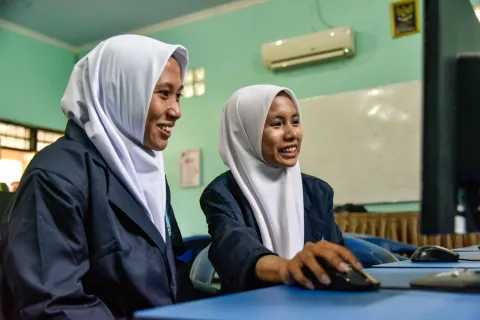
Now in the second grade of senior high school, Nana thrives in a busy schedule of academics and after-school activities. Her aspirations are as bold as her courage. “I want to be a judge. Insya Allah (God willing), I want to uphold justice for people to enjoy their rights,” she declares. “I want to be someone useful, for my family and for the nation,” she adds, determination shining in her eyes.
Today, in the city of Makassar in South Sulawesi province, she stands confidently before an audience of her peers. She is sharing her journey, passing on the lessons she has learned from writing her own story. “When I refused the proposals, I felt freedom because I was able to voice my thoughts,” she explains. “If I did not do it, I would not be as free as I am now, playing with friends, studying, going out.”

Nana’s journey underscores Indonesia’s significant strides in reducing child marriage. Nationally, child marriage has been halved in the last 10 years, from 13.55 per cent to 5.90 per cent in 2024. In South Sulawesi, child marriage has declined from 9.33 per cent in 2022 to 8.09 per cent in 2024.
UNICEF has been working closely with the government, UNFPA, UN Women and local partners to contribute to this progress throughout Indonesia, supporting tailored efforts at the provincial level in East Java, West Nusa Tenggara and South Sulawesi, through the BERANI programme funded by the Government of Canada.
These initiatives include life skills education in schools, including Islamic boarding schools (pesantren), child-led campaigns and the engagement of religious and traditional leaders to advocate ending child marriage, positive parenting support for parents and public awareness campaigns. UNICEF also supports the strengthening of community-based child protection mechanisms to prevent, respond and establish referral pathways for children who need to access services, including children who are already married.

At the national level, the government has prioritized child marriage prevention in the National Medium-Term Development Plan (RPJMN - Rencana Pembangunan Jangka Menengah Nasional), and through the development of a national strategy to reduce child marriage.
“We continue to strengthen collaboration for child marriage prevention. The role of PKK (Family Welfare Development) is to address issues like children who drop out of school, stunting and child marriage, reaching even remote villages. Besides providing services for child marriage victims, it's also essential to enforce the Sexual Violence Crimes Law (UU TPKS) to create a deterrent effect in society. This ensures that young girls like Nana are no longer forced to marry at an early age and can develop their full potential,” explains Hj. Andi Murlina, SH, Kepala Dinas Pemberdayaan Perempuan dan Perlindungan Anak, Sulawesi Selatan explains.

Nana’s message of resilience remains vital for thousands of young girls who still face pressure to accept early marriage proposals. She has become an advocate who encourages other teenagers to resist child marriage.
I think people now realize the effects of child marriage. I hope the government can continue to educate the public, especially parents with daughters, and create regulations to protect children and their rights, especially girls.