Transforming young lives in rural Papua
‘Adolescent Circle’ cultivates safe and friendly environments for children
- English
- Bahasa Indonesia
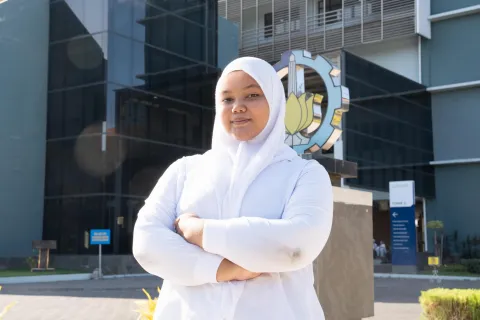
Twelve-year-old Yomi Puhiri, who hails from Jayapura, Papua, was a high achiever who excelled at the top of her class, until the pressure of economic hardship forced her to drop out of elementary school.
Yomi’s father lost his job during COVID-19, which was a serious blow for the family. Yomi had to help her mother sell pinang (areca nut) in a humble stall by the road in her village. As the youngest of six children, Yomi felt overwhelmed by the big changes and had difficulties expressing her thoughts and emotions.
"I used to be a bit shy and felt pressured,” Yomi says, admitting that her background had a significant impact on her confidence. “But I know this situation should not define me.”
Yomi’s journey took an unexpected turn when she joined the ‘Adolescent Circle’,
a UNICEF-initiated programme designed to create a safe and friendly space with positive activities and self-development for youth in rural Papua.
Adolescent Circles are an innovative approach to help adolescents through challenging times, building on the UNICEF-WHO toolkit Helping Adolescents Thrive. Through a partnership with the Z Zurich Foundation, UNICEF is currently piloting new approaches to promote mental well-being and prevent mental health conditions among young people and caregivers.
The Adolescent Circle that Yomi joined has been implemented since July 2023 in three provinces and four districts and municipalities in Papua, reaching 234 adolescents and youth. Participants are from various backgrounds and some of them grapple with various challenges, including unstable home situations and being married, out of school or engaged in child labour.
The Adolescent Circle equips them to cope with stressful circumstances, build healthy relationships, learn new skills and engage positively with their communities.
Children in Papua have faced an increased risk of violence, exploitation and mental health challenges since the COVID-19 pandemic. The prevalence of child marriage escalated from 11.52 per cent in 2018 to 13.21 per cent in 2021 (Susenas) and there have been rising cases of violence against children, particularly sexual violence.
A 2022 national survey revealed that one in three adolescents (34.9 percent) had a mental health problem in the prior 12 months, and only 6.6 percent of adolescents with a mental health problem had accessed services that provide support or counselling nationally.

“Being in the group has boosted my confidence and improved my ability to communicate and express opinions and my emotions,” says Yomi, whose favourite topic in the Circle activities is learning about various emotions and how to express them positively.
"It was also my chance to reconnect with education. Despite my age and family’s background, I was determined to continue learning,” she says. After joining the Adolescent Circle, Yomi began a community-based education (PKBM) programme. “This is somewhat different from regular school, but I still like it,” she says.
Angelina Ongge, who lives in a neighboring village, has witnessed how the Adolescent Circle activities have benefited her daughter, Maria, age 14, notably helping her to be a more compassionate and loving person, especially to her younger siblings.
“She now says ‘Mom, I want to hold my younger sibling’, which is quite an improvement as she had a history of hitting her younger sibling out of jealousy,” Angelina says.

“Initially, she wanted to go there to look for friends, but the benefit extends beyond just finding friends. It has also shaped my daughter to have a better personality,” she reflects.
Yomi's active membership in the Adolescent Circle has transformed her life. “My confidence crashed when I had to drop out of school,” says Yomi. “Being in this community helped me to have a support system and to continue to thrive.”
UNICEF is grateful to Z Zurich Foundation for helping to support this activity.