Investing in adolescent girls: a strategic driver towards achieving Golden Indonesia 2045 vision
New study shows how investing in the education, health, and protection of adolescent girls will yield multiplied returns on investment for the country
- English
- Bahasa Indonesia
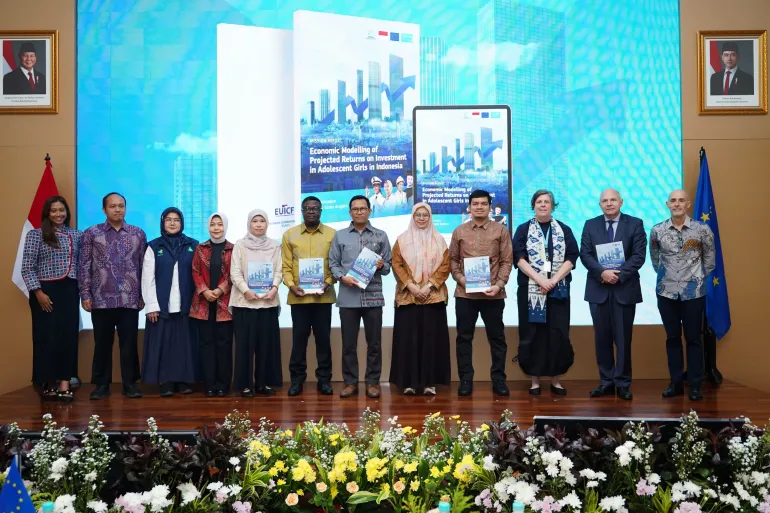
Jakarta, 4 June 2026 – The Ministry of National Development Planning/BAPPENAS, supported by the European Union (EU) and UNICEF, today launched the results of an economic modelling study on the return on investment (RoI) in adolescent girls in Indonesia.
The key findings of the study are presented in a report and policy brief entitled Investing in Adolescent Girls: A Productivity Strategy Towards Indonesia’s 2045 Vision. The study was initiated to develop a data-driven economic model to estimate the financial and socio-economic benefits of investing in adolescent girls.
The findings show that ensuring the rights of around 21.5 million girls aged 10–19, representing 15.5 per cent of Indonesia’s total population (BPS, 2025), to quality education, health, and protection services can also generate long-term benefits for society and the economy. The most effective areas of investment to help inform decision-makers in designing targeted interventions are identified in the report.
“Productivity-led growth is now a necessity. Future growth must be underpinned by improvements in productivity, technological innovation, and workforce quality -- this includes raising the female labor force participation rate from 56.3 percent in 2025 to 70.0 percent by 2045,” stated Eka Chandra Buana, Deputy for Macro Development Planning at the Ministry of National Development Planning/BAPPENAS.
The study also highlights a significant gender gap in labour force participation, with rates of 52-57 per cent for women and 80-84 per cent for men. Despite progress being made for realising child rights, challenges remain, with a long-term impact on society. Child marriage, where 5.9 per cent of girls marry before the age of 18, as well as the prevalence of anaemia among adolescent girls, estimated at 16.3 per cent, represent significant constraints on human development. Without targeted and sustained interventions, these structural barriers risk slowing the pace of Indonesia’s overall economic and social progress.
Deputy for Human and Cultural Development at the Ministry of National Development Planning/BAPPENAS, Pungkas Bahjuri Ali, also emphasised, "We currently have 21.5 million adolescent girls out of a total of 44 million young people. They are the future workforce, leaders, mothers, and parents who will determine the quality of the next generation. We hope this study reinforces the view that investing in adolescent girls is a strategic investment in human development, economic growth, and the future of Indonesia."
The Chargé d’Affaires of the European Union Delegation to Indonesia, Mr. Stephan Mechati stated, “The European Union is proud to champion together with UNICEF this highly strategic Indonesian initiative, which underscores our deep shared commitment to advancing gender equality. We share a fundamental conviction that when adolescent girls are empowered with quality education, robust healthcare, digital literacy, and equal opportunities, entire societies become more prosperous, resilient, and inclusive. This initiative directly echoes the EU Gender Action Plan, placing the rights and potential of women and youth at the very heart of our vision for sustainable development in Indonesia.”
The study analysed six key interventions in the areas of education, health and protection, all of which demonstrate positive economic returns. Vocational training recorded the highest RoI, at 22.4 times, as it helps accelerate the transition into the workforce. Mental health interventions generated benefits 11.2 times greater through improved school attendance and job stability. Meanwhile, social protection programmes, through Family Hope Programme (PKH), placed the third highest return with 10.1 times to national Gross Domestic Product (GDP) growth.
UNICEF Indonesia’s Representative, Maniza Zaman, said, “Across the world, UNICEF works with partners so that every girl can realise her rights and reach her full potential. Investing in adolescent girls is both the right thing to do and a smart investment in a country’s future. It advances children’s rights, strengthens human capital, and supports more inclusive and sustainable growth and development. UNICEF is committed to supporting the Government of Indonesia’s efforts to design and implement evidence-based solutions that empower girls and unlock long-term social and economic benefits.”
As a follow-up, the study recommends a phased implementation strategy aligned with the National Long-Term Development Plan (RPJPN) 2025–2045. In the short term, it emphasizes the need to strengthen data systems and enhance cross-ministerial coordination. In the medium term, priority should be given to further strengthening and integrating data systems, including education records, health utilisation data, and social protection information, to enable comprehensive analysis of cross-sectoral interactions. Meanwhile, in the long term, the development of an integrated national adolescent human capital framework is essential, with clear linkages to labour market demands and national productivity targets.
Overall, the study recommends prioritising improvements in the quality of services and equitable access across education, health, and social protection sectors. These should directly benefit adolescent girls and provide better opportunities for every girl to contribute to Indonesia's aspirations and high-income status by 2045.
As part of the EU-Indonesia Cooperation Facility (EUICF) initiative, this study was conducted in collaboration with the Ministry of National Development Planning/BAPPENAS, the Ministry of Women’s Empowerment and Child Protection (KPPPA), the Ministry of Manpower, the Ministry of Primary and Secondary Education, the Ministry of Higher Education, Science, and Technology, the Ministry of Health, the Ministry of Population and Family Development/BKKBN, and Statistics Indonesia (BPS). The launch event was attended by representatives from various ministries and technical agencies, as well as civil society organisations.
Media contacts
About UNICEF
UNICEF promotes the rights and wellbeing of every child, in everything we do. Together with our partners, we work in 190 countries and territories to translate that commitment into practical action, focusing special effort on reaching the most vulnerable and excluded children, to the benefit of all children, everywhere.
For more information about UNICEF and its work for children, visit www.unicef.org.