I’m Not Just a Girl: The Story of an Adolescent Girl Who Found Her Power Through Tech
Skills4Girls programme inspires more than 3,000 girls and boys in East Java to create solutions for real-world problems
- English
- Bahasa Indonesia
“We’re girls—so why choose technology?” Nikmah’s friend asked with curiosity in her voice. She was surprised by Nikmah’s decision to pursue the technology theme instead of more traditional options, such as food and beverage or tailoring. Her friend’s question didn’t discourage Nikmah. Instead, it lit a fire within her: “I felt ignited. Even though I am a girl, I want to keep learning about digital technology. I can do it too!” she told herself.
Nikmah comes from a humble family. Her father is a farmer, and her mother is a housewife and a caregiver, who often helps the community as well. Her journey into technology began without any prior experience, but she knew digital skills could open doors to a better future – and that’s why she joined the Skills4Girls programme – an initiative that helps girls gain digital skills implemented at Nikmah’s school in East Java province.
Every year, the programme reaches adolescents, especially girls like Nikmah and her friends, who come from vulnerable backgrounds. The programme helps bridge the gap between the skills girls need to be competitive in the 21st-century workforce.

“Participating in this programme made me believe that I can be like my friends who understand technology. But I had to learn slowly,” she recalls her first encounter with technology. “In technology, I believe critical thinking is key to achieving the results we need,” she said, highlighting the importance of doing what she loves.
The Skills4Girls programme has been implemented in several provinces in Indonesia since 2022. In East Java province, in partnership with the provincial government, this programme is a mandatory extracurricular activity being rolled out in formal and non-formal senior secondary schools to support adolescents who often face financial barriers in acquiring relevant skill sets before entering the labour market.
Through the Skills4Girls programme, students - mostly girls from disadvantaged backgrounds - learn how to address challenges in their personal lives and communities. Girls develop essential skills, including digital literacy, creativity, problem-solving, and entrepreneurship, to address issues they care about and that impact their lives and communities.
Industry experts in Science, Technology, Engineering, and Mathematics (STEM), many of whom are women, serve as role models for girls participating in the Skills4Girls programme, inspiring them and demonstrating that careers in STEM are not only for men, but also that women have a place in tech jobs. This approach corresponds to findings from the UNICEF East Asia and Pacific Region study on Supporting STEM Career Transition for Girls in ASEAN, which spotlights Indonesia, stating that social norms may limit girls’ career options and their confidence in pursuing higher skills or careers in non-traditional fields such as STEM. Therefore, having expert mentors, especially young women from these fields as role models, can act as a catalyst for adolescent girls to guide their career pathways and transition into the workforce.

Nikmah, together with other girls, received intensive training for several months through extracurricular activities at school to learn digital and entrepreneurship skills as part of their participation in the Skills4Girls programme. Besides training on digital skills to design the prototype of their solution ideas and business plan development to further grow their solutions, the girls also benefited from mentoring to further prepare their career pathways.
As a result, Nikmah acquired the knowledge and skills that led her to create an app called Peluk Kamu (or Hugging You). “It [the app] is a solution to help other adolescents like me find a safe space to share stories, to vent about issues they are facing,” explained Nikmah. The app also features tools to help users access professional counseling and learn more about mental health.

Nikmah’s success didn’t happen overnight. It was nurtured by her mentor, Atik Roisanah, a digital skills trainer at the school Nikmah attends. “She is an introverted person, but she has a lot of curiosity,” recalls Atik of her first encounter with Nikmah when searching for students with potential in digital skills in her school. Atik was surprised to learn that behind Nikmah’s quiet demeanor was a great passion. “I remember when I proposed an idea, she came back with more thoughtful solutions than mine. She has passion and is ready to go forward,” she added.

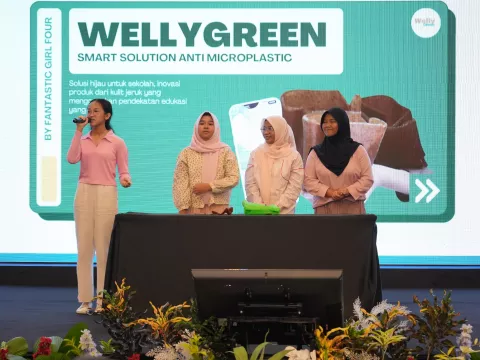
That passion shone during a bootcamp activity organized by the East Java Provincial Education Office, in which participants were encouraged to develop prototypes of their digital application ideas. Nikmah and her team were delighted that their idea was selected as a top pick by a panel of expert judges. It was a proud moment for Atik as she witnessed Nikmah visibly flourishing. “I thought that communication was not in her comfort zone, but during bootcamp, I was amazed by her progress. It turned out that she is excellent at speaking – expressing opinions with extraordinary articulation. I felt an immense sense of pride,” explained Atik.

Asmaul, Nikmah’s school principal, shares this pride and believes Nikmah’s journey will inspire others. “Girls should embrace technology early. They must learn to use it wisely and safely,” she said.

Before joining the programme, Nikmah hadn’t considered going to university as it seemed out of reach: “My family’s financial situation does not allow us to afford my college tuition.” As the eldest of two siblings, Nikmah has to consider her family before deciding about her future. However, Nikmah’s participation in the Skills4Girls programme gave her a renewed determination to find new solutions to overcome this barrier and to access higher education.

Nikmah’s journey is a powerful example of how digital skills can transform the lives of adolescents, especially girls. According to the UNDP’s Women in STEM in the Asia Pacific study released in 2024, in Indonesia, only 25% of tertiary graduates in engineering fields are women, and 35% in Information and Communication Technology (ICT). Many adolescents and young girls like Nikmah, particularly from remote or marginalized communities, lack access to quality STEM and digital education and employment. This means less labour force participation, particularly in higher-paying economic fields, and a significant pay gap compared to men.
Since the programme launch in 2022, more than 100,000 adolescent girls and boys have been reached through schools in Jakarta and East Java provinces with support from Clé de Peau Beauté. The programme has provided innovative approaches to skills development opportunities for adolescents, integral to the mission of the Government of Indonesia to introduce STEM and prepare students for their working life after education.

Dr. Aries Agung Paewai, Head of the East Java Provincial Education Office, a champion in advocating for STEM learning opportunities for girls, is convinced that gender should not be a barrier to girls’ education and the realization of their dreams. "Technology does not see gender. It is a part of life. Everyone uses technology, and everyone must understand it because it plays a role in daily life. Men and women are equal—when they master technology, they can understand anything, including their own personal development,” he explained.
As for Nikmah, she’s just getting started and has a strong message for other girls who aspire to succeed in the technology field. "My hope is that more girls become braver in trying new things, such as technology and science. Girls and women are equally capable of learning technology, just like men. We have the same right to study technology and science,” said Nikmah.