Opportunities for girls to break barriers and thrive
Building fundamental step towards securing a promising future for young girls

Putu Kania Gayatri, known as Kania, is a determined 14-year-old student attending 49 Junior High School in Eastern Jakarta. Her ultimate aspiration is to join government security forces in the future. Within the school environment, she actively explores ways in which science and technology can be harnessed to safeguard vulnerable communities “I am interested in learning new skills, especially digital skills like Artificial Intelligence, because this is relevant to what I will pursue in the future, and to see how technology can be used to support people. These skills will also help me now to find innovative solutions to address social issues among adolescents, like cyberbullying,” Kania says.
As a young woman venturing into non-traditional fields and careers, Kania acknowledges the numerous challenges she must confront to transform her dreams into reality. She recognizes that support from those around her is indispensable.
“I often feel discouraged and lack self-confidence. Many people question my ability to achieve my dream, just because I am a girl with ambitions in a male-dominated field. But I believe that gender and age shouldn’t hold me back. I cannot limit myself just because I am a girl and I am young. I will try to prove that my ambitions and hard work will help realize my dreams,” says Kania.
In her pursuit of preparedness, Kania dedicates herself to academic endeavors, engages in various extracurricular activities, actively participates in student clubs and organizations, and embraces other relevant experiences that enhance her skills. Kania emphasizes the invaluable role played by her family, who fervently support and cheer her on in her quest to achieve her goals.

Mrs Tanti Widhiya, Kania’s mother, firmly believes that parents have a crucial role in creating a secure space for discussions and providing opportunities for children to unleash their full potential, just as she does with her daughter. “Our family is open for any discussion with Kania about her career and interests. We are working out ways to provide a safe environment for her to explore many things,” she affirms.
Mrs Widhiya advocates for equal opportunities for girls to nurture their abilities, irrespective of their interests or circumstances. “We witness a lot of people in the job market who still believe that girls are less capable than boys,” she says. “By providing girls with routine exposure to self-development opportunities like skills trainings, seminars and career support, girls can be better prepared for their future and life in the 21st century.”
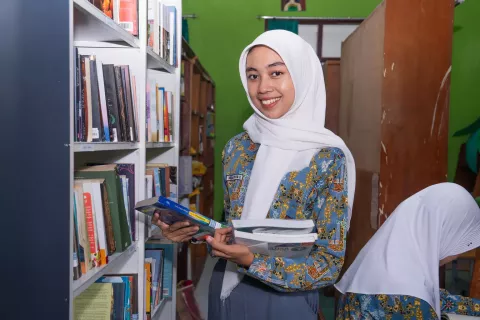
Ananta Zahra, another 14-year-old, shares a profound love for computer science and dreams of working at a start-up company in Jakarta’s bustling business district. Unlike Kania, she faces significant barriers on her path to realizing her desired future. As the eldest child in a modest family residing on the outskirts of Jakarta, Ananta confronts limited choices. Selflessly, she considers the education of her three younger siblings while striving to carve out her own career. Nonetheless, her unwavering passion propels her to go the extra mile, engaging in solitary studies, borrowing books from her elder cousin, and frequently utilizing her parents' sole laptop, which unfortunately succumbed to irreparable damage.

“I found it fascinating to learn how code makes software work and is even able to control hardware like robots,” says Ananta. “However, since the laptop died, I have nowhere to practice or learn about it. If I could learn more about coding, I wouldn’t ask for anything more.”
Contemplating the experiences of Kania and Ananta, their teacher Ms. Suci, underscores the importance of schools and educators recognizing and supporting the interests and needs of adolescents. It is crucial to address stereotypes surrounding technology, life opportunities and career options.
“When it comes to learning experiences, some subjects are still gendered, and so limit the opportunities for girls to thrive. STEM opportunities need to be made available to girls to support their participation through learning programmes or competition,” explains the friendly teacher. “The role of teachers is to support them in ways that are relevant to them individually.”

In today's rapidly evolving landscape characterized by globalization, new technologies and evolving labour markets, adolescents, particularly girls, to acquire the necessary skills and knowledge to that will empower them for work, citizenship, and life in the 21st century. This preparation is vital for them to navigate unforeseen challenges and unleash their full potential. Failure to provide enhanced opportunities for digital skills learning and adoption will result in fewer learning and employment prospects for girls and thereby subjecting them to additional barriers in workforce participation.
“Schools need to engage more with adolescent girls inside and outside school programmes,” says Kania full of determination. “Peer support will enable girls to learn and support each other, for example by identifying role models who can motivate and provide guidance. Girls shouldn’t have to do things alone and we need support from our family, schools and communities.”
UNICEF implements the Skills4Girls programme with funding support from Clé de Peau Beauté. The collaboration with UNICEF strives to empower adolescent girls such as Kania and Ananta by providing them with opportunities to develop crucial 21st-century skills. This partnership recognizes that investing in these skills is a fundamental step towards securing a promising future for young girls. By equipping them with the necessary tools and knowledge, we enable them to thrive in an ever-evolving world. Through this joint effort, the aim is to foster their growth, unlock their potential, and create a pathway to success.