A new start to life for little Durga
Little Durga pinches her brother Vikram and quickly disappears into the adjoining room. She comes out, this time, snips her friend’s pencil and hides again.

- English
- हिंदी
Little Durga pinches her brother Vikram and quickly disappears into the adjoining room. She comes out, this time, snips her friend’s pencil and hides again. She continues her daily routine, till Durga’s classmates have had enough and they complain to the teacher.
“No Durga. Don’t tease your friends. Come back.” The teacher calls her out repeatedly.
Durga appears from the room and hands over the pencil, pen and three toys to the teacher. The teacher plants a kiss on Durga’s cheeks and asks her to roleplay her favourite story.
The story of ‘Tortoise and Hare’. Durga makes all the right faces, but to the mild annoyance of her teacher, allows the hare to cross the winning line.
“I can never get upset with her. Seeing Durga Kumari do these antics makes me proud. I feel fulfilled and happy” says Manju Aggarwal, Durga’s preschool teacher and an Anganwadi worker.
And Manju’s happiness is for a reason. Durga’s short journey in Manju’s Anganwadi and preschool has been nothing short of extraordinary.
A flight from a malnourished child who struggled to gain weight and concentrate on her studies, to a four-and-a-half-year-old healthy child, who performs brilliantly in her Anganwadi and preschool.
A journey possible because of Manju’s dedication and the IKEA-supported UNICEF Early Childhood Development Programme in Udaipur.
The programme provides primary healthcare, food, and pre-school education to children like Durga at Anganwadi's in an integrated manner to ensure proper physical growth and holistic development of children.
A new beginning
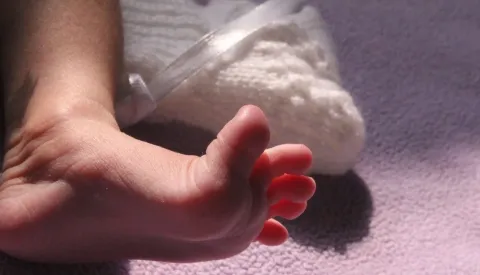
Durga was born with low birth weight in early 2014 to her parents in Kitora village in the geographically challenging district of Udaipur in the northern Indian state of Rajasthan.
In Rajasthan, adult literacy rates are low, particularly among women. There is a high burden of child marriage and, consequently, early motherhood.
Durga’s mother, like 350,000 mothers in Rajasthan, was married early and bore Durga at a very young age. Her family, like a majority of the families in this arid village, come from poor and marginalised communities, which are not able to provide quality, nutritious food to their children in their first few years.
Lack of access to nutritious food, coupled with low birthweight and frequent illness, meant Durga continued to be stunted till she was three years old.
Close to 39 per cent of children under five years of age are malnourished in Rajasthan. Stunted children have an underdeveloped brain, including diminished mental ability, learning capacity and poor school performance.
When Durga joined Anganwadi and preschool, she, like most stunted children, was very weak and displayed little interest in the activities at the Anganwadi centre.
“She refused to eat, slept most of the time and had no interest in the activities at the centre,” says Manju.
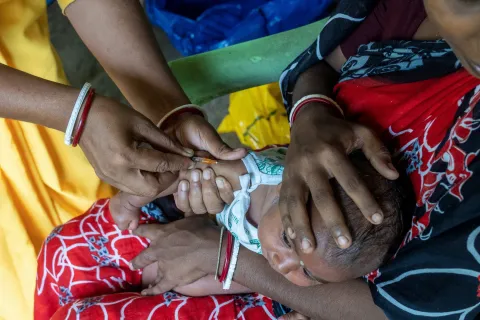
As part of the ICDS referral programme, Durga got referred to the Malnutrition Treatment Centre (MTC) at the RNT Medical College hospital in Udaipur.
At the MTC, doctors administered Durga nutrition supplements and counselled her parents about the need to provide nutritious food to Durga and also advised her to visit the Anganwadi regularly.
Manju ensured that Durga was regular to the Anganwadi centre, and she benefited from the Integrated Child Development Services (ICDS) programme.
As part of the scheme, children aged three to six years receive balanced, nutritious food that includes a wholesome intake of carbohydrates, fats, and proteins. Every child receives 500 kilocalories, which include 12-15 grams of protein, every day.
Manju regularly monitored her health indicators and made sure Durga ate all the meals offered at the Anganwadi. The regularity of the balanced foods had a positive effect on Durga’s health.
From a stagnant weight of 5.5 kilograms for almost two years, Durga’s weight increased to 10 kilograms in less than nine months. Her other health parameters also improved, and she began to exhibit more significant interest in the activities at the preschool.
“Durga not only became regular but also enjoyed herself in the preschool,” says Manju.
“She responded to my instructions and also mingled with her classmates,” adds Manju with a smile.
Focus on Early Child Education
Global evidence shows that 90 per cent of brain development occurs by the age of five. Balanced nutrition, stimulation, and protection are a must for early childhood development and determine a child’s cognitive, emotional and social development.
They also help define a child’s capacity to learn, future success and even future happiness. Investing in early childhood development programmes can foster critical skills in children and, in the long term, boost the economy by enhancing productivity.
Understanding the role of Early Childhood Development (ECD) for the whole and productive life of children, the IKEA-supported Early Childhood Education programme at the preschool and Anganwadi is play-based, as children learn best through play and active exploration in these early years.
Durga’s day at the Anganwadi and preschool has an ideal mix of play-based activities, both individually and in the group, which aim at building children’s linguistic, creative and cognitive development.
These activities, streamlined throughout the day, include storytelling, drawing, painting, word building, role-playing, and counting. They are aimed at creating an interactive and individualised environment which encourages children to ask questions, be creative and remain curious.
“The children love storybooks, colouring and performing. They gather around me when I open a new storybook in the classroom,” says Manju.
"We also teach them to wash their hands before they have meals and after they come from the toilet," says Manju. "They also teach these habits to their parents."
Prayers, playful exercises and scheduled time for snacks and hot meals punctuate these activities.
Seamless transition to primary school
More importantly, these activities prepare children to transition smoothly to primary school. A growing body of evidence in India suggests that there is a learning crisis in the country. Children are enrolled in school but failing to learn the basics.
“Regular preschool participation from age 4 to 5 years has a significant impact on children’s school readiness levels at age 5+, with the quality of preschool education emerging as a key factor in enhancing school readiness levels,” says Mita Gupta, Education Specialist at UNICEF India.
“Evidence indicates that good Early Childhood Education (ECE) programmes change the development trajectory of children by the time they enter school”, adds Mita.
Close to 60 students from Kitroo Anganwadi centre have been enrolled in the adjoining Government High School. “The performance of children who have attended preschool is always better than the children who have never or irregularly attended preschool,” says Manju.
A fact acknowledged by the principal of the school. Durga’s sister is one of the beneficiaries of the Anganwadi and preschool.
Back at home, Durga talks nonstop. About her poems, her friends and her unending stories.
“She has changed a lot. She isn’t the silent Durga,” says her mother flanked by Durga’s brother and sister. “She wants to visit the Anganwadi even in the night,” interrupts her father.
The parents look towards Manju and express their gratitude. “It is all because of her.”
Manju nods in acknowledgement. She veers towards Durga and chuckles, “kachwa jeetha hain, khargosh nahin”
“The tortoise wins the race and not the hare.”