On World Children’s Day, children present a Charter of Demands to Parliamentarians to reopen schools safely and bridge the digital divide
More than 230 monuments #GoBlue across India to express solidarity and support to child rights, children’s education and re-imagining a better world for India’s children

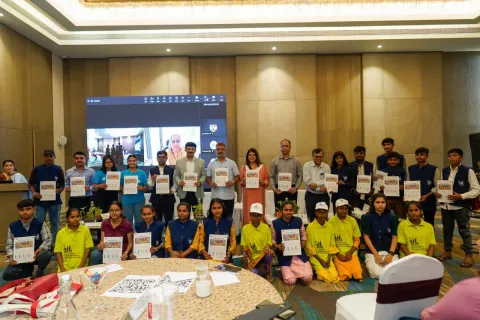
NEW DELHI, 20 November 2021 – On World Children’s Day, a day of advocacy and action for children, by children and with children, the Parliamentarians’ Group for Children (PGC) in
partnership with UNICEF India, convened a virtual ‘Children’s Parliament’ in the presence of 35 Members of Parliament, including the PGC Chairperson Hon’ble MP Shri Gaurav Gogoi and Conveners Hon’ble MP Dr. Sanjay Jaiswal and Hon’ble MP Dr. Heena Gavit.
Eminent speakers in the session included Shri Indevar Pandey, Secretary, Ministry of Women and Child Development, Government of India, Mr Shombi Sharp, UN Resident Coordinator in India and Yasumasa Kimura, Representative a.i., UNICEF India.
Representing 1500 children from 16 states, 14 children have passionately shared their experiences in learning loss, and the challenges they faced because of prolonged school closure through the pandemic. Children and young people presented a nine-point Charter of Demands to the Parliamentarians urging them to take actions to support their learning recovery.
With safe reopening of schools across the country after more than a year, the children’s Charter of Demands focuses attention on safe school reopening as well as equitable access to online learning, reducing the size of the syllabus and prioritizing vaccination for children. Sharing of the Children’s Charter of Demands was followed by a question and answer, open discussion.
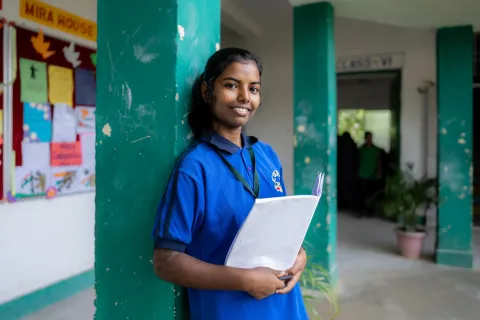
Kritika, a 15-year-old from Delhi who facilitated the presentation of the Charter of Demands mentioned, “My peers and I have faced various challenges on education. Today we feel grateful that Parliamentarians have come here to listen to our demands.”
Extended closure of schools affected not only education but also children’s physical and psychological wellbeing. Online learning was not accessible to all. According to UNICEF’s rapid assessment conducted in six states in 2020 – Assam, Bihar, Madhya Pradesh, Kerala, Gujarat, and Uttar Pradesh, 76 per cent of parents of children between the ages of 5-13 years, and 80 per cent of adolescents between 14-18 years, reported learning less compared to when they were learning in school.
A UNICEF survey on the state of learning[1] during the pandemic had shown that just over 10 per cent of students surveyed had no access to a smartphone in or outside of their homes. It was also found that close to 45 per cent of the children who did not use any remote learning opportunities were altogether unaware of any resource from which they could learn. This underlines the critical importance of schools as a physical space for learning.
Welcoming the Parliamentarians, children and guests, Gaurav Gogoi, Hon’ble MP and Chairperson, Parliamentarians’ Group for Children, reiterated, that World Children’s Day reminds all us of our commitments and duty to ensure that children have their hopes, dreams, and aspirations intact. Addressing the children as leaders of tomorrow and the future of India, he said, “As we move forward, I want you to know that we have your best interests at heart. It is my sincere hope that the takeaways from today will guide us to work even harder for the same.”
PGC is a platform that convenes, informs and engages Members of Parliament across states and across political affiliations on children's rights. Recognizing education as the central element impacting human capital, PGC has been at the forefront of recommending strategies for mitigating the learning crisis.
Delivering his address, the Shri Indevar Pandey, Secretary, Ministry of Women and Child Development, Government of India said, “The children participating in today’s session are showing promise to be the leaders of tomorrow. They are the changemakers who are going to be shaping our future. I want to reaffirm that the Government is working to create a world in which every child has a safe and healthy childhood. The Government is committed to protecting your future and each of us works to ensure that no child is left behind.”
Mr. Shombi Sharp, the UN Resident Coordinator in India said, “Today, we gathered with children and policymakers to celebrate World Children’s Day, Baal Divas, by learning from young people across India how to build a better today and tomorrow. India is playing a pivotal role in the global quest for child rights and the UN is proud to partner on achieving SDG 4 (Quality Education) as a force multiplier for the full Agenda 2030.”
Yasumasa Kimura, UNICEF India Representative a.i., said “The global pandemic has impacted children in so many ways – Education being a critical area, along with nutrition, immunization, mental and physical health, and protection of children. As we hope to recover from nearly two years of the pandemic that took away school education from countless children, it becomes essential to move forward with a plan for recovering education,” he added, “All your participation fills us with hope that the policy landscape will see evolutions to accommodate and prioritize the best interests of our children.”
India child rights week
From National Children’s Day on 14 November to the World Children’s Day on 20 November, UNICEF organized a range of activities across India in solidarity for children’s rights especially after the COVID-19 pandemic:
#GoBlue: Over two hundred and thirty iconic government buildings landmarks and monuments - from the Rashtrapati Bhavan, North and South Block, the Parliament House and Qutab Minar, Indian Women Press Corps in New Delhi, and other significant buildings, across India – were lit up in blue on 19-20 November, signifying the nation-wide celebration of child rights and putting the spotlight on children’s learning recovery.
- In Jharkhand, the CM House, the Education Project Council, a few schools, the Vidhan Sabha (Legislative Assembly) Raj Bhawan (Governor’s House) went blue.
- In Madhya Pradesh, two tribal villages in Jhabua and Dhar districts and 75 tourism spots including the Vidhan Sabha and the Raj Bhawan were lit in blue.
- Rajasthan supported children’s rights by lighting up the Hawa Mahal, the State Legislative Assembly, the Jawahar Circle, and the Patrika Circle in Jaipur in blue.
- In Uttar Pradesh, the Lucknow Metro stations, 90 Child Care Institutions, and the Lucknow and Varanasi railway stations were lit in blue.
- Other prominent building that were lit in blue across the country include the Howrah Bridge, in Kolkata (West Bengal), Charminar, Maulana Azad National Urdu University, Hyderabad (Telangana), Sun Temple, Konark (Odisha), prominent structures and monuments such as the Clock Tower in Raipur (Chhattisgarh), the Gandhi Mandap, the Brahmaputra River Heritage Centre and Rope Way in Guwahati (Assam), Science City and the Rani-ki-Vav, a UNESCO World Heritage site in Ahmedabad (Gujarat), Khanqah Munemia Qamaria, a prominent Sufi site in Patna (Bihar), and the Chhatrapati Shivaji Terminus, a historic terminal train station and UNESCO World Heritage Site in Mumbai (Maharashtra).
- Sixteen UN agencies including UN Resident Coordinator’s office, UNHCR in New Delhi and UNICEF Offices across India also went blue.
- Kids’ take over took place across India in several schools and classrooms. Kids Takeovers are the ideal expression of our commitment to making WCD a day of action for children, by children. UNICEF Bihar office was also taken over by twenty kids, while the CFO role taken over by an 8-year-old. Kids from across eight States took over schools, classrooms, radio stations, science city and UNICEF social channels over this Child Rights week.
- Corporate partners’ engagement: As a part of their corporate engagement, UNICEF partners, Housing.com, SATO- Lixil lent their social platforms for children. On Google India’s social channels, UNICEF experts answered frequently searched questions on children’s safety, wellbeing and development. This week, Oracle India employees' children trained hearing impaired children on sign language and engaged their employees. B-Medical systems joined #GoBlue campaign by illuminating their corporate office and manufacturing plant in blue for the entire week and facilitated a #KidsTakeOver session at their office highlighting WCD theme for the year 2021.
- A virtual concert by Ricky Kej, Grammy award winner and UNICEF celebrity advocate for Karnataka and Telangana and 20 well-known singers is being held on 20 November.
- Symbolic ‘Pandemic Classroom’: Earlier in the week, UNICEF India unveiled a symbolic ‘Pandemic Classroom’ installation in a Select CITYWALK in New Delhi on National Children’s Day marked every year on 14 November 2021 leading up to World Children’s Day. Empty rows of desks and chairs along with backpacks were set up to draw urgent attention to the plight of millions of young children who missed going to school for over a year due to the school closures through the pandemic and have consequently experienced learning loss.
Please see link for #GoBlue pictures here
[1] UNICEF Rapid Assessment in Aug-Sept 2020 covering nearly 6000 parents, adolescents, and teachers across six states along with interviews of 80 stakeholders approximately
Media contacts
About UNICEF
UNICEF promotes the rights and wellbeing of every child, in everything we do. Together with our partners, we work in 190 countries and territories to translate that commitment into practical action, focusing special effort on reaching the most vulnerable and excluded children, to the benefit of all children, everywhere.
UNICEF India relies on the support and donations from businesses and individuals to sustain and expand health, nutrition, water and sanitation, education and child protection programmes for all girls and boys in India. Support us today to help every child survive and thrive!
For more information on UNICEF India and its work visit https://www.unicef.org/india/. Follow us on Twitter, Facebook, Instagram and LinkedIn