Extension for community health care outcome model for early childhood development
UNICEF has leveraged advances in the field of telemedicine in Georgia to implement the Extension for Community Health care Outcomes (ECHO) Model, focusing on the monitoring and care of children under six

- English
- ქართული
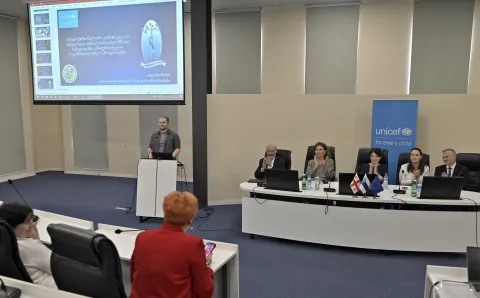
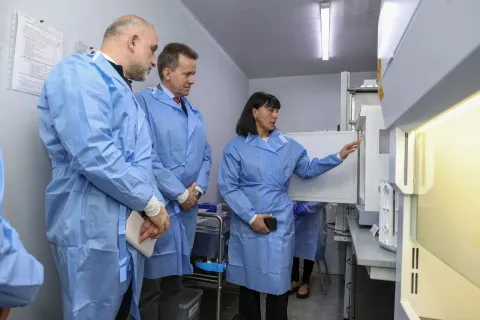
UNICEF has leveraged advances in the field of telemedicine in Georgia to implement the Extension for Community Health care Outcomes (ECHO) Model, focusing on the monitoring and care of children under six, including those affected by autism spectrum disorder (ASD). With support from the European Union, UNICEF developed a concept to roll out the ECHO Model in Georgia and partnered with Caritas for on-the-ground implementation. This innovative project involves primary health care (PHC) professionals from selected rural telemedicine sites who engage in an interactive, case-based remote learning process led by an interdisciplinary team of experts. The goal is to enhance the PHC professionals’ role in detecting ASD early, coordinating its assessment and treatment, counseling the parents and classroom teacher, and monitoring the child’s progress on a long-term basis.
Consequently, children in remote regions continue to receive care from their local family doctors, who are consistently supported and updated by specialists via remote guidance. To ensure the results of these enhanced telemedicine sessions are adequately reported and used, UNICEF has mainstreamed the respective communication platform within the child growth and development monitoring system for children aged 0–6 piloted at 50 rural PHC sites.
Moving knowledge, not people
The ECHO Model represents a significant evolution in the field of telemedicine, moving beyond the conventional one-on-one consultations between a specialist and a patient. Instead, it introduces a hub of experts who provide guidance remotely to other specialists. These specialists then apply the insights gained to better serve their patients, thereby expanding the reach and impact of the Model. Central to the ECHO Model approach is the philosophy of “all teach, all learn,” which revolves around an interactive environment where ongoing mentoring and teaching occur, thereby fostering peer-to-peer teaching. Additionally, the Model emphasizes a collaborative approach to problem-solving, ensuring that all participants can contribute to and benefit from the collective knowledge.

Establishing evaluation metrics for the ECHO Model
Although the ECHO Model is a well-established tele-mentoring framework, adopted by over 700 organizations worldwide across various sectors, a unified list of success metrics to evaluate its effectiveness does not yet exist. UNICEF has recommended the use of evaluation indicators identified by an international panel of experts across four domains: (i) engagement of participants; (ii) design and operation of ECHO Hub; (iii) engagement of the ECHO Hub team, and (iv) local impact.
By categorizing these indicators into four main domains, practitioners and teams implementing the ECHO Model can consistently measure their achievements or shortcomings. This indicator framework is expected to provide the reference and to support decision-making on wide application of the ECHO Model and its expansion beyond applications such as recognizing ASD.
The pilot’s relatively short duration did not provide UNICEF with sufficient time to fully assess the local impact. However, in the other three domains, the indicators demonstrated a significant level of effectiveness. Below is the list of indicators utilized by the project per domain.
Engagement of participants:
- Participants attend ECHO sessions regularly
- Number of participants who present cases for discussion
- Number of ECHO sessions where participants present cases from their local context
- Higher levels of participant satisfaction with didactic content, panel experts representation/hub team support
- Higher levels of participant satisfaction with learning/advice/support gained from case presentation and discussion
- Measurable increase in spoke participants who contribute to the discussion verbally or via chat
Design and operation of ECHO Hub:
- Evidence that the ECHO Model delivers on the findings of the learning needs assessment
- Higher levels of balance in dialogue contributed by hub experts versus participants, demonstrating participants are contributing at least 50 per cent of the talking
- Evidence of an interprofessional and diverse hub team
- Evidence of communication systems/processes developed for routine engagement with stakeholders outside of ECHO sessions
Engagement of the ECHO Hub team:
- High levels of expert hub/panelist experience and satisfaction (enjoyable, high value, time efficient)
- Evidence of relevant stakeholders having a clear understanding of the ECHO Model, its theoretical and practical application, and potential benefits
- High levels of strong and organized facilitation role/function, panel cohesion and satisfaction during ECHO sessions
- Demonstrated ability to recruit and retain Champion, Facilitator, Panelists with the right qualification, skills, expertise, lived experience, ability to present well and make spoke participants feel comfortable.

The ECHO Model is considered as an innovation in continuing medical education (CME) process. UNICEF intends to showcase the approach as an effective solution of CME for health-care practitioners that used a hub-and-spoke model to leverage knowledge from specialists to PHC providers in different regions.
The pilot of the ECHO Model has demonstrated its high feasibility, acceptability and potential sustainability. The Model offers significant benefits to health-care providers and aligns well with the Government’s policy on CME.
About the project:
The project, “Minimizing the impact of the COVID-19 outbreak in Georgia through telemedicine and digital health solutions,” aims to harness the potential of digital tools for advancing telehealth services and promoting health in Georgia. This assistance is an integral part of the EU’s and UN’s support to the COVID-19 response in the country, as well as ongoing WHO technical assistance under the UHC-Partnership to support the commitment of national authorities to primary health care reform and the advancement of UHC in Georgia.
The project is implemented by four UN partners (WHO, UNFPA, UNICEF, UNOPS) under WHO leadership.