A Tap of Hope
How UNICEF's Revolving Fund Programme Transformed Lives in a Small Egyptian Village

- English
- العربية
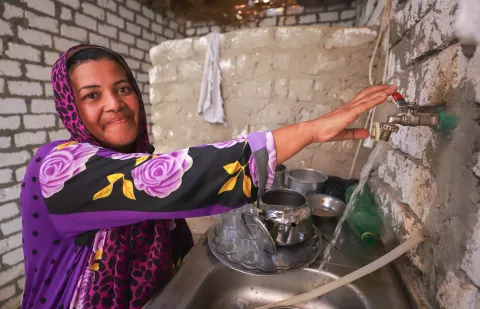
With curiosity, surprise and joy, eight-month-old Rayyan opens the newly installed water tap in his house. His mother, Sabrin, says with disbelief, "We never expected that one day we would have a water tap at home."
Sabreen and her children will remember the 17th of December 2023, as the day when drinking water first reached their home, thanks to the UNICEF-supported revolving fund programme.
But what was life like for this family before the tap was installed?

UNICEF/Egypt 2024/ Ahmed Emad
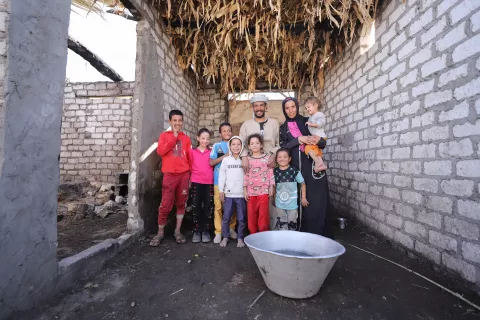
Sabreen is 26 years old and has four children: Suha (5), Dunia (6), Malik (3) and Rayyan (8) months.
The family lives a modest life in the village of Kawala in Sohag Governorate, an area that is extremely dry and hot in summer and very cold in winter.

UNICEF/Egypt 2024/ Ahmed Emad
In June of the same year, a team from UNICEF and the Sohag Water Company (a governmental partner) visited this village to identify the most deprived families in urgent need of water and sanitation connections.
Sabreen's house was among them.


Inside her house, which does not even have a fan to relieve the heat waves, she described the difficulty of life without a drinking water tap at home, especially with young children: "We walk or ride donkeys a long distance to get drinking water because the water from the hand pump in the village tastes salty."
"For drinking and cooking, we need seven jerry cans a day. For washing and bathing, we need about 20 more. They are still not enough sometimes."
In Egypt, the water company in each governorate is responsible for the infrastructure to deliver water to the main streets. However, installing a water connection at households must be paid for by families who often cannot afford it, especially in poor villages.
Because Sabreen and her family could not afford to install a water connection at home, they spent many hot summer days and cold winter nights thirsty because of the distance they had to travel to get drinking water. A single trip to get water might take about an hour. "My husband is ill,” she says, “When it’s dark, it’s not safe for him to take that journey for water."
Now, thanks to the UNICEF-supported revolving fund programme, Sabreen and 88 of her neighbours in Kawala village in the Akhmim district of Sohag have a clean water connection at home.
Running since 2016, the programme aims to increase the ability of the most vulnerable families to afford safe drinking water connections and sanitation systems at home. The revolving fund is an innovative financing mechanism to make home connections affordable for these families.

In collaboration with water and sanitation companies and NGOs in different governorates, UNICEF designed this unique programme to assess and prioritize water and sanitation needs. UNICEF then allocated the necessary financial resources to the water companies so that citizens who are unable to afford household water connections are "funded" in the form of a loan. This loan is repaid in interest-free monthly installments by the citizens to the water companies, replenishing the fund's resources and allowing more families to benefit in the same way.

The 88 connections in this village were among 575 water and sewage connections installed at a cost of 2.7 million Egyptian Pounds in Sohag governorate by December 2023. The cost of these connection is to be paid in installments over a period of four years. An evaluation of the candidates’ social status was conducted to ensure their eligibility.