How the Akelius Progamme Makes Language Learning Fun and Meaningful for Children on the Move
By learning English through interactive digital lessons, Sudanese children on the move are rebuilding confidence, recovering lost learning, and rediscovering their love for language.

- English
- العربية
In a small learning space in Karkar, Aswan, the morning begins not with silence, but with anticipation.
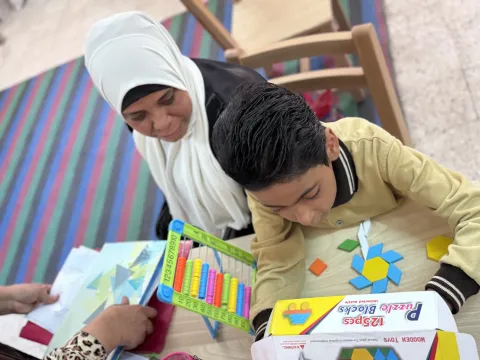
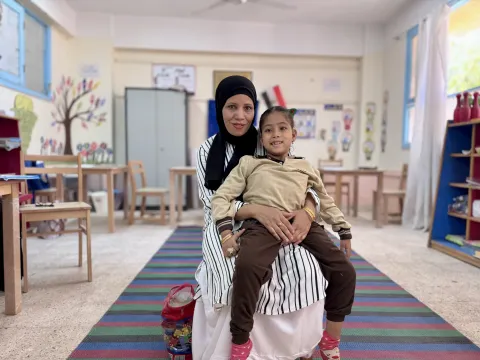
Tablets light up. Headphones are adjusted. A teacher moves between desks as children log into their lessons. For many of them, these devices represent something far bigger than technology; they are a pathway to recovering lost learning and rebuilding confidence after months, even years, without formal schooling. Sudanese children on the move in Karkar learning spaces in Aswan are taking remedial classes in Mathematics, Arabic, and English. The English language is supported through the Akelius programme using interactive tablets.

Among them is 12-year-old Rahaf Ahmed.
Rahaf sits upright, her fingers moving confidently across the screen as colorful words appear. English has become her favorite subject.
Through Akelius, Rahaf listens carefully to each word, repeats it, watches the colorful images pass by for each new word she learns, and plays interactive games and exercises until she gets the pronunciation right.
Rahaf decided, with enthusiasm mixed with the nervousness of someone who has recently learned the language, to introduce herself to us in English. She shared that she came from Al-Fasher in Sudan, now lives in Wadi Karkar in Aswan, and that her favorite color is blue.
She then returned to her mother tongue to tell us about her experience with Akelius, adding:
“English is my favorite subject because it is easy and enjoyable. I also like learning on the tablet because it pronounces the English words and helps me memorize them quickly.”
Before joining the programme, Rahaf had lost almost two full academic years. The gap made everything feel harder, especially English. But interactive learning changed that. Instead of struggling to keep up, she can now learn at her own pace, replaying lessons as many times as she needs.
One of her proudest moments came when she introduced herself in English for the first time.
Rahaf hopes to become a doctor. When asked about the importance of language in medical education, she replied without hesitation:
“Of course it’s useful, because some medical equipment is in English, and it will be easier for me to read it and understand it.”

Rahaf’s experience with Akelius is shared by many of her classmates. Across the classroom sits Mounir, another 12-year-old who has rediscovered his motivation to learn.
Not long ago, school did not interest him at all. He began skipping classes at Karkar’s learning space, mostly spending time in the local markets, playing street football, or watching his favorite football teams on the small TV screen in a nearby shop. But when tablets were introduced, disinterest quickly gave way to curiosity and soon turned into excitement.
Mounir admits that he loves Arabic and thinks English is too hard. However, he added: “Since they brought the tablets, I enjoy going to school,” he says. “I don’t want to miss the English lessons, so when I travel to Europe, I can speak with people.” Mr. Moataz, his English teacher, can barely hide his pride. “Mounir is now always the first through the door,” he says, “and before anything else, he wants to know: are we learning English today?”
Next to Mounir sits Abdel Kader AbdAllah, who had to flee Khartoum with his family and experienced a one-and-a-half-year learning gap.
“I like English the most because I learn it on the tablet,” he says with a determined smile. “When I see the picture, I understand the meaning. The images help me remember the word.”

For Abdelqader, learning has become more interactive and collaborative among students. He explains: “We all work on the tablets. I listen to the words and arrange the sentences, and sometimes, if I don’t know something, I ask my classmate.”
He adds that the application’s gradual learning approach helps him understand better, as it begins with vocabulary before asking students to build sentences. As he describes it: “I like learning on Akelius because it first teaches you the words and then asks you to put them together, and the level keeps getting harder. I’m now at level five, and every now and then I go home and tell my family what I’ve learned. They encourage me and say, ‘Good, maybe next time you’ll learn even more.’”
He also highlights how widely the enthusiasm for the application has spread among students, noting: “We all love Akelius here. If I had been using it for a year, I could have reached much further, maybe B2.”
Indeed, all the children agree on one thing: two hours per week on the tablet is not enough.
“I wish we could use the tablet every day,” Rahaf says eagerly. Mounir also nods. “When I start learning, I don’t want to stop,” he says. “I want to continue.”
The Akelius programme currently provides interactive English learning for Sudanese refugee children. It equips classrooms with tablets and the Akelius application, helping students practice vocabulary, pronunciation, and sentence formation at their own pace. Teachers guide lessons, monitor progress, and provide targeted support for children who have experienced learning gaps.
Through this blended approach, and in only three months of running the programme in 66 educational spaces across Egypt, around 3,100 children and 230 educators directly benefit, while thousands of family members are reached indirectly, helping children regain confidence, motivation, and the chance to catch up academically, even with just two hours a week on the tablets.
After months, and sometimes years, of disrupted education, these children are rebuilding their learning step by step. With the Akelius programme, the classroom is no longer a place of frustration, but a space where they can move forward with confidence.
Through a two-year partnership between Egypt’s Ministry of Education and Technical Education, UNICEF, and the Akelius Foundation, the programme is expanding inclusive digital learning opportunities for marginalized children across Egypt.