Art Therapy for Changing Behavior
How a UNICEF-supported Child Protection Center helped three children during tough times?

- English
- العربية
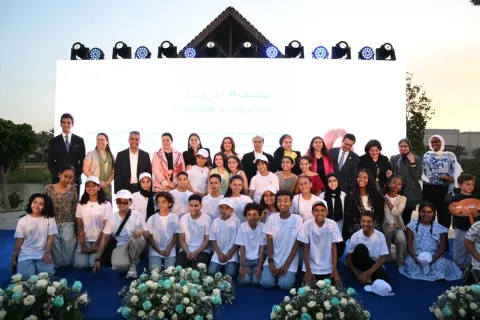
On the day of this official visit, a young girl named Gehad confidently and courteously approached and welcomed the EU ambassador in Egypt. Everyone praised her kindness and intelligence, without knowing she at the center of a success story of the Child Protection Center set up by UNICEF within the National Foundation for Family and Community Development (NFFCD) in Alexandria.
When she heard from a neighbor about the free services offered by the center, Gehad’s mother (who has seven children) came to the center complaining about problems in tاhe behavior of three of her children.
Alaa Ibrahim, a case manager met her and listened to her problem carefully. She understood that two children were violent with their parents, siblings and classmates, while the third was the complete opposite: he was very introverted and did not interact with anyone.
"Ibrahim was very challenging. He had issues with anger management and aggressive reactions with no respect to the elderly. His brother Adham who’s in the second grade was an introvert but also quickly lost his temper. Their sister Gehad who’s in the fifth grade and a bright student doesn’t listen to any one and sees she’s always right. The three have different personalities and dealt aggressively with each other", explained the mother.

Alaa started asking her about the environment in which the children live. She lined up her questions in a professional and thoughtful way as she was trained to do by UNICEF and discovered that the children’s behavioral disorders was actually reflecting disputes taking place in the family.
The mother admitted that she was also aggressive with the children. She was overwhelmed by responsibilities. But she was willing to change.
Alaa went through some of the Center’s services that could be useful, such as family counseling, conducted individually and collectively for parents to increase their awareness about positive parents, various forms of violence against children (especially disciplinary violence) and to learn how to avoid them.
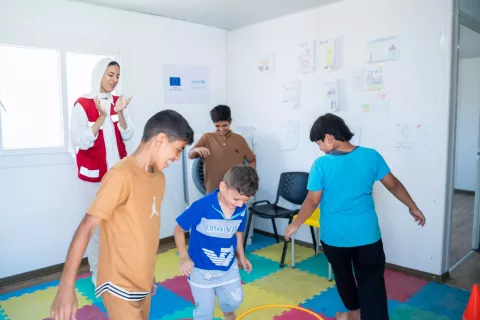
Alaa also set up individual psychosocial support sessions with the children and suggested they could take part in a therapeutic art activity the mother: psychodrama.
Psychodrama is a method of psychotherapy that combines the art of drama with therapeutic psychology. It’s helps a person express feelings and emotions by role playing related to current, past or future situations to be have more acceptance to the feelings related to these situations.
As she learned how to start conversation with her children, the mother discovered that her son Ibrahim felt she did not stand for him or defend his rights. He was feeling insecure . "He was constantly feeling he could be crushed by anyone."
Through dialogue, the mother was able to convince him to listen to others and try to use his strength, intelligence and popularity to defend the rights of the weak. “He has the personality of a leader, and I felt that there are many children who listen to him. He began to apply why he learned at the Center with his colleagues at school and influence them”, she added.

Ibrahim was able to resolve disputes and fight bullying among many of his classmates at school using his popularity, and so did his sister Gehad who was also very popular in her class.
Over time, the mother felt great improvement. The three children behaved better inside and outside the house, and she also became calmer in dealing with them.
About what she benefited from the family counseling sessions, she says: "I did not know the importance of hugging a kid or approaching him/her if he/she has a problem. I now listen and communicate. Personally, I feel better, and this is reflected on their attitude towards me.”
The mother remembers the EU Ambassador's visit and the reaction of her children: "When they came back home, they opened the television so that they would show us proudly that we took pictures and videos with him.”
The family, along with more than 400 other cases, have benefited from the services of the Center since its establishment in April 2019 by UNICEF and the provision of technical to it and financial support by funded by the European Union.
The Center provides free support and assistance to children who are victims of physical, emotional and sexual violence and abuse, according to a case management approach, to identify their needs for financial, social, psychological, medical and legal support.
In addition to providing specialized psychiatric services by physicians and specialists, the center also offers psychosocial support services such as art therapy, recreational and educational activities for children and their families.