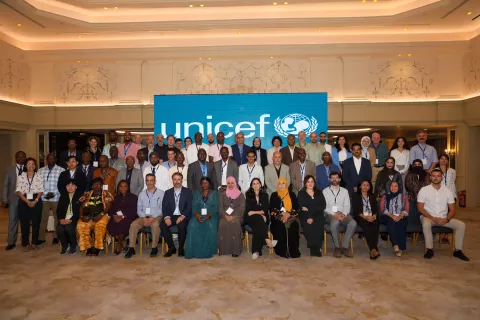
Deputy Minister of Health joins UNICEF and J-PAL MENA to discuss evidence on fertility and family planning

- English
- العربية
CAIRO, 22 February 2022 – Today, UNICEF Egypt and the Abdul Latif Jameel Poverty Action Lab Middle East and North Africa (J-PAL MENA) co-hosted a seminar at the American University in Cairo (AUC) on “Fertility and family planning: Insights on promoting healthy behaviors and curbing population growth in Egypt”, with the support of Allianz Egypt.
The seminar featured Dr. Tarek Tawfik, Deputy Minister of Health and Population for Population; Dr. Caroline Krafft, J-PAL MENA invited researcher and Associate Professor in the Department of Economics and Political Science at St. Catherine University; Dr. Fazlul Haque, UNICEF Egypt Acting Representative; Frederika Meijer, UNFPA Representative in Egypt; and Dina Heikal, Social and Behavioral Change Officer at UNICEF Egypt.
During the opening remarks, Dr. Haque stressed that family planning is of importance not only to prevent early or unwanted pregnancy but also to space and limit numbers of children, to enable mothers to meet the needs of existing children and to support maternal health. Family planning issues should be of equal concern to boys and young men as to girls and young women.
Dr. Caroline Krafft shared insights from J-PAL’s global evidence base on fertility and family planning, focusing on the following key takeaways: increasing educational and economic opportunities for girls and young women can reduce early childbearing; awareness messaging can help shift attitudes towards fertility and childbearing; providing women with private access to family planning services can lead to increased take up; tailoring programs to consumers’ preferences can lead to more contraceptive use, although more evidence is needed; and providing targeted training to healthcare providers can be effective in improving family planning service delivery.
Dr. Tawfik followed up with an overview of national efforts to reduce fertility rates and a perspective on persisting challenges. Ms. Meijer then discussed UNFPA’s efforts in supporting national policies and programs to ensure widespread access to reproductive health services and to improve maternal and child health outcomes. Ms. Heikal concluded with a discussion on using gender transformative parenting as a way to address desired fertility and family planning decisions, focusing on social and behavioral change dimensions.
This seminar is the fifth in the Global Evidence for Egypt Spotlight Seminar Series, which bring together Egyptian policymakers and J-PAL affiliated professors in a discussion about how to tackle pertinent policy issues in Egypt. During each seminar, policymakers highlight a particular development priority in Egypt. J-PAL affiliated researchers frame the priority from a global perspective and offer evidence-informed insights for improving policy and program design. In dialogue, the panel of policymakers and J-PAL affiliates ground the evidence in the Egyptian context and together explore possible policy solutions.
The adoption of the evidence-based decision-making process stands as a key priority to UNICEF’s efforts with the Egyptian Government and this partnership with J-PAL helps foster a dialogue between Egyptian policymakers, development partners and leading affiliated researchers to discuss pertinent policy issues that affect children and youth’s wellbeing in Egypt.
******
About J-PAL MENA at AUC
The Abdul Latif Jameel Poverty Action Lab Middle East and North Africa (J-PAL MENA) at The American University in Cairo’s School of Business is a regional office established in July 2020, as a part of a larger network of research centers worldwide working to reduce poverty by ensuring that policy is informed by scientific evidence. Anchored by a network of more than 200 affiliated professors at universities around the world, J-PAL MENA draws on results from randomized impact evaluations to answer critical questions in the fight against poverty. We build partnerships with governments, NGOs, donors, and others to share this knowledge, scale up effective programs, and advance evidence-informed decision-making.
J-PAL was launched at the Massachusetts Institute of Technology in 2003 and has regional centers in Africa, Europe, Latin America and the Caribbean, the Middle East and North Africa, North America, South Asia, and Southeast Asia. For more information, visit povertyactionlab.org.
About the American University in Cairo School of Business
Boasting an unrivaled reputation as the top private business school in Egypt and one of the best in Africa and the Arab world, AUC School of Business is dedicated to transforming the eager and innovative minds of today to become the responsible change agents of tomorrow, all while developing relevance and leadership in an evolving ecosystem.
Situated within AUC and enjoying nearly seven decades’ worth of history, the School offers a wide range of programs and activities that extend beyond the classroom to provide a holistic and engaging experiential learning approach. The School’s seal of excellence is the Triple Crown accreditation, which places it among the top 1 percent of educational institutions worldwide to achieve the Association to Advance Collegiate Schools of Business, the Association of MBAs and the European Quality Improvement System accreditations.
For more information, visit business.aucegypt.edu/
About the American University in Cairo
Founded in 1919, The American University in Cairo (AUC) is a leading English-language, American-accredited institution of higher education and center of the intellectual, social, and cultural life of the Arab world. It is a vital bridge between East and West, linking Egypt and the region to the world through scholarly research, partnerships with academic and research institutions and study abroad programs.
The University offers 40 undergraduate, 52 master’s and two PhD programs rooted in a liberal arts education that encourages students to think critically and find creative solutions to conflicts and challenges facing both the region and the world.
An independent, nonprofit, politically non-partisan, non-sectarian and equal opportunity institution, AUC is fully accredited in Egypt and the United States. For more information, visit www.aucegypt.edu/
Media contacts
About UNICEF
UNICEF promotes the rights and wellbeing of every child, in everything we do. Together with our partners, we work in 190 countries and territories to translate that commitment into practical action, focusing special effort on reaching the most vulnerable and excluded children, to the benefit of all children, everywhere.
For more information about UNICEF and its work for children, visit www.unicef.org/egypt/