A safe place to heal: Psychologist’s work in a Refugee Collective Accommodation Centre in Wrocław
From volunteer to counselor, Oksana helps children and adults affected by war find safety and hope in Poland

- English
- Polish
Oksana Gorna, 51, has worked as a psychological counselor for more than 10 years. In Ukraine, she worked as a school psychologist, supporting students, parents and teachers. She is specialized in play therapy, psychological first aid and grief. She has also worked with people who have experienced violence, including in schools, and has helped people overcome traumatic experiences.
In 2019, Oksana moved with her family to Wrocław, in south-western Poland. Originally from Khmelnytskyi Oblast in western Ukraine, she has Polish roots, which influenced her decision to relocate.
Recalling the end of winter and beginning of spring 2022, when the war in Ukraine escalated, Oksana says she and her husband initially volunteered at the train station. In February 2022, Oksana saw that the Wrocław-based Foundation Kaleidoscope of Cultures was looking for Ukrainian-speaking psychologists to help refugees. She decided to join, first as a volunteer and later as a permanent team member.
As the number of people arriving from Ukraine in Wrocław grew, the city opened several collective accommodation centres to host the most vulnerable. One of them was Przystanek Grochowa, was supported by UNICEF in cooperation with the municipality of Wrocław. The assistance focused on strengthening resilience, facilitating access to services and mental health and psychological support, preventing violence against children, and fostering social integration.
Oksana’s role became essential. She worked with people in crisis, particularly those experiencing the effects of war trauma and PTSD. She supports both adults and children who have suffered loss. Initially, she and her colleagues met refugees at train stations and in collective accommodation centres.
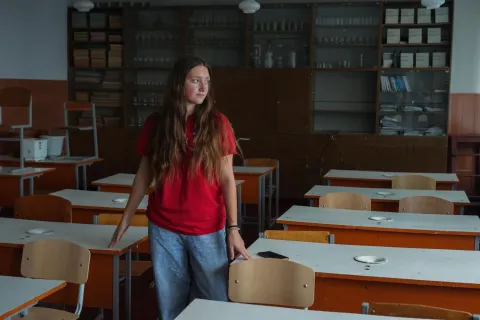
At Przystanek Grochowa, Oksana took shifts supporting the residents. The facility had previously been a school but hadn't been used in recent years. In just ten days after opening a collective accommodation center there, the facility was renovated, and beds were installed in the gym and classrooms. Communal dining areas, showers, and laundry facilities were also set up. Once ready, the centre began receiving refugees arriving in Wrocław who had no place to stay.
Oksana highlights the dedication of the centre’s staff, who, like her, started as volunteers. “There were people with big hearts. They gave residents a sense of inner calm. It’s clear that people were fleeing and seeking safety, but they were also looking for peace. You can be a guru in psychology, read many books, but if you don’t have a good, calm heart, little will succeed.” In addition to the staff, student volunteers helped maintain shared spaces.

Oksana thinks of the residents she supported from a baby born in Kyiv on 24 February 2022 to an elderly man, born in 1944. “He was alone at first, and then his grandson, who has a mental health problems, joined him. The grandson went straight to psychiatric care upon arriving in Poland, and now the grandfather takes care of his grandson,” Oksana explains.
“Psychological support needs varied,” she shares. “To some, I was a daughter, to others a mother, a friend, or the person who would tell colleagues, ‘Are you tired? You need to take a day off and get some rest.’ I also provided psychological education, explaining why certain things were happening.”
Oksana emphasizes that while working at the centre, she did not conduct therapy but provided counseling. “We didn’t do any therapy because there’s no time or space for it. Therapy goes deeper. When someone is injured and still in trauma, without resources, you can’t start therapy. You have to support them first, so they have the strength for therapy, then the process can begin. It was behavioral counseling, explaining why something is happening and how it might be better handled.”
Over time, as residents stayed longer, conflicts occasionally arose. Oksana’s role was often to help resolve disputes, sometimes through group meetings over tea to create a less formal atmosphere.
As a child psychologist, Oksana pays particular attention to children. “For children in this situation, attention is very important. Mothers were also in a state where their protective mechanisms were focused on preserving themselves. It’s like when you are on a plane, first the oxygen mask on yourself, then on your child. So I would gather the mothers and say, ‘I understand how hard this is, but give your children ten minutes, they need eye contact.’ Children don’t fully understand the situation happening in the world. But when a mother is near and embraces them, the child feels safer,” she explains. Oksana’s guidance helped both children and adults regain a sense of normalcy and security amidst ongoing trauma.
Looking back at her time at Przystanek Grochowa, Oksana reflects on the challenges and rewards of working closely with both adults and children under extreme stress. Her work required not only professional expertise but also empathy, patience, and adaptability to the varying needs of residents, from immediate support upon arrival to longer-term guidance for those staying months or even years.
The Przystanek Grochowa centre operated until the end of October 2025. It is now closed, and residents have been relocated to other centres.

When asked how she manages the emotional stress of such demanding work, compounded by the ongoing war in Ukraine, Oksana replies: “I am supported by my faith, my confidence and my family. I don’t know how effective I would be on my own. But with my family, my children, hugs, flowers given by my husband — it all helps me take a break from work and return to private life.”
Through her empathy and professional expertise, Oksana has helped people navigate the uncertainty and trauma of displacement, providing stability when it was needed most.
***
Collective Accommodation Centres, initially established as emergency housing at the onset of the refugee crisis, currently host nearly 16,000 people across Poland, with children accounting for an estimated 30 per cent of residents. The largest concentration of centres and residents is located in the Lower Silesian, Lesser Poland and Masovian voivodeships. In response, UNICEF implements a programme to strengthen the protection, wellbeing and social inclusion of refugee children from Ukraine and their caregivers living in collective centres across all three regions. In Lower Silesia, the programme is delivered in partnership with the City of Wrocław and, at regional level, through a consortium of non-governmental organizations, including Nomada Association, Kaleidoscope of Cultures Foundation and the Ukraine Foundation. The programme provides integrated support focused on child protection, psychosocial wellbeing and inclusion in local systems of education, healthcare, social assistance and the labour market, while promoting families’ transition towards stable, independent living and strengthening local child protection and social inclusion systems.
This important work for refugee children and caregivers from Ukraine in Poland is made possible thanks to the generous support of the Bureau of Population, Refugees, and Migration of the US Department of State (PRM) and the Government of the Republic of Korea.