Survive, inspire and take action
They survived polio and today they are going door to door so that no child has to go through what they did

- Français
- English
In Kikwit, the largest city in Kwilu province in the western Democratic Republic of the Congo (DRC), a three-year-old girl opens her mouth wide. In just a few seconds, two drops of oral polio vaccine land on her tongue. She is now protected from a devastating disease that, had she contracted it, might even have killed her.
Her name is Promedi. She doesn’t know it yet, but these two drops are the result of a fight led by people who weren’t as lucky as her – survivors of polio who turned their experiences into a mission to protect others. Their goal: to make sure no child suffers like they did.
For Adosy Nseyi, her life changed when she was just eight years old. One weekend, she felt slightly feverish. But what seemed like a more-or-less harmless symptom quickly developed into paralysis. She had contracted polio.
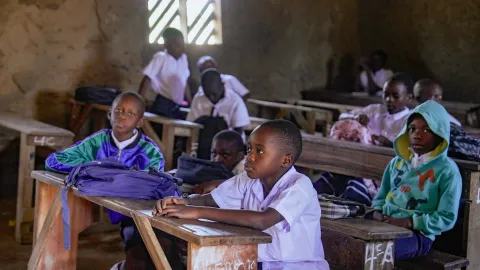
At school, her classmates excluded her. Even within her own family, some turned away. It was a time of pain and isolation.

But her father stood by her. With his unwavering support, Adosy returned to school and earned a degree in administration. Today, at 51, she dedicates her life to supporting young girls with disabilities, helping them stand tall just as she does.
She also visits families to raise awareness about vaccination and hygiene. For her, every conversation, every small action, has the power to save a life.
Everywhere I go, I tell parents to vaccinate their children. When they see me and hear my story, they understand why it's important.

Just a few streets away, Paulin Masebau carries the same fight. He was five when he contracted polio. In his community, people call it Buka Buka – the literal translation is “that what breaks the legs.”
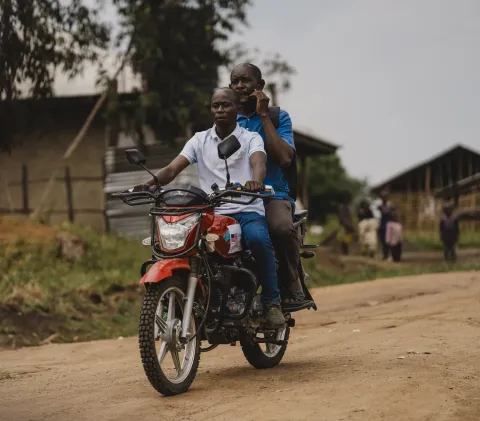
Today, Paulin is a teacher, a community health worker, and a respected role model. He joins every polio vaccination campaign, going door to door to talk with families and support health teams.
"I ask parents to vaccinate their children, so they don’t become disabled like me," he explains.
But Paulin is advocating for more than just vaccines. He advocates for an inclusive society where all children — with or without disabilities — are seen, valued and supported. "Yes, I have a physical disability," he says with a smile, "but I am healthy and full of joy."
Apelo Jolie Kiswa was just learning to walk when she contracted polio. From an early age, she had to adapt and find new ways of moving through life. Most importantly, she turned her experience into a commitment to help others.

Polio awakened a strength in me. Today, I’m proud to be a community health activist.
During vaccination campaigns, Apelo walks through neighbourhoods and villages, knocks on doors, and talks to families and parents. She also talks on community radio stations to provide reliable information and answer questions from those who are hesitant.
And it works. "Many families who used to reject vaccination have changed their minds. Now they immunize their children," she says.
In 2024, DRC recorded a remarkable drop in cases of variant poliovirus — from 288 cases in 2023 to just 26. It’s proof that efforts are paying off, especially in communities where voices like Adosy’s, Paulin’s and Apelo’s are making all the difference.

With support from UNICEF, WHO, the United States Agency for International Development (USAID), the European Investment Bank-European Commission, the Gates Foundation, the Government of Canada, Rotary and Gavi, the Vaccine Alliance, more than 27 million children received at least two drops of oral vaccine during the four National Vaccination Days in 2024.
UNICEF is working to strengthen cold chain systems, ensure reliable vaccine supply, and mobilise communities. But it’s the voices of survivors, those who lived through polio and choose to speak out, that are driving the greatest change.
By sharing their stories, Adosy, Paulin, and Apelo are educating, inspiring, and protecting. Their personal struggles have become a collective fight — one that brings us closer to a world free of polio.