Racing against malnutrition in Goma
Without proper care and adequate nutrition, thousands of displaced children remain vulnerable to disease and epidemics

- Français
- English
Since January 2025, life has become even more difficult for displaced families in Goma, the provincial capital of North Kivu in the eastern Democratic Republic of the Congo (DRC). After the new de facto authorities ordered displacement sites to be dismantled, many families were forced to return to their areas of origin or seek shelter with host families in the city.
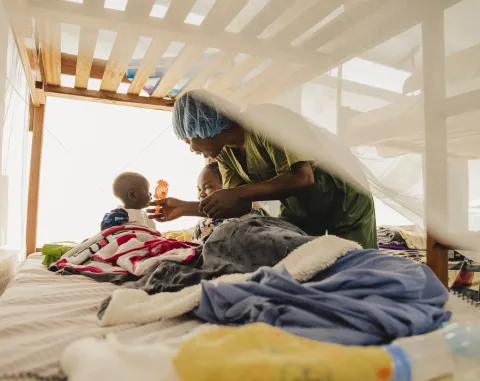
Now scattered across various neighbourhoods, families have once again lost access to basic services — including healthcare that was previously available in displacement camps. Struggling to feed their children, many parents are facing the heart-breaking reality of seeing their children become severely malnourished.
To help provide continued care, UNICEF launched a community-based campaign in March 2025 to identify malnourished children.
More than 200 community workers, trained with support from the UK’s Foreign, Commonwealth and Development Office (FCDO), went door-to-door across Goma, using special tapes to measure children's mid-upper arm circumference — a quick way to detect malnutrition.

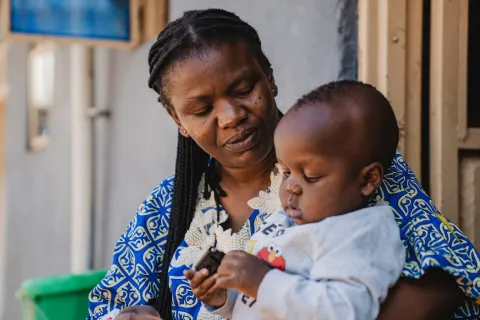
That’s how 16-month-old Samuel was identified. His mother, Aisha, looked on anxiously.
“The tape showed yellow,” she said. “It means Samuel has moderate acute malnutrition. His father and I just can’t afford to feed him properly.”
Since conflict forced them from their home, Samuel’s parents have lost everything. Buying enough food has become nearly impossible. Community workers visit regularly to monitor Samuel’s progress and offer nutrition advice.
But for many families, following this advice is easier said than done.
“Honestly, I can’t always do everything they recommend,” Aisha admits. “We simply don’t have the means. My son doesn’t get a balanced meal every day, but I try. Sometimes my neighbour and I team up to find food.”
In March alone, more than 65,000 children in Goma were screened — and over 2,000 were diagnosed with moderate or severe acute malnutrition. Around 600 pregnant or breastfeeding women were also referred for care.

One-year-old Akuzwe is one of the children now receiving help. His mother, Chucrani Lolote, does all she can to care for her three children.
“To feed my children, my mother and I transport goods. The money we earn helps us to survive, but sometimes it's complicated,” she explains.
When Akuzwe was diagnosed with acute malnutrition, Chucrani rushed him to a nearby health centre.
“The doctors made me feel very welcome,” she says. “They weighed my child and ran some tests. For two weeks now, I've been receiving rations for him, and I finally see a difference. Last time, he had gained 200 grams.”
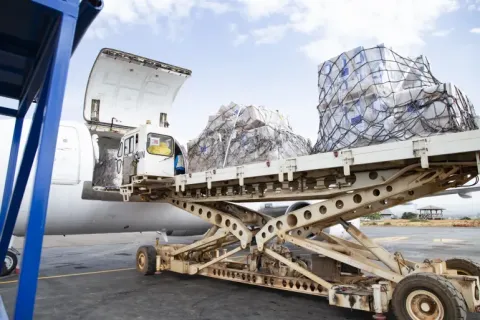
With support from the Bureau for Humanitarian Assistance (BHA), UNICEF provided the nutrition supplies needed for the campaign, ensuring that children could be treated without delay.

But screening is only the first step. Home visits are just as important — and community health volunteers like Maman Anto are at the heart of this effort.
“When we visit families, we measure the mid-upper arm circumference of children under five. If the ribbon shows yellow or red – a sign of moderate or severe acute malnutrition – we tell parents what to do, because without proper care, the child could die”, explains Maman Anto.
Their work doesn’t stop at screening. Each visit is a chance to teach parents about healthy eating habits and the small, vital actions that help children grow up strong and healthy.
Thanks to their tireless efforts, children like Samuel and Akuzwe are getting the care they need. But the crisis remains severe, and the needs are immense.

Malnutrition weakens children's immune systems, making them especially vulnerable to diseases such as cholera, mpox, and measles. This creates a vicious cycle: illness worsens malnutrition, and malnutrition further reduces the body’s ability to fight off infections.
In eastern DRC, this threat continues to grow. Given the urgency of the situation, a coordinated, sustained, and strengthened response is essential. This requires a multisectoral approach that brings together health, water, hygiene, sanitation, food security, child protection, and education.
Still, Chucrani remains hopeful:
“My dream is to see my children grow up healthy and to give them an education,” she says.