Learning beyond classroom walls
Distance learning offers a second chance to children whose education was disrupted by conflict

- Français
- English
Every September, millions of children around the world return to school after weeks of holidays. New backpacks, fresh notebooks, neatly aligned desks and joyful reunions with classmates are all familiar signs of a new school year filled with promise.
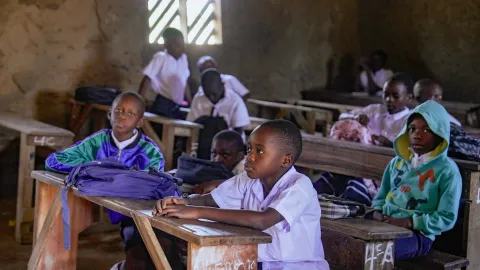
In Munigi, a neighbourhood on the outskirts of Goma in eastern Democratic Republic of the Congo (DRC), learning takes a different form. In an abandoned classroom, lessons are broadcast through a radio that plays pre-recorded classes following the national curriculum.
Teacher Juvenal Mumbere leads Level 3 pupils, equivalent to fifth and sixth grade, in this unique learning initiative.
Supported by UNICEF, in collaboration with the Ministry of Primary, Secondary and Technical Education, the Ministry of Social Affairs, and the Ministry of National Education and New Citizenship, the radio education programme enables thousands of out-of-school children to continue learning.

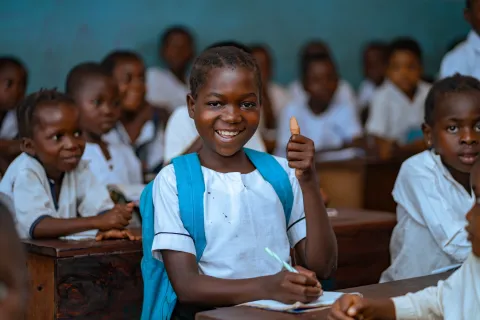
This is the case for Abiga, 13, whose education was suddenly interrupted when her family fled the war. When they finally returned to Munigi, new challenges appeared, including school fees her mother could not afford.
One day, she overheard a group of children talking about a radio learning programme.
“They told me it was for children who had dropped out of school. I asked to join, and they accepted me,” she says proudly.
Today, Abiga is one of the most dedicated pupils. “I had forgotten a lot, but little by little it’s all coming back. And most of all, I’ve made new friends.”
Aziza, 15, faced a different challenge. “I got sick, and my mother couldn’t afford my school fees anymore,” she explains, holding tightly the radio that delivers her lessons.

After missing several months of school, Aziza was identified by a team from Village d’Espoir, a UNICEF partner organisation in Munigi. They were identifying out-of-school children and encouraging them to join the radio learning initiative. Aziza enrolled and now studies alongside Abiga.
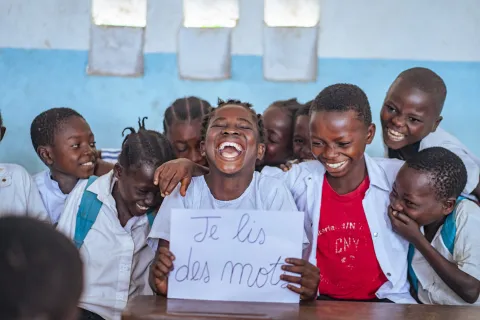
“We study together and help each other. If one of us loses a pen, the other lends hers. We learn and we laugh,” she says with a smile.
Aziza dreams of becoming a businesswoman, selling clothes and learning to sew.
At the centre of the room, a solar-powered radio plays the pre-recorded lessons. Across North Kivu, similar learning spaces are run with the same enthusiasm, in courtyards, under trees or in unused buildings.

Three times a week, around fifteen pupils gather around Juvenal Mumbere to follow the lessons.
“This is my way of helping children who no longer have access to school,” the teacher says. “My classroom feels like a family.”
The initiative provides crucial support to children who cannot attend formal schools. It keeps them engaged, motivated and ready to reintegrate into the education system as soon as conditions allow.
“I’m happy because I remember what I learned before, and I’ve found my friends again,” says Christian, 14, who hopes to study medicine and become a doctor like his mother.

Since September 2024, around 4,600 children have benefited from the distance learning initiative, supported by the European Union’s Humanitarian Aid (ECHO) and Education Cannot Wait (ECW) in North and South Kivu. More than 15,000 pupils have received school supplies, and nearly 290 teachers have been trained in inclusive education, gender-based violence prevention and psychosocial support.
During the 2025-2026 school year, UNICEF, in partnership with ECHO, ECW, the Global Partnership for Education (GPE) and the Central Emergency Response Fund (CERF), will build around 300 classrooms and temporary learning spaces.
For Abiga, Aziza, Christian and many others, education remains a vital anchor that goes far beyond classroom walls. It opens the door to knowledge, protects children from the risks of conflict, and upholds their fundamental right to learn.