Hélène, school brigades leader of a Healthy School
Mboboto Primary School has held its title of Healthy School since 2013

- Français
- English
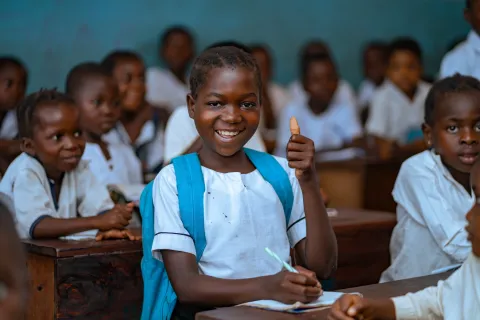
“I wanted to be a school brigades leader because I like being a leade. I have friends who were leaders of brigades in other schools and I wanted to be like them. I have been elected school brigades leader 2 years running", says Hélène Liyongo, proudly, a year 6 student at Mboboto Primary School in Mbandaka.
"As leader of the school brigades, I ask the other students who are brigade members to pick up any paper lying around on the ground, to cut down any tall grass growing in the playground and to clean the toilets. Also, I personally check that all the students wash their hands before eating. I have authority so the students listen to me!"

Mboboto Primary School has held its status of Healthy School since 2013. Today, it is one of 72 schools who have earned the title in Equateur Province. “In order to obtain this title, it was necessary that at least 80% of the students had access to drinking water, used hygienic toilets and knew the principles of hand washing,” explained Thérèse Lomboto, School Head. In return, UNICEF has constructed a well, toilets and washbasins at the school.
UNICEF has also given the school sanitation kits containing dustbins, wastepaper baskets, rakes, wheelbarrows and brooms together with health education manuals for each class. This equipment is managed by the school brigades with the aim of empowering the children themselves to take charge of the sanitation of their environment.

”Many things have changed since the school joined the ‘healthy schools’ programme. Before, we had a great deal of absenteeism attributable to a lack of hygiene. Some fifty students would abandon their schooling over the course of a year due to illness. Now, we start the year with 400 students and we finish it with 400 students! The system works so well that a good number of students take the hygiene practices home with them. For example, many of them have introduced a means of handwashing at home,” says the head, smiling.

Reinforcing hygiene has also contributed to academic achievement.
We had between 50% and 60% success in the state exam but now we are 80% successful!