Charles, Naomie and Daniel’s journeys of resilience
In South Kivu, children formerly associated with parties to the conflict reclaim their childhood

- Français
- English
Charles* was herding goats. Naomie* was collecting firewood. Daniel* was walking home. In a matter of moments, their childhoods were stolen. Abducted by armed groups, they spent weeks and months in the bush, used for different purposes and separated from their families and communities, affecting their well-being and their lives.
Today, they are back in school and are slowly rebuilding their lives. Thanks to the mobilisation of community-based child protection networks, they are reclaiming, day after day, safety, dignity and hope.
Since resuming his education, 16-year-old Charles arrives early at school each morning, eager to see his classmates again. In mid-2024, while herding goats with his brother, he was abducted by an armed group and taken deep into the bush.
“They pointed their guns at me and ordered me to follow them. They told my little brother to go home,” he recalls.

At the camp, Charles joined other children and was assigned daily tasks. “We had to clean clothes and shoes and later stand at the barriers to collect money from drivers. Sometimes we had to take things from people passing by when we were told to,” he explains.
After several weeks, awareness-raising campaigns carried out by community leaders, supported by UNICEF’s implementing partners and the Community-based Child Protection Network, helped secure his release. Charles was reunited with his parents and younger brother and received psychosocial support for supporting his social reinsertion into his community.
The first months were difficult. When he returned, his friends were afraid of him. “They thought I had become violent, and it wasn’t entirely wrong,” he says. “But thanks to the counselling sessions, I became calm and respectful again, and I started playing with my friends and going back to school.”
Now in his third year of secondary school, Charles enjoys spending time with his two closest friends. “Their presence helps me feel like a normal child again: free and happy.”

In her classroom, 14-year-old Naomie* carefully writes the conjugation of the verb “to be” on the blackboard. For her, returning to learning is not just about lessons, but about finding her way forward.
Last year, Naomie was abducted by armed men and taken about 25 kilometres from her village. There, with other children, she was forced to cook and carry out household tasks.
After one month, Naomie and several other children were released. Reunited with her family, she received psychosocial support through group activities and individual counselling to help her social reintegration. Returning home did not immediately erase the trauma.
“At first, other children were afraid of us. I felt isolated. Everyone saw me as a dangerous girl in the village,” she says. “But my family gave me the strength to believe that things would get better.”
Today, she is back in school, in the eighth grade of secondary education. “I feel very positive now. I go to school, I have made many new friends, and even people in the village are starting to respect me again.”
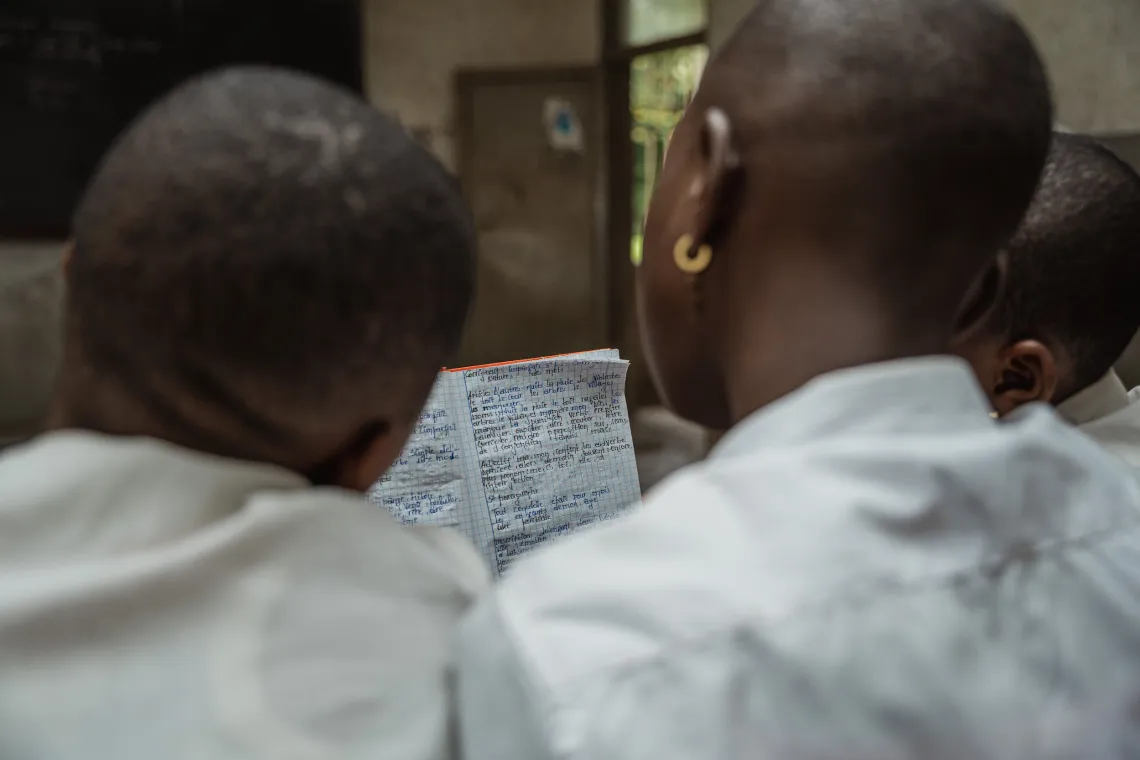
In class, Naomie is always surrounded by her friends. “Since last year, we’ve been sharing the same desk. She’s very smart, always smiling, and often helps me in class,” says one of them.
Across South Kivu, hundreds of children have endured similar experiences. The resurgence of armed conflict has deepened an already fragile and protracted protection crisis, leading to repeated and massive displacements, and exposing children to grave violations, including recruitment and use by armed groups and sexual violence.
Through MONUSCO’s programmatic funding, UNICEF contributes to the implementation of the United Nations Support Plan for the disengagement of MONUSCO in South Kivu, ensuring that child protection services continue throughout this transition period.
Thanks to this support, more than 400 children formerly associated with parties to conflict have received transitional care and support for family reunification and community reintegration.

One of them is 14-year-old Daniel*. In his classroom, Daniel leans over his notebook, carefully taking notes. Concentrated and determined, he dreams of becoming a pharmacist.
Abducted just few meters from his home, Daniel spent several weeks in a forest armed group camp, where he guarded traditional medicines and helped collect money at checkpoints. Released following advocacy by community leaders, he returned home and received psychosocial and educational support, along with other vulnerable children at risk of the communities.
“I attended several support sessions in a safe space. My family and some of my friends also played a big role in helping me,” he explains.
Back in school, Daniel discovered a passion for chemistry. “I want to learn how medicines are made and I want to become a pharmacist to help others.”
* All names have been changed to allow children to rebuild safely their lives. In 2025, more than 5,350 children associated with parties to conflict in eastern Democratic Republic of the Congo were supported with the help of key partners, including the European Union (ECHO), the U.S. Department of State’s Bureau of African Affairs, the United Nations Peacebuilding Fund (PBF), MONUSCO, as well as the Governments of Canada, France and Norway, alongside KOICA and Sida.