New horizons for digital learning in Bhutan
What happens when digital learning becomes a door to a whole new world of possibilities?

With integrated lessons, teacher training and access to digital learning platforms, children in Bhutan are not just learning English, they are discovering confidence, curiosity, and a whole new world of possibility.
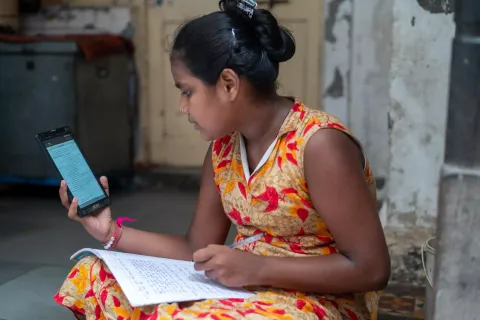
For nine-year-old Mahesh Adhikari, that moment of discovery came last year when UNICEF delivered 39 digital tablets to his school that were preloaded with high-quality digital learning software. Until then, Mahesh’s dream of exploring different worlds and cultures felt far out of reach. Suddenly, with a swipe and a tap, he was connected to stories, songs and games in English – a language his parents don’t speak, but one that could get him to the places of his dreams.

Teachers at Tashithang Middle Secondary School quickly saw the change in learning outcomes. With training and tools provided by UNICEF and the Akelius Foundation, they began weaving technology into lessons.
The Akelius Digital Learning Course, designed to help children master language skills, gave students who speak the local Lhotshamkha dialect at home a chance to practice English in a fun, self-paced way. Currently operational in 17 countries, the course is accessible via computers, tablets and smartphones – both online and off.
“They struggle because they cannot understand our instructions in English,” says teacher Boley Raj Rai. “But now, they want to learn on their own. Their confidence grows every day.”
Another teacher, Tshering Samden, noticed a shift in classroom energy. “Earlier they were shy and hesitant. Now they follow instructions better, even in regular classes.” The new tool gives them courage to try without fear.


For Mahesh, the game is a challenge he loves. He aims for five stars in every activity, pushing himself to master each task.
For ten-year-old Pema Om Ghalley, the songs are her favourite. “What do you see?” and “What do you eat?” may sound simple, but they teach her the building blocks of inquiry, the art of asking questions, and the skills to look for answers.
“At first, the children were afraid to press anything on the tablets. Now, they don’t want to stop,” says Samden.
Bhutan is a country where English is the medium of instruction but not the language of home. For many children, this initiative is their first chance to practice and play with the English language and their first encounter with digital technology.
The impact is already visible: more participation, greater confidence, and more joy in learning. And while it’s too early to measure long-term outcomes, one thing is clear: that technology is transforming classrooms into spaces of possibility, and, somehow, creating space for new learning opportunities in other areas.
UNICEF’s vision is simple yet profound. Equipping teachers, schools and governments with the tools they need go beyond digital as usual to prepare today’s children for the bold new world of the 21st century. In Bhutan, that vision is taking root in the hands of children like Mahesh and Pema, who are not just adapting to change, but learning to shape the future.