

EdTech for Good Framework 2.0
Evaluating and designing responsible digital and AI-enabled tools for learning and teaching

The EdTech for Good Framework V2.0 offers a structured, evidence-based way to assess whether digital and AI-enabled tools are transparent, safe, educationally sound, contextually appropriate, and accessible. As a global public good, it is a structured in a way to build and interpret an evidence portfolio related directly to teaching and learning environments.
AI-enabled EdTech tools have the potential to transform education at scale: supporting teachers, personalizing learning, expanding access, and helping young people develop the competencies needed for work and life in a rapidly changing world. As the technology evolves rapidly, decision makers and technology leaders alike need support to establish effective guardrails, establish clear norms and technical guidelines based on human-centred and equity-driven design principles, and identify effective and impactful AI-enabled tools that empower teachers, enrich learning and improve learning outcomes.
What is the EdTech for Good Framework 2.0?
The EdTech for Good Framework, launched in 2024, was developed by UNICEF with its strategic partners, the Ministry for Foreign Affairs of Finland, the Asian Development Bank and Arm. Version 2.0 builds on lessons from applying the framework to evaluate more than 1,400 EdTech tools, as well as a comprehensive review process incorporating over 900 inputs from 141 organizations across 60 countries.
The updated framework also helps users better understand the organization behind an EdTech product or service, its intended purpose, its suitability for responsible and safe use in education, and whether claims about the product are supported by appropriate evidence.
A structured evidence portfolio
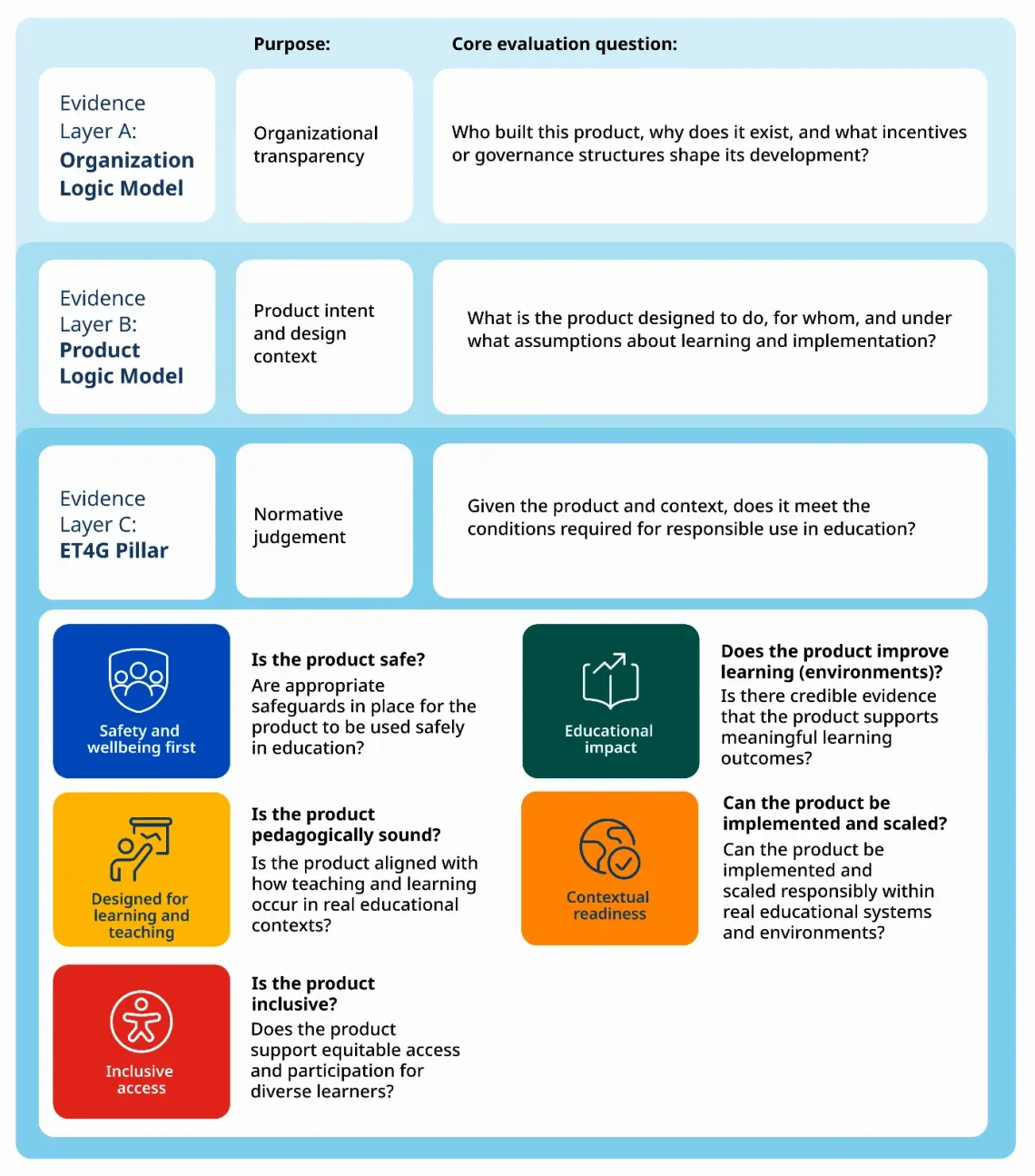
The V2.0 of the framework represents a comprehensive evidence portfolio and is organised in three layers. These three layers gather information in a targeted way around three main question areas:
- Who is behind the product? What incentives guide its development?
- What is the product intended to do?
Is the product appropriate for responsible use in education? This third layer helps to define what it means for a tool to be designed for good within an educational environment through five focused pillars that make explicit the conditions under which EdTech can be considered safe, equitable, contextually appropriate and beneficial for children and education systems. Together, they ensure that equity, gender equality, local relevance and implementation conditions are treated as core dimensions of EdTech quality, rather than as secondary considerations.
Who the framework is for
The EdTech for Good Framework may be used for different purposes by different stakeholders. Whilst evaluation is a central use case, the framework can also be used earlier in the product lifecycle to guide design, inform transparent communication, facilitate public-private dialogue or prepare for procurement processes.
Assessing AI-enabled tools
Within the EdTech for Good framework, nearly 40 guiding questions are classified as AI-relevant. In this way, AI considerations are evaluated within the full context in which technologies operate in education, rather than being treated as an isolated technical layer.
How to adopt and adapt the framework
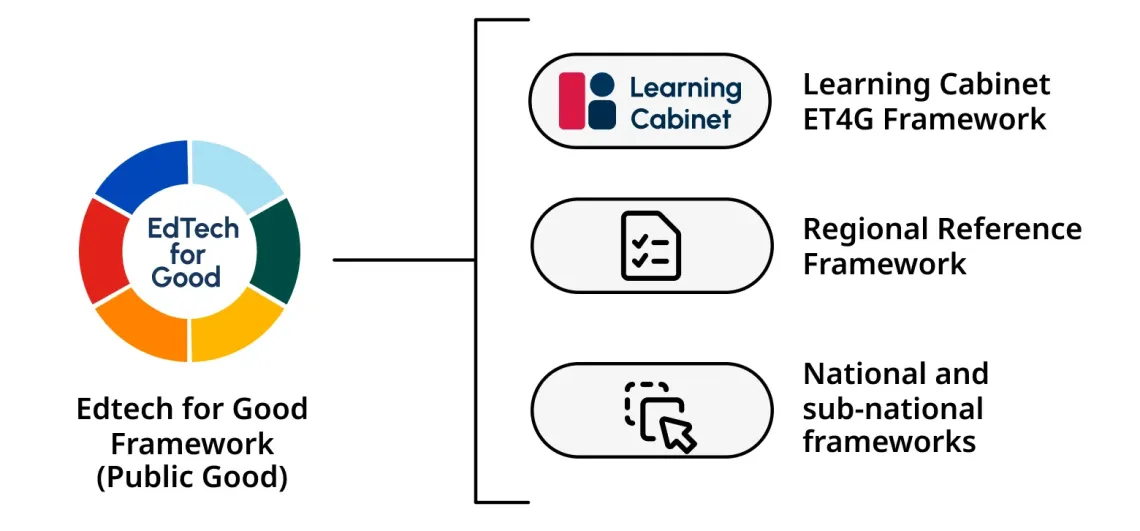
The EdTech for Good framework is provided as a public good licensed under a Creative Commons license and is designed to be adapted to local needs and contexts. It can be adapted by governments and partners to inform the development of national EdTech standards, EdTech evaluation frameworks, procurement processes, quality assurance mechanisms and responsible EdTech development on a global, regional or national level, or assess a specific technology area. Adaptation can address different needs regarding evidence thresholds, knock out criteria, scope of evaluation, scoring models and minimum requirements. Adaptation is intended to increase the relevance and usability of the framework across diverse contexts and purposes.
A growing community
Version 2.0 is endorsed and adopted by a growing number of organizations in a shared commitment to greater transparency, accountability and impact.
Become an endorser
Organizations engaged in EdTech implementation, evaluation, investment, or standard-setting are invited to endorse the Framework.
By endorsing, organizations commit to:
- Promoting its principles and values
- Using it, where relevant, in assessment, procurement, investment, or implementation processes
- Contributing to more transparent, evidence-based, and child-centred EdTech ecosystems
Endorsers may be invited to participate in consultations and will be publicly recognized.
Terms:
- UNICEF may display the organization’s name and logo (subject to due diligence)
- Endorsement does not constitute a formal partnership
- Use of UNICEF’s name or logo is not permitted outside approved materials
Other ways to engage:
- Apply the Framework in research, procurement, or due diligence
- Adapt it for regional or national use
- Join the community of practice
Become an endorser or provide feedback by contacting the EdTech for Good team.
News
Creative Commons

EdTech for Good Framework 2.0 © 2026 by UNICEF. Creative Commons Attribution 4.0 International