

Blue Unicorn Portfolio
Accelerating and scaling EdTech solutions with potential to reach 100+ million children worldwide
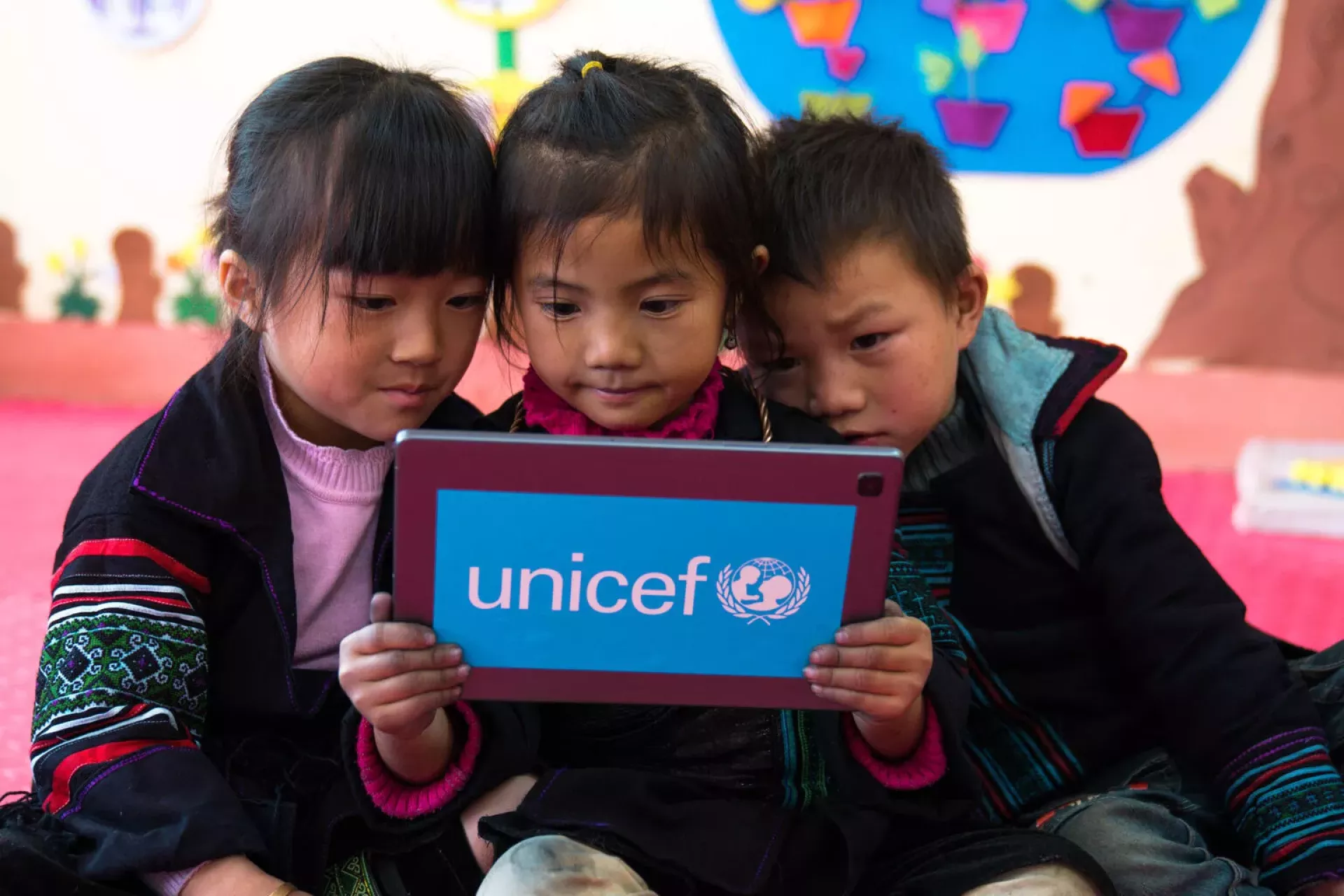
The Blue Unicorn Portfolio translates standards and curation into action by supporting high-potential digital learning solutions to reach scale and measurable impact.
Launched in 2024, the portfolio targets learning innovations capable of reaching 100 million learners and addressing critical gaps in foundational learning, inclusion, teacher support and future skills. Following a rigorous selection process, the first cohort was onboarded in April 2025.
What is the Blue Unicorn Portfolio?
Guided by UNICEF’s Digital Education Strategy and the EdTech for Good Framework, the Blue Unicorn Portfolio identifies, supports, and accelerates proven EdTech solutions that demonstrate clear evidence of improving student learning. Selected solutions receive dedicated acceleration support, field implementation opportunities, and readiness for multi-country implementation. These will be implemented through governments, UNICEF's Country Offices, and local and global partners, ensuring both scalability and sustainability.
In parallel, UNICEF provides tailored acceleration support to portfolio companies, helping them strengthen scalability in low-resource contexts. These improvements are benefiting not only UNICEF programmes but also the broader user base of these solutions, now reaching 12+ million learners globally.
Outcomes
- 7 tools are being implemented across 15 country deployments
- Implementations are led by Ministries of Education and UNICEF Country Offices
- Each deployment is paired with independent third-party research to measure learning outcomes
- Offline functionality and device-sharing features
- Low-resource AI-enabled teacher supports
- Improved pedagogical guidance models
- Strengthened delivery and staffing models
Resources
How it works
The Blue Unicorn Portfolio follows three key steps to scale impactful EdTech solutions:
1. Screening
Solutions are first assessed through UNICEF’s Learning Cabinet using the EdTech for Good Framework, focusing on safety, inclusivity, and proven impact.
2. Portfolio Selection & Matching
UNICEF and country governments select cohorts of solutions that address key programmatic bottlenecks in areas such as foundational learning, teacher skills and shortages and future skills.
3. Pathway to scale
Selected solutions, matched with countries, enter a two-phase journey:
- Model for Scale (3–6 months): Small scale implementation in 1-2 new contexts
- Accelerate (8–10 months): Large scale implementation in one or more countries
- Throughout the journey, the acceleration is supported with mentoring, business modeling and evidence-generation.
Scaling
- Eduten expanding to nationwide implementation in Bhutan with government funding (34,000+ learners), while being rolled out to more schools in Lao PDR and Uzbekistan as part of the acceleration following the pilot in 2024
- Matific moving into acceleration in Honduras and Ukraine, with potential to reach 800,000 learners
- Eidu being explored for large-scale adoption in Indonesia
- Portfolio expansion underway across Europe, Asia, and Latin America.