From prompts to simple applications: school students can explore AI through a new course developed by UNICEF and the Ministry of Education and Research
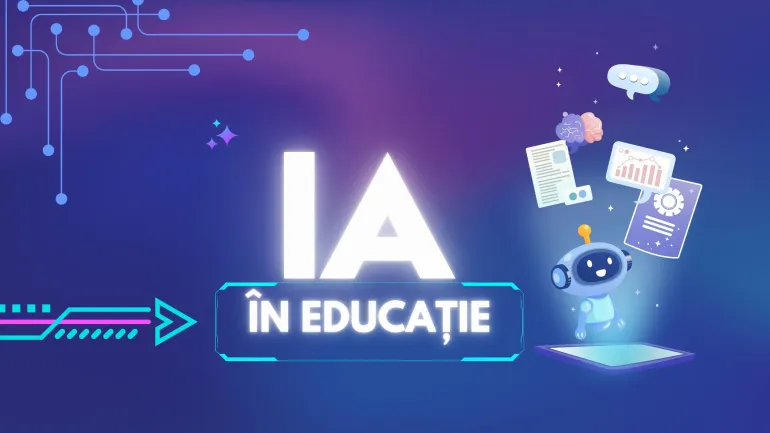
Artificial Intelligence can be a useful support tool at school: it can explain a lesson, help pupils revise for a test, organize their ideas for a project, or even create simple applications. But, like any tool, what matters is how it is used.
In this context, UNICEF, together with the Ministry of Education and Research, with financial support from the Global Partnership for Education, has developed a course on Artificial Intelligence for lower and upper secondary grades. The course shows how AI can be used safely, responsibly and creatively.
The course includes 26 practical lessons and starts from essential questions for pupils: how AI works, what it can do, what its limitations are, and how information generated by these tools can be verified.
A key focus is placed on using AI as a personalized tutor. Pupils can discover how to receive step-by-step explanations, practise school subjects, generate revision questions, receive examples and identify more easily what they still need to learn.
The course also helps pupils organize and visualize information more clearly, using AI tools to turn complex concepts into mind maps, infographics, presentations, flashcards, quizzes and summaries that are easier to follow and remember.
The course also includes a hands-on digital creation component. Pupils learn how to use AI to build simple tools that can support their learning, such as a Pomodoro timer, an exam grade calculator or an interactive quiz. In this way, AI becomes more than a source of information: it becomes a tool that helps pupils create, test ideas and develop their own projects.
Online safety and the responsible use of technology are central themes of the course. Pupils learn how to protect their accounts and personal data, how to recognize incorrect or incomplete information generated by AI, and why it is important to check sources before using an answer.
At the end of the course, pupils are invited to create their own ethical code for using AI, a set of principles to help them use technology correctly, safely and responsibly, both at school and in everyday life.
Through this course, UNICEF and the Ministry of Education and Research encourage pupils to explore Artificial Intelligence as a support for learning, not as a shortcut. When used properly, AI can help pupils understand better, learn in a more organized way, develop critical thinking and create with greater confidence.
Explore the course on Artificial Intelligence and discover how you can use AI safely, responsibly and creatively, at school and in everyday life.
Media contacts
About UNICEF
UNICEF promotes the rights and wellbeing of every child, in everything we do. Together with our partners, we work in 190 countries and territories to translate that commitment into practical action, focusing special effort on reaching the most vulnerable and excluded children, to the benefit of all children, everywhere.
For more information about UNICEF and its work for children, visit www.unicef.org
Follow UNICEF on Twitter, Linkedin and Facebook