More than numbers: the stories behind immunization in Cuba
Nurse Kenia Carredano has transformed the vaccination clinic at the "28 de Enero" polyclinic into a space of care, trust, and education

- Español
- English
There is a quiet and confident atmosphere in the vaccination waiting room at the 28 de enero Polyclinic Center in Havana’s Playa municipality. One-year-old girls and boys, along with their parents, wait to receive one of the vaccines included in the national immunisation schedule: the MMR, which protects against mumps, measles and rubella (MMR). All eyes are focused on nurse Kenia Carredano Llerandi, who, with more than two decades of experience, has become a familiar and beloved face in the community. She, with her close and professional manner, guides each family through a process that goes far beyond a simple jab: it is an act of protection and love, fundamental for children’s health.
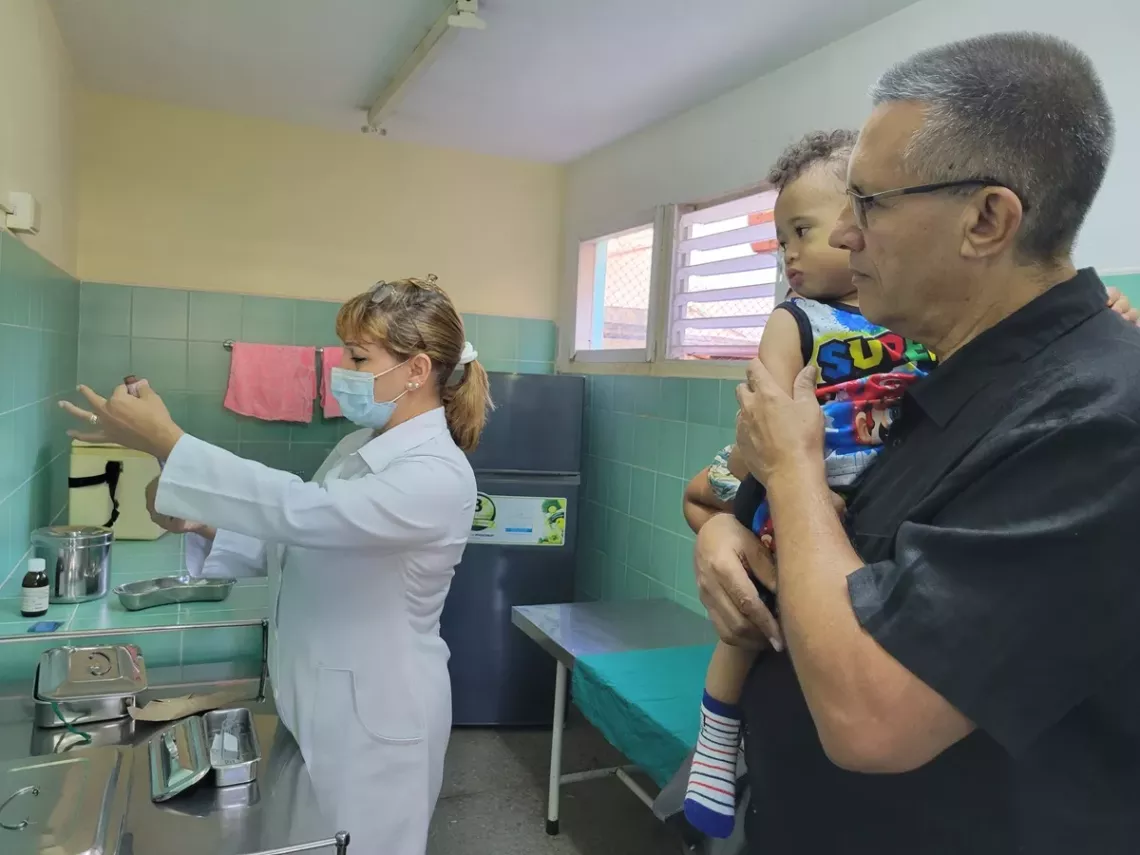
“From the prenatal stage, the vaccination schedule is explained to the family, both in the maternity hospital and at the doctor’s office,” says Kenia as she writes down the date on the vaccination card of one-year-old Thiago, who will receive the MMR. Each child arrives with a doctor’s order, and before administering the vaccine, Kenia conducts a careful interview with the family to ensure that they are in optimal health.
Kenya stresses the importance of involving mothers, fathers and other family members in the process. “They see that all the material is disposable and safe, that we safeguard the cold chain of the vaccines and they trust what we are doing,” she says. Her approach not only reinforces the safety of the vaccination system, but also builds mutual trust.
Every month, between 200 and 300 children pass through the polyclinic’s vaccination centre to receive a dose of the vaccines included in the national schedule.

Safety and confidence: the experience in the vaccination centre
Alberto Salazar, Thiago’s father, watches carefully as Kenia prepares the MMR vaccine dose. Next to him, Yadira Mora, Thiago’s mother, caresses her son. “I feel very calm and confident bringing the child to receive the MMR vaccine,” says Alberto. He deeply values the constant interaction with Kenya, her willingness to clarify doubts and her focus on parenting education. “It is reassuring to know that there are places like this, where one as a parent can be sure that our children are being cared for in the best way.”
Brenda Fernandez, Valeria’s mother, shares similar feelings. “I brought my daughter here today because I know how important it is to protect her against diseases like mumps, rubella and measles. I want to make sure she is protected,” explained Brenda while holding her little girl in her arms because, although she is taking baby steps, she is not yet walking. Brenda stresses that Kenya’s detailed guidance has given her the reassurance she needs. “Knowing that the possible adverse reactions of the MMR vaccine are mild gives me even more security. I am also happy to be looking after her long-term health.”

MMR vaccine, a cornerstone of child health
The MMR vaccine –first dose at 12 months of age and a second dose at 6 years of age– protects against three highly contagious diseases.
Kenya stresses the importance of following the recommended vaccination schedule and reminds us that while mild reactions, such as fever or rashes, may occur, the benefits of immunisation far outweigh any risks. “I always stress the importance of not giving medication after vaccination without consulting a health professional.”
UNICEF and its historic support for vaccination in Cuba
Since 1992, UNICEF has been a strategic partner of Cuba’s Expanded Programme on Immunisation (EPI). Over the past decades, this support has been shown in procuring cold chain equipment, essential medical supplies such as syringes and safety boxes, and strengthening health professionals’ technical capacities.
One of the most significant contributions has been the annual purchase of between 70,000 and 100,000 doses of MMR vaccine, which is not produced locally. In 2024, UNICEF Cuba procured 94,000 doses, enough to cover all one-year-old children in the country. This support ensures no child is left without the necessary protection against measles, mumps and rubella.

The dedication of Kenya and the team at the 28 de enero Polyclinic Center reflects their commitment to children’s health in Cuba. Alberto and Brenda, like many other families, find in this vaccination centre not only a place where their children are vaccinated, but also a place of care, trust and education. In a world where child vaccination coverage faces constant challenges, Cuba’s example and the work of professionals like Kenya stand as a model to follow in the struggle to protect future generations.