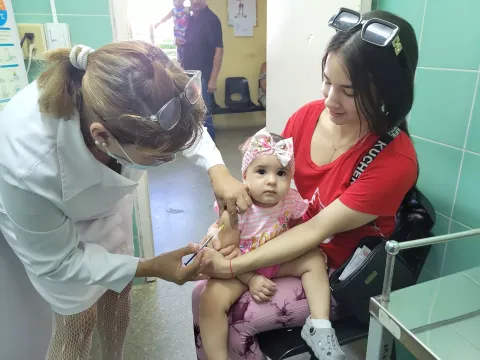
UNICEF supports the national workshop on vaccine-preventable diseases
Cuba stands out in Latin America and the Caribbean for maintaining more than 98 percent vaccination coverage nationwide

- Español
- English
HAVANA, 15 July 2024 - The Cuban Ministry of Public Health (MINSAP), with support from the United Nations Children's Fund (UNICEF), held a national workshop on vaccine-preventable diseases, a pivotal meeting to strengthen the country's Expanded Programme on Immunization (EPI).
The workshop brought together provincial and municipal heads of the EPI, as well as officials from the Pedro Kourí Institute of Tropical Medicine, medical assistance and the Finlay Vaccine Institute. During five days of work, participants analysed vaccination coverage, evaluated compliance with surveillance indicators for the different vaccine-preventable diseases and received training in the detection, classification and follow-up of adverse events caused by vaccines; they also addressed the challenges and preparedness of personnel for the introduction of new vaccines, such as pneumococcal vaccines.
A recent World Health Organization (WHO) and UNICEF report showed that global childhood immunisation coverage stagnated in 2023. Thus, the number of unimmunised or under-immunised children will increase by 2.7 million compared to pre-pandemic levels in 2019.
These trends show that global immunisation coverage has remained largely unchanged since 2022 and reflect the continuing challenges posed by disruptions to healthcare services, logistical challenges, vaccine hesitancy and inequities in access to services.
Cuba stands out in Latin America and the Caribbean for maintaining vaccination coverage of over 98 percent nationwide. Its achievements include eliminating diseases such as diphtheria, measles, mumps, rubella, polio and whooping cough. This contrasts with the trend reported in UNICEF’s State of the World’s Children 2023 report, which shows a decline in child immunisation rates in the region.
Sunny Guidotti, UNICEF Deputy Representative in Cuba, highlighted the importance of the event: “This workshop represents an invaluable opportunity to exchange knowledge, share successful experiences and address common challenges. We hope that they will strengthen their capacities and that we will explore new ways to support the country's Expanded Programme on Immunization,” she said.
Meanwhile, Dr. Carilda Peña García, Vice Minister of Public Health, thanked UNICEF for its continued support in this area: “UNICEF's collaboration has been fundamental in the acquisition of the vaccine against measles, mumps and rubella (MMR) and in the strengthening of the cold chain, crucial elements in our vaccination strategy,” she said.
UNICEF has supported the EPI since 1992 to eliminate and prevent vaccine-preventable diseases. The actions undertaken include the acquisition of cold chain equipment, which is indispensable for the proper conservation of vaccines; essential medical supplies for vaccination, such as syringes and safety boxes; and the strengthening of technical capacities of health professionals linked to the vaccination process.
Since the 2000s, UNICEF has contributed to the work of the EPI through the annual purchase of between 70,000 and 100,000 doses of MMR vaccine, which are not produced in the country. In 2024, with the purchase of 94,000 doses of this vaccine, UNICEF Cuba contributes to reaching all children at the age of one year in the country and protecting them against measles, mumps and rubella.
Media contacts
About UNICEF
UNICEF promotes the rights and wellbeing of every child, in everything we do. Together with our partners, we work in 190 countries and territories to translate that commitment into practical action, focusing special effort on reaching the most vulnerable and excluded children, to the benefit of all children, everywhere.
Follow UNICEF Cuba on X, Facebook, Instagram, Threads, YouTube, LinkedIn, WhatsApp and Telegram