More than 113,000 students in Croatia benefit from the PoMoZi Da program
Croatian Institute for Public Health and UNICEF presented results of PoMoZi Da program, involving over 900 schools
- Hrvatski
- English
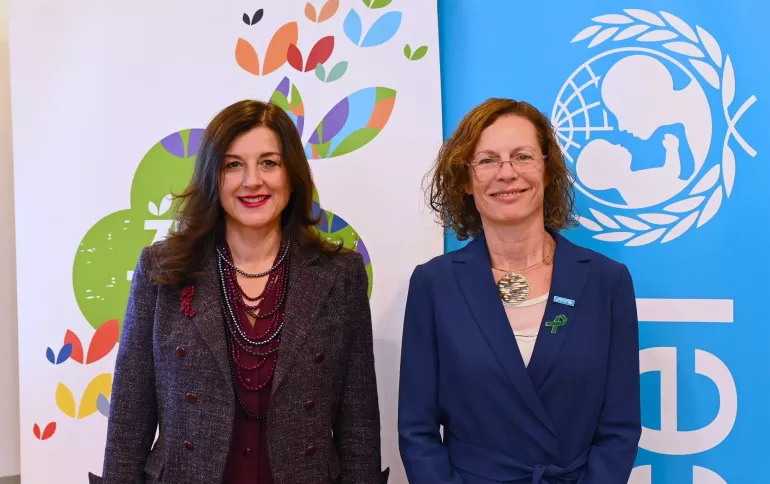
Zagreb, October 10, 2024 – In observance of World Mental Health Day, UNICEF Office for Croatia and the Croatian Institute of Public Health (CIPH) presented the results of PoMoZi Da, the first standardized program for mental health literacy among teachers and educators at the Hospitality and Tourism School in Zagreb.
The PoMoZi Da program was developed as part of HZJZ's National Program Living Healthy and is based on World Health Organization recommendations and findings from a national survey on the health literacy of educational professionals regarding children and adolescents' mental health. Through the program, teachers, educators, and other professionals in schools develop skills in providing psychological first aid, to strengthen them to better recognize mental health issues, offer initial support to pupils and students showing signs of psychological distress, and encourage them to seek professional help when necessary.
“Epidemiological data show that mental health issues among youth in Croatia are extremely widespread. One in four individuals aged 16 has reported having thoughts of self-harm, while one in ten has admitted to attempting suicide. Given the prevalence of this problem, it is crucial to work on strengthening mental health literacy. This is particularly important for educational professionals, who, according to research, largely do not feel confident in their own abilities. The evidence-based program PoMoZiDa, which is present at the national level, is sustainable and has strengthened as many as 1,390 educational professionals to date. This program is immensely important for the prevention of mental health issues and the promotion of health in general. We are glad that UNICEF has recognized this and we thank them for their support and contribution over the past two years”, said Professor dr. Sanja Musić Milanović, M.D., Specialist in Epidemiology.
According to the World Health Organization, 50% of all mental disorders begin before the age of 14. A UNICEF report, The State of the World’s Children 2021 indicated that 11.5%, or about 44,000 adolescents aged 10 to 19 in Croatia, face mental health challenges. Many of them, discouraged by stigma and misunderstanding, often hide their struggles, fearing that their feelings and experiences will not be accepted by friends, teachers, or family. It is the responsibility of adults to support them and provide information, and teachers are primary adults students interact with during their school years. A 2017 CIPH study revealed that 98% of educational professionals are willing to seek help for students with mental health issues, yet 71% feel uncertain about their ability to provide that assistance.
To address this, it is crucial to empower teachers, educators, and school counselors, which is the goal of the successful implementation of the PoMoZi Da program. The program has achieved the following results so far:
- 3,914 educational professionals have completed basic training
- 1,390 educational professionals have completed advanced training
- 902 schools (591 primary and 311 secondary) have joined the program
An estimated 113,500 students have benefited from the program, increasing the likelihood that children with mental health issues are identified within the school setting.
UNICEF has also played a significant role in achieving these results during 2023 and 2024. Funds raised from the Milky Way Race 2022 enabled national program coverage, training for new trainers and educators, and increased the number of teachers and professionals who have participated in the training. Additional modules on psychological first aid for children and youth have been introduced, focusing on trauma, self-harm, and suicide among young people.
“We must recognize the strong impact that mental health issues in childhood and adolescence can have on their future and our whole society. Investing in the mental health of our children today is essential for a prosperous future. When we support them in overcoming mental health problems, we are helping them navigate better through the challenges of life, allowing them to thrive and contribute to their communities. By empowering teachers with the skills to respond to mental health concerns we are creating a supportive school environment where every child can get the understanding they need. Let’s continue working together to ensure that no child or young person has to struggle with mental health problems alone”, concluded Luisa Brumana, UNICEF Croatia Representative.
###
About the PoMoZi Da Program
The PoMoZi Da program is an initiative aimed at improving the mental health literacy of educational professionals to better protect the mental health of children and youth in school settings. Developed within the framework of CIPH’s National Program Living Healthy, it is recognized as an innovative, evidence-based program tailored to the needs of teachers and educators, developed by a team of experts from academia, clinical practice, and the education sector. The program fosters a national network of 3P educators—trained mental health specialists from county public health institutes—who conduct mental health training within their regions. UNICEF Office for Croatia has financially supported the program through donations raised during the humanitarian Milky Way Race from March 2023 to September 2024.
Media contacts
O UNICEF-u
UNICEF promiče prava i dobrobit djece u svemu što radimo. U suradnji s partnerima, radimo u nekima od najizazovnijih dijelova svijeta kako bismo pomogli najugroženijoj djeci na svijetu. U više od 190 država i teritorija radimo za svako dijete, s posebnim fokusom na najranjiviju djecu.
Pratite što radimo za djecu i mlade u Hrvatskoj na našem Facebooku, Instagramu, Twitteru i YouTubeu.