High-level conference aims to accelerate action against child poverty and social exclusion
Joint action for the European Child Guarantee in Zagreb

- Hrvatski
- English
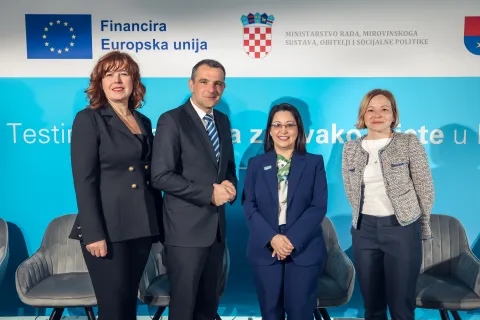
Zagreb, 30 March 2026 — European ministers, senior government officials and other high-level representatives gathered in Zagreb today at the High-Level Conference on the European Child Guarantee, “Accelerating Action for Children in Europe — From Commitment to Implementation”. The two-day Conference aims to strengthen political commitment to reduce child poverty and social exclusion across Europe and ensure that national reforms are fully aligned with the Guarantee.
The European Child Guarantee (ECG) aims to prevent and combat children’s social exclusion through access to essential services for those in need, particularly education, healthcare, good nutrition and housing.
The Conference will share lessons learned from the development and testing of the ECG in seven countries, including Croatia, paving the way for its acceleration across the region.
The Conference was co-organised by UNICEF, the European Commission and the Ministry of Labour, Pension System, Family and Social Policy of the Republic of Croatia.
In addition to the delegation from Croatia, representatives from 15 countries, including 6 EU member states, as well as 9 countries of Southern and Eastern Europe, have travelled to Zagreb to discuss and learn from each other on the potential of the European Child Guarantee.
Highlights of day one (30 March)
The first day of the conference focused on high-level commitments and roadmaps of EU candidate countries and potential candidates, alongside the presentation of the joint EU–UNICEF regional cooperation programme to support the development of robust, evidence based, costed and sequenced ECG action plans and to strengthen governance, financing and monitoring capacities across the participating countries.
Opening remarks were delivered by Majda Burić, Member of the Croatian Parliament and Special Envoy of the President of the Croatian Parliament, Alen Ružić, Croatia’s Minister of Labour, Pension System, Family and Social Policy, Mathieu Bousquet, Director, Directorate General for Enlargement and Eastern Neighbourhood, European Commission (via video message), Tatjana Katkić Stanić, Ombudswoman for children and Regina De Dominicis, UNICEF Regional Director for Europe and Central Asia.

“No child chooses the circumstances into which they are born, but society chooses whether it will provide them with an opportunity for a dignified life and full development. Let this very thought be the guiding thread of today’s discussions and of our future actions. The European Child Guarantee represents a conscious decision by society and policymakers to give children the opportunity for a dignified life and full development. Yet, its true value is measured by the concrete changes it brings to children’s everyday lives,” said Alen Ružić, Minister of Labour, Pension System, Family and Social Policy of the Republic of Croatia.

“Central to the Commission’s enduring commitment is the European Child Guarantee, adopted in June 2021. This initiative provides effective and free access to essential services for children, such as early childhood education, healthcare, nutritious meals and adequate housing. The Guarantee represents a substantial investment in future adults, providing the skills, competencies and opportunities to fully participate in the labour market and society, ensuring that no child is left behind. The European Commission is particularly encouraged by the proactive stance of the candidate countries and potential candidates, who are embracing the European Child Guarantee recommendation ahead of EU accession. Collaborative efforts have been reinforced by the Commission’s guidance and numerous consultations, marking today’s conference as a significant milestone in our shared journey towards social cohesion and inclusiveness. We express our gratitude to UNICEF for their unwavering collaboration in this endeavour,” said Katarina Ivanković Knežević, Director for Social Rights and Inclusion at the European Commission.

“The European Child Guarantee represents a major step forward in ensuring that every child in Europe has access to essential services. Its success will be measured not by plans, but by the real difference it makes in children’s lives — access to healthcare, education and the support every child needs to thrive. UNICEF is proud to work with the European Commission and with governments across the region to turn this commitment into concrete action. Croatia’s leadership, including its strong pilot of the European Child Guarantee, has set an important example for others to follow. Today’s gathering is a chance to build on this momentum and accelerate progress so that every child, wherever they live, has an equal opportunity to grow up safe, healthy and included,” said Regina De Dominicis, UNICEF Regional Director for Europe and Central Asia.

“All children have equal rights, but unfortunately, they still do not have equal opportunities. This is why it is important to develop the European Child Guarantee not only as a concept, but as a shared European value. It is a key tool for all of us to ensure, through thoughtful policies, approaches and concrete measures, that every child receives support in growing up. The Child Guarantee is a tool to help us shape public policies according to the needs of every child. Croatia’s experience shows that, with well‑considered measures and approaches, meaningful progress can be achieved, although we still face the challenge of moving from a general approach to targeted interventions. Today’s conference is an opportunity to share our experience with other countries, to reflect on the effects and, through joint dialogue, define the key priorities that will focus on reducing inequalities and creating equal opportunities for children who are at risk of poverty as well as social exclusion. I see the European Child Guarantee as the foundation for building strong communities of equal opportunities for children,” said Tatjana Katkić Stanić, Ombudswoman for Children.

In her keynote address, Ms Ivanković Knežević emphasised that the European Commission, in its 2026 Work Programme, 'Europe's Independence Moment', aims to further enhance the sustainability, competitiveness and social well-being of the European Union. Building upon the solid foundations laid by previous mandates, this programme seeks to make significant strides in tackling current social challenges. The European Pillar of Social Rights Action Plan of 2021 has seen commendable achievements, notably with the EU well on track to meet the headline employment rate target of 75%. The Commission is poised to build on this momentum by addressing the remaining challenges, including the estimated 93 million individuals still facing the risk of poverty or social exclusion. Addressing the above challenges and acknowledging the dynamic challenges of our times — such as digitalisation, artificial intelligence and the evolving mental health landscape — the Commission will introduce the first-ever EU Anti-Poverty Strategy. This initiative is set to help to eradicate severe poverty by 2050, ensuring adequate access to essential protections and services for all, thereby fostering a brighter future for generations to come.
During the high-level sessions, representatives from candidate countries and potential candidates outlined national commitments, roadmaps, opportunities and challenges in developing or implementing ECG action plans, emphasising the importance of intersectoral coordination and alignment with EU accession priorities.
The organisers also presented the joint EU–UNICEF regional cooperation programme supporting nine participating countries in developing robust, evidence-based, costed and sequenced ECG action plans, and in strengthening governance, financing and monitoring capacities.
The event reaffirmed the role of the ECG Learning Lab, co-hosted by UNICEF Offices in Croatia and Romania in collaboration with UNICEF’s Regional Office for Europe and Central Asia, as a platform for knowledge exchange, mutual learning and coordinated technical support.
Looking ahead to day two (31 March):
Tomorrow’s Conference programme will focus on peer learning and technical exchange among the Child Guarantee national coordinators of the EU member states and representatives of enlargement partners, exploring lessons learned, promising implementation models and monitoring frameworks. Sessions will include deep dives on integrated services, intersectoral coordination, financing as well as the monitoring and evaluation of the ECG, with contributions from ECG coordinators from EU member states and ECG contact points from candidate countries and potential candidates.
###
About the European Child Guarantee
The European Child Guarantee (Council Recommendation 2021/1004) aims to prevent and combat child social exclusion by ensuring free and effective access to essential services for children in need, including education, healthcare, adequate nutrition and housing. Croatia was one of seven EU member states that implemented the 24-month pilot programme, “Testing the Child Guarantee in the EU Member States”. Throughout this process, UNICEF has supported the European Commission and the seven countries in a series of activities at EU-wide, national and sub-national levels.
In July 2023, the Government of the Republic of Croatia endorsed the National action plan to implement the EU Council recommendations on establishing the European Child Guarantee (NAP CG), the main operational tool for improving equal access to key services for children in need, as an important way to prevent social exclusion and poverty in general.

Media contacts
ABOUT UNICEF
UNICEF promotes the rights and well-being of children in everything we do. In partnership with others, we work in some of the most challenging parts of the world to help the most vulnerable children. In more than 190 countries and territories, we work for every child, with a special focus on the most vulnerable.
Follow what we do for children and youth in Croatia and beyond on our Facebook, Instagram, X and YouTube.