Saving lives amid a deadly cholera outbreak.
“Community health workers are the backbone of our response” : Dr. Mahamoud Adam, Chief Medical Officer.

- English
- Français
At the Adré health district in eastern Chad, daily life has changed.
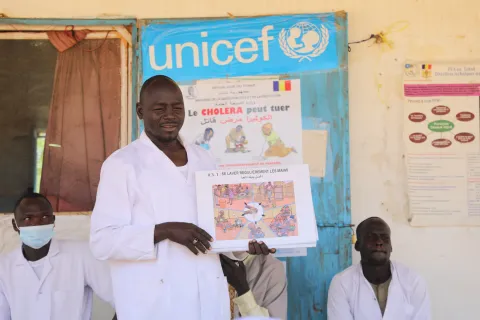
From the very entrance, a new routine is now mandatory: carefully washing hands and strictly remaining within allowed areas. Just a few steps further, a poster clearly reminds visitors of simple yet vital actions to fight a common enemy: cholera.
Inside the district’s cholera treatment unit, vigilance is at its highest.
Here, Fatimé Ketema Ganda, a staff member of the NGO Doctors without borders, and her team stand on the frontlines to save lives.
Since the onset of the cholera outbreak in mid-July in eastern Chad, more than 2,009 suspected cases have been reported, including 133 deaths as of 12 September. In Adré, community resilience is taking shape; as of 23 August, 23 patients had been treated, with 21 recovered, 2 still under intensive care, and no deaths recorded.
“At first, people did not believe cholera was real, which contributed to its spread. Now, patients and their families are testifying to its existence,” says Fatimé.

This resilience in Adré is the result of strong, coordinated collective action. From the first reported cases, UNICEF and its partners, with financial support from the Government of Sweden, the European Union Humanitarian Aid, the Central Emergency Response Fund (CERF), and The Pandemic Fund, joined forces with the Chadian government to act swiftly and save lives.
A risk communication and community engagement plan has been deployed in the affected areas: community volunteers go door-to-door, through streets, households, and markets to raise awareness, reassure, and protect the population. Hygiene kits and water purification products are distributed, and handwashing stations are installed at strategic points. Medicines and other essential medical supplies are pre-positioned in health centers to ensure prompt patient care. To strengthen patient care, UNICEF and NGO Doctors without borders have signed an agreement to ensure access to safe drinking water at the cholera treatment unit in Adré, by connecting its water points to the borehole built by UNICEF within the hospital.
By the end of August 2025, a milestone was reached: a rapid vaccination campaign led by the Ministry of Health and Prevention and its partners succeeded in protecting over 850,000 people in the hardest-hit areas.
At the cholera treatment unit, 52-year-old Issa Adam listens carefully as Fatimé gives her final guidance. Just a few days earlier, he had been fighting for his life. What started as a mild stomachache quickly escalated into severe diarrhea and vomiting, confirming the feared diagnosis: cholera.
Thanks to timely care, Issa is feeling much better. “As you can see, I feel good now,” he says with a relieved smile. Issa recalls drinking water from the Wadi, a nearby stream by his field, just days before the first symptoms appeared.

While healthcare teams work tirelessly to treat patients, the real fight against cholera extends far beyond the walls of health facilities.
Communication and community awareness are critical, and it is thanks to the relentless work of community volunteers that we are able to contain the outbreak here in Adre.
There are 150 community volunteers covering Adré, a city of nearly 526,000 inhabitants. Trained and equipped by UNICEF, these volunteers come from both Chadian host communities and Sudanese refugee populations. “Community volunteers are the backbone of our cholera response; without them, it would be extremely difficult,” Dr. Mahamoud emphasizes.

Among these frontline actors, Jonas and Marie Noëlle are recognized figures in Adré. Using their picture box, they encourage residents to adopt new behaviors to protect themselves. “What we do is for ourselves, our families, and the entire community, to eliminate cholera in Chad,” says Marie Noëlle.


About 130 km from Adré, at the Dougui refugee camp and surrounding villages, the momentum continues. Here, Leila Mohamed Adam, a Sudanese refugee, goes from household to household with her team to decontaminate affected homes and their surroundings.
“We are proud of protecting our community and acting for others; united, we will eradicate this disease” Leila says.
Thanks to this collective mobilization of healthcare workers, community volunteers, and humanitarian actors of all kinds, lives are saved every day despite ongoing challenges. “Our logistical capacity is limited, and human resources are insufficient” says Dr. Mahamoud.


While health authorities and their partners are doing everything possible to contain the outbreak, the fight against cholera is far from over.
To overcome this epidemic, every action must be strengthened and sustained over time, to protect communities and, gradually, eradicate the disease.