In Sarh, a new strategy to vaccinate every child
In Sarh, a new vaccination approach brings health services closer to families and strengthens children’s protection

- English
- Français
On this morning at the “15 Ans” health centre, located in the 15 Ans neighborhood of the city of Sarh, in Moyen-Chari province, Solkem Natacha, the head of the centre, is hard at work. She receives patients, refers them for care, and supervises routine vaccination activities.
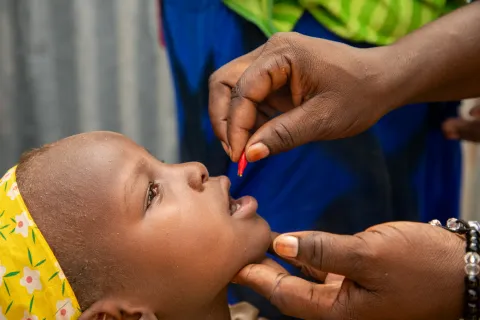
A few months ago, Solkem Natacha was among the health centre managers in Moyen-Chari trained by UNICEF on the “Reaching Every District” (RED) approach. This approach aims to help every district provide regular, accessible, and high-quality vaccination services to sustainably increase the number of vaccinated children. In practice, it enables health workers to travel to reach families living in remote areas and neighborhoods, identify unvaccinated children or those who have missed doses, and encourage community participation through awareness-raising and educational discussions — ensuring that every child, in every district, receives all their vaccines.

For Solkem Natacha, this approach has transformed the way they work. She explains:
“Before, we didn’t look for unvaccinated children. After the training, we started going into the community to identify those who were not vaccinated and to follow up on children lost to follow-up.”
Solkem recalls meeting a mother during a sensitization session whose child had never been vaccinated:
“Her child was showing symptoms of measles and had never received a vaccine. It was only after the awareness session that she understood the importance of vaccination.”
She adds:
“We focus on women because once they understand, they will spread the message within their communities.”
Among the women reached through the approach and who regularly visit the 15 Ans health centre is Tog-Asra Jeanine, a 31-year-old mother of one child.

She shares:
“Before, I didn’t understand why children needed to be vaccinated. I only went because it was required. Today, I know that vaccination protects our children from diseases like measles and polio.”
Tog-Asra, who dreams of becoming a midwife, is committed to spreading the message in her community so that no child falls ill due to lack of vaccination.

At the Bégou health centre, located in another neighborhood of Sarh and also implementing the “Reaching Every District” approach, Kriga Nargaye, the manager of the Expanded Programme on Immunization, has observed an increase in the number of vaccinated children. He notes:
“Mothers now better understand the benefits of vaccination and the risks of not doing it. Every week, we see a high turnout at the vaccination service.”

UNICEF, in partnership with the Ministry of Public Health and Prevention and with financial support from the Republic of Korea, is working to strengthen essential health services, particularly vaccination, and to improve primary healthcare infrastructure so that every child, wherever they are, can access quality health services.
Key areas of support include strengthening the cold chain and logistical capacity for vaccination, implementing the “Reaching Every District” approach to reach all communities, building the skills of community health workers, supporting community-based organizations to boost demand for health services, equipping primary healthcare facilities with essential devices, and improving sustainable access to water in health centers.