All for her pride
The story of a volunteer health promoter’s commitment, set against the backdrop of a measles outbreak in Chad

- English
- Français
Sometimes, tragedies shape destiny. They begin a new chapter and change a mother’s purpose. When Zouleikha Mahamat, 31, rushed her feverish daughter to the clinic, she didn’t know that measles would change her daughter’s life—and quietly change her own, too. Today, Zouleikha is a community health champion in Am Zoer, 70 kilometers from Abéché in eastern Chad. That day, five years ago, became the foundation of a quiet mission: to make her community safer, healthier, and to give the children born here a chance to grow stronger than those who came before.
Am Zoer is surrounded by the vast, sun-bleached plains of the Sahel. It is a place not often seen on maps, nor in most stories, though the history of Chad, for a brief moment, has passed through this place. Many of its residents live in simple homes and rely on pastoralism or small trade. Doubts around vaccination still linger, and illnesses like measles are often treated with traditional remedies first. In this landscape, the local health centre, though modest, plays a vital role, especially in times of crisis. And it is in these moments that people like Zouleikha step in, bridges between tradition and modern care.
“Before, when I talked to people, they didn’t know that diseases like measles could be treated. Children who got sick would either die or become deaf. The perception of vaccination was negative or marked by ignorance. However, people in the community now understand the importance of vaccination, and during campaigns, parents accept having their children immunized,”
she says.
Measles continues to threaten the lives of children in Chad, especially in communities where vaccine coverage remains dangerously low. Only 63% of children receive the first dose of the measles vaccine (MCV1), and just 35% get the second (MCV2), according to WHO and UNICEF estimates. In 2024, the country recorded 1,026 confirmed cases —and in the first four months of 2025 alone, 181 confirmed cases have already been recorded. These numbers are more than statistics; they are a reminder of what’s at stake when children remain unprotected.
Zouleikha’s memory returns to those dark days: the fever, the remedies passed down through generations, the escalation of danger. Then came the sprint to the hospital. A life saved, but not without a cost. Her daughter survived the disease but lost one eye. A capsule of human tragedy and survival that became the soil for something else to grow: conviction.
“At first, I didn’t know that measles was a disease that could be treated,” she says. “I used tamarind juice and other traditional remedies, but when my daughter’s condition worsened, a neighbour advised me to go to the hospital. I was shocked to learn the disease could be treated.”
The experience changed her entirely.
“Before my daughter’s illness, I didn’t know care was available at the hospital, and I didn’t vaccinate my children. But after that experience, I understood the importance of vaccination and made sure my two younger children were vaccinated. This prevented them from being affected during the recent outbreak. It was after my daughter’s illness that I decided to get involved and spread the message to all mothers, so they would agree to have their children vaccinated against measles and keep them healthy,”
says Zouleikha.
It’s an ordinary sunny day, and the weekly market is bustling. In the middle of it all is Zouleikha, wearing her yellow hat and shirt, starting her awareness work as she always does — early. From five to seven in the morning before going to school, and often again in the afternoons when time allows. She works mostly in town, especially on market days, and visits surrounding villages when she can.
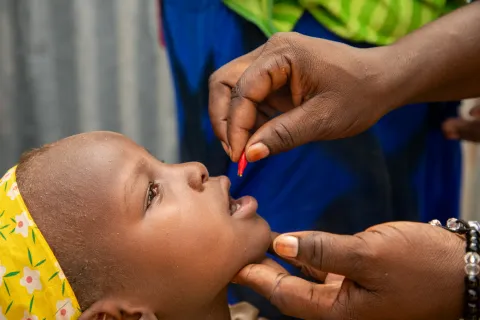
She regularly supports the health centre’s outreach efforts, raising awareness about the importance of vaccination. During every campaign, she’s called upon to speak with mothers and convince them to vaccinate their children against measles, polio, and yellow fever. Occasionally, she borrows loudspeakers from the health centre to amplify her voice.
Her work is entirely voluntary. There’s no compensation, no transport to reach the villages, and limited training. Yet, her commitment is steadfast — and has not gone unnoticed. Her family supports her, as do the health centre staff, the community, and even religious and traditional leaders.
“People now understand the importance of vaccination,”
she says.
“There has been a lot of change. My hope is that through my efforts, fewer children in the community — and hopefully my region — will be affected by measles.”
Among those who support her, one person stands out: her 12-year-old daughter, Loubassa.
“She encourages me and is proud of me. She hopes that, thanks to her mother’s work, other children — including her siblings — will not suffer from measles.”
Every conversation, every campaign, every early morning, it’s all for her pride. And through that pride, the whole community is being protected.
Thanks to the support of key partners such as the GAVI Alliance, the Measles and Rubella Partnership, and others, UNICEF is supporting Chad's Ministry of Public Health in the fight against measles, strengthening immunization systems, and contributing to the protection and saving of countless lives.