Ensuring health, safety, and dignity for refugees, returnees and host communities.
"Everything is clean now. There are no more bad smells, and we feel safe to use the facilities, even at night," says Hadje Adam Ahmit, a Sudanese refugee.

- English
- Français
Originally from El Geneina in the Tendalti region of Western Darfur, Sudan, Hadje Adam Ahmit, 27, left everything behind on the evening of May 7, 2023. That day, her city was attacked by armed men who spread terror and devastation.
"We fled with only the clothes we were wearing and a small amount of savings," Hadje recalls. She, her parents, her three siblings, and around 20 others got into a minibus, not knowing exactly where they were going.
The journey was anxiety-ridden, marked by the constant fear of an ambush. On board, the cries of children and the lamentations of those who had to leave loved ones behind underscored the collective distress. "The atmosphere was very sad, but fortunately, my entire family managed to get on the bus," adds Hadje.
Upon arriving in Adré, a border town in Chad, Hadje, her family, and all the other passengers were directed to a reception center where they were registered. After several days spent in a makeshift tent set up by her family, Hadje decided with her older brother to return to Tendalti to recover some belongings and food. But it was too late. "Everything had been reduced to ashes, and attacks continued in nearby areas. I never want to return there," she confides.
Faced with the precarious living conditions in Adré, where hundreds of Sudanese refugees were already gathering, Hadje and her family decided to move to Farchana, a town about 50 kilometers away. Farchana has been home to thousands of Sudanese refugees since 2004, following the first crisis in Sudan in 2003.
After several months in Farchana, Hadje's family was provided with three small mud-and-straw houses. It was a temporary relief, soon overshadowed by further challenges.
The sanitation situation was dire. "Before the construction of family latrines, we all used communal latrines. They were so unsanitary and poorly maintained that no one in the camp used them anymore, which led many to defecate in the open," Hadje explains.
To address this, UNICEF, in partnership with World Vision, implemented a Community-Led Total Sanitation (CLTS) approach within the refugee camp and the village of Farchana. This approach relies on collective awareness and active involvement of beneficiaries in the construction and maintenance of their own sanitation facilities.
The project was implemented on two levels. In the camp, it sparked community interest and supported them in building 300 semi-durable latrines for about 7,200 people.

Before the construction of family latrines, we all used the communal latrines. They were so unhygienic and poorly maintained that no one in the camp used them anymore, which led many people to resort to open defecation.
In the village, the project encouraged self-construction of latrines by the residents. UNICEF provided technical expertise, and the communities mobilized to construct 1,159 latrines, ensuring each family benefited.
Everything is clean now. There are no more bad smells, and we now feel safe to use the facilities, even at night.
Open defecation remains a public health issue in Chad, where 63% of the population still practices it, leading to significant health, safety, and dignity challenges for communities.
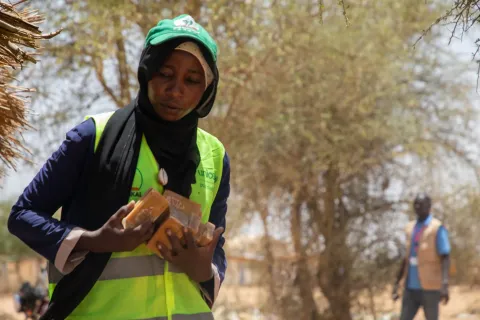
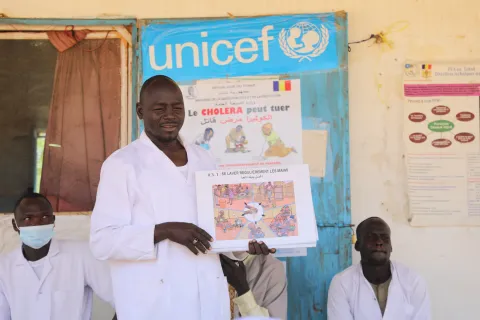
To strengthen the improvement of sanitary conditions, community relays are educating the populations on good hygiene practices. Additionally, UNICEF, in collaboration with World Vision, has distributed essential hygiene kits including buckets, jerrycans, soap, kettles, cups, bleach, and potty training seats for children.
Togoum Davy Diallo, Water, Sanitation, and Hygiene (WASH) officer at World Vision, highlights the importance of this collaboration.

We are working hand in hand to provide concrete solutions for vulnerable populations. This partnership is essential for communities, whether they are refugees, returnees, or locals.
Despite these hardships, Hadje remains hopeful. Before the crisis in her country, she was a student and now dreams of a career in information technology. But beyond her personal ambitions, she dreams of a world in peace:
"People have different cultures, but we must learn to accept each other and live together."
Hadje's journey is one of extraordinary resilience, a powerful testimony to the will to rebuild despite adversity.
Thanks to the financial support from the Government of Japan, the Central Emergency Response Fund (CERF), European Union humanitarian aid, the Government of Sweden and the German Federal Foreign Office, UNICEF and its partners are improving access to clean water, sanitation, and hygiene for refugees, returnees, and host communities in eastern Chad.