In Chad, education support helps vulnerable girls stay in school
As part of the Chad School Reform Programme (PRET), the Ministry of National Education, Bilingualism and Civic Promotion, in collaboration with UNICEF and its partners, is strengthening support for girls’ education to help the most vulnerable children sta

- English
- Français
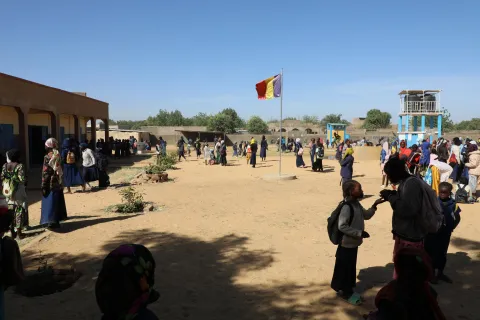
Early in the morning, the courtyard of the school EGTH in Pala, in the Mayo-Kebbi Ouest Province in southwestern Chad, gradually comes to life. Parents and caregivers begin to arrive, exchanging greetings, smiles and conversations. They have all gathered for an important occasion: the distribution of the second instalment of school grants for vulnerable girls under the Chad School Reform Programme (PRET).
For many families, this support provides much-needed relief from the financial burden of schooling. For others, it represents something even greater: an opportunity for their daughters to remain in school, continue learning and build a brighter future.
The goal of this initiative is to accelerate girls’ education, particularly for those from the most vulnerable households. It supports girls' enrolment, retention in school and transition from primary to lower secondary education -a stage at which many girls are at risk of dropping out because of economic and social challenges.
Implemented by the Ministry of National Education, Bilingualism and Civic Promotion in collaboration with UNICEF and its partners and funded by the Global Partnership for Education (GPE), the initiative aims to support 25,000 vulnerable girls in 318 schools across the provinces of Barh El Ghazal, Kanem, Guéra, Salamat, Mayo-Kebbi Est, Mayo-Kebbi Ouest, Logone Occidental, Logone Oriental and Mandoul.


The support is provided through direct cash transfers to beneficiary households. Running until 2028, the programme helps families overcome financial barriers that still prevent many girls from continuing their education.
Following an initial payment made in December 2025, families have been receiving the second instalment since July 2026. Each beneficiary receives approximately 70 dollars per school year to help cover education-related expenses, including school supplies, school uniforms, shoes, enrolment fees and other essential needs.

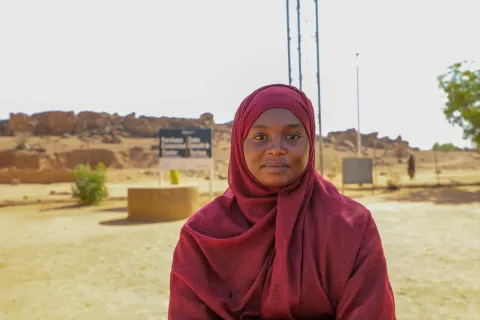
Among the caregivers is 26-year-old Marie Bahane, a Modern Literature student at the University of Pala. As the guardian of her two younger sisters, aged 12 and 13, who both attend school, she says the grant has transformed their daily lives.
Before receiving this support, preparing for the new school year was often a major challenge for the family.
"With the first instalment, we were able to pay school fees and buy school bags, shoes and clothes. It was a huge relief,"
she says.
As the next school year approaches, Marie plans to use the second instalment to further support her sisters, especially the one who will be entering lower secondary school.
"Since one of them is moving to Grade 6, this support will help cover her enrolment, school supplies and the uniforms she needs,"
she explains.
For Marie, the impact of the grant goes far beyond financial assistance.
"The children are more motivated because they have school bags, learning materials and everything they need. Before, some students were enrolled late because their parents did not have the money at the start of the school year to buy notebooks or school supplies. Today, this support is helping them stay in school,"
she says.

A few kilometres from Pala, in the village of Bissi-Mafou, another beneficiary is nurturing a big dream. Fifteen-year-old Deuyikbe Berthe is a Grade 7 student at Bissi-Mafou Secondary School and will move up to Grade 8 at the start of the next school year.
Thanks to the grant received by her parents, Berthe has been able to pay her school enrolment fees and buy textbooks to support her learning, particularly in French, biology and English.
She also chose to invest part of the grant in buying a goat, hoping it will become a small source of income to help meet future needs.
"I am happy to have received this grant. It will help us do something useful and prepare better for school,"
she says with a smile.
Like many girls supported through the programme, Berthe has a clear ambition: to succeed in her studies and become a teacher.
In Pala and across the other participating communities, this school grant represents far more than financial assistance. It is helping remove some of the barriers that prevent vulnerable girls from continuing their education, giving them a greater opportunity to learn, thrive and fulfil their potential.