Strengthened support for epidemic outbreaks in the Central African Republic
A timely Mastercard Foundation investment through UNICEF at a new hospital for major epidemics is helping reinforce the wider system during the mpox epidemic response.

- English
- Français
It has been a busy summer at the recently built Centre Hospitalier des Grande Endémies (‘Hospital Centre for Major Epidemics’) just outside Bangui, the capital of the Central African Republic. In June 2025, the empty modern hospital took up its new role for the first time, serving as a reception centre for suspected mpox cases in the country.
The first patient was the 29-year-old wife of a fisherman who lived on a small river island up country. A hunter had brought infected monkey meat to the community.
“Two weeks after eating the meat, there were the first signs something was wrong,” says her husband Grace à Dieu when we met him in the hospital isolation ward. “There were some swellings around the neck. This was followed by a fever and some lesions on the face. We weren’t at all sure what it was.”
“Some people said it was measles while others said someone was attacking us with black magic. A brother-in-law was visiting at the time and said that it looked like infectious disease that they were being warned about in the city. So we took a motorbike taxi; the driver, me and my wife.”

The case was quickly diagnosed as mpox in Bangui, and they became the first patients isolated at the new hospital.
“With the access to a telephone here we could call family, and soon there were others who were also coming down sick. And others in the family who were not well, came too to be treated. A two-year-old child sadly passed away here with mpox. We are thankful for the food here as it was difficult at home. We hope to heal 100% and then return to our homes and families. The staff are really supportive.”
An mpox epidemic was declared in the Central African Republic (CAR) on 20 July 2024, simultaneously in the Bangui 2 and Bimbo health districts, both densely populated urban areas.
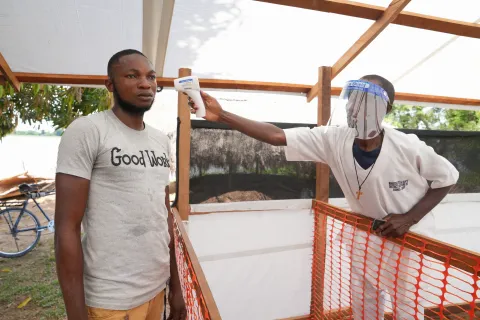
In response, UNICEF, with support from the Mastercard Foundation and from Gavi, the Vaccine Alliance, is upgrading the Centre Hospitalier des Grande Endémies into a safe treatment centre for suspected and confirmed cases. This includes setting up a triage and decontamination area, a visitor area, a waste disposal system and additional latrines.
These measures will bring this healthcare infrastructure up to standard with an adequate isolation system that can be activated immediately in the event of any epidemic.
“The support from Mastercard Foundation has been indispensable for implementing the response to contain the mpox epidemic in CAR, to prevent the spread of the virus and to treat those affected,” says Dr Bruno Aholoukpe, UNICEF CAR’s Chief of Health and Nutrition. “This upgraded healthcare facility, which complies with all relevant standards, will enable cases to be treated in accordance with international standards, ensuring that isolation areas are suitable for children and women, while avoiding the separation of family members, through family-based care.”
The triage and decontamination area will allow much safer reception and management of suspected cases, while a dedicated shelter will provide space for visiting family members. Once fully operational, ambulances will have a dedicated entry point, and contaminated waste disposal will be improved. Two new toilet blocks will also improve hygiene facilities for patients and staff.

Testing the facilities
“When the first patient arrived, they had to quickly work out where in the vast building they would be isolated, and some procedures to build infection prevention and control procedures,” says Dr Paola Demba, who was supervising the ward on the day we visited. At the peak they had 23 patients in the ward, but this has started to go down for now.
“Fortunately, staff had already been vaccinated against mpox beforehand.”
Mpox vaccination began on 18 January 2025, led by the Minister of Health and Population, targeting key workers, in line with international guidelines.
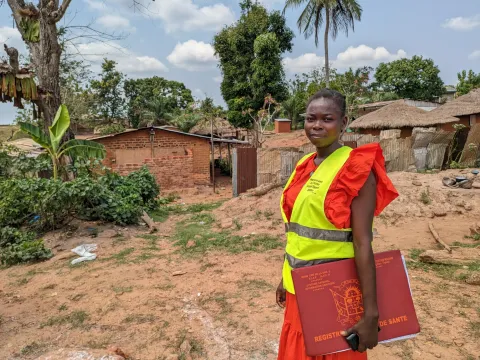
These interventions at the hospital are just one part of the multisectoral response supported by UNICEF through a Mastercard Foundation grant. Alongside case management, the programme is reinforcing coordination, training for health workers, improving water and sanitation, enhancing prevention measures at schools, promoting behaviour change, and advancing child protection.
Aime is a community health worker who helped identify the first cases to the hospital and became infected himself.
“I’m glad there is a facility like this. I didn’t know it existed,” he said. “Without it we would have just stayed in our neighbourhood. I do hope eventually there will be some more equipment. It’s not an easy sickness to have.”
__
Note - UNICEF does not endorse any products, goods, or services.