Preparing for mpox in a fragile health system
UNICEF, the Mastercard Foundation and Gavi are working in the Central African Republic to strengthen health systems against the epidemic

- English
- Français
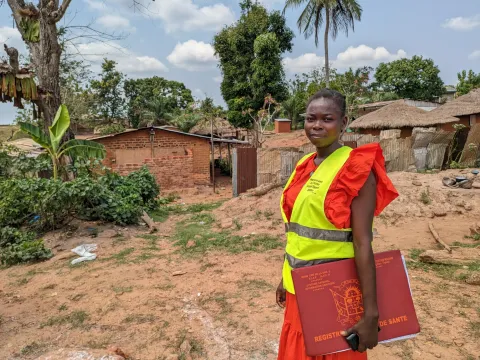
Bertille Yassenga, head of the Ngoulinga Health Centre, five kilometres from the town of Grimari, is all smiles as she welcomes mothers who have come with their children. She and her assistant, nurse Mediatek Yamende, are proud of the service they provide for a population of 7,600 people.
But they haven’t always enjoyed a quiet working environment. At the beginning of the year there was a different atmosphere as people feared a coming m-pox epidemic.
“We had heard that many mpox cases were recorded in our health district, we were worried,” says Bertille. “In January, we were called for a training, where we were taught to identify suspected cases and to put in place measures for prevention. We are happy that, ever since, this threat appears to have become a distant danger.”
The health personnel from the eight health centres of Grimari and Kouango sub-prefectures, plus the two district hospitals, had indeed reasons to be unsettled. According to Dr. Freddo Biguene, Grimari’s District Medical Officer, by December 2024 they had recorded 50 confirmed cases of mpox in their zone, including two deaths. Knowing that “monkey pox”, as it was formerly known, is highly contagious, it was imperative to act quickly and to know what actions to prioritize in a health system with limited resources.
The zone of Grimari and Kouango, in the centre of the Central African Republic, has a population of 175,000. It was one of the areas of intervention for a project coordinated by UNICEF, funded by the Mastercard Foundation with support from Gavi the Vaccine Alliance. When the Ministry of Health and Population, in partnership with UNICEF and the World Health Organization, launched the country’s strategy to stop the spread of mpox, in January 2025, it became clear that all actions had to focus on prevention. The number of vaccines available is extremely limited and reserved only for medical personnel and relatives of suspected cases.

“Every time we had a suspected case, we took a blood sample and sent it to Bangui for testing,” says Dr. Biguene. “We isolated the patients and put them on antibiotics. Luckily enough, they all responded well to the treatment.”
Identifying the suspected cases was made possible thanks to a wide network of community liaison volunteers present in all villages. Training them, as well as all health practitioners, became the priority of the project.
Cyril Ango, a senior nurse in Grimari District Hospital, was one of the first trainees. “We were taught that one of the risky behaviours that favoured the transmission of mpox was eating certain kinds of bush meat, particularly of dead animals that are found in the forests,” he remembers.
Alongside the training, community liaison volunteers undertook a house-by-house information campaign. The more people that knew the main symptoms, the greater the chance that they would raise the alarm if they saw a suspected case. Spots and body rashes could be signs of a possible presence of mpox, as well as of some other diseases, like measles and chickenpox, hence the importance of a quick referral to the nearest hospital for isolation and testing.
At the end of all training sessions, health personnel were given hygiene kits: hand-washing facilities, soap, disinfectants, hydro-alcohol gel, as well as protective equipment for themselves. In total 200 health workers were trained in the prevention of infectious diseases with a focus on mpox, and 25 health facilities equipped with infection prevention and control (IPC) (WASH) kits. In education, 389 students, teachers and parents' association members were also trained in mpox prevention measures and 40 schools provided with WASH IPC kits.
And two power generators were given to both district hospitals, in Grimari and Kouango, to boost their capacity.

In July 2024, the World Health Organisation raised an alert about a significant increase of mpox worldwide, with most cases being recorded in Africa. Countries like the Democratic Republic of the Congo, Uganda and Sierra Leone have seen a quick spread of the disease, with thousands of recorded cases.
According to official data, 512 suspected cases were identified in the Central African Republic, from July to December 2024. Most of these cases were in the Lobaye prefecture, the southwestern part of the country, 91 confirmed. From January to August 2025, there were 427 cases, 28 of which were confirmed. Mbaïki, Bangassou, Sangha-Mbaéré and Kembé-Satéma are now the zones where the epidemic is active, with an average of four confirmed cases every week.

The anti-mpox strategy in Grimari and Kouango was completed with some actions to improve hygiene in the communities, including increasing the number of latrines in villages as well as the rehabilitation of four water boreholes: two in Grimari and two in Kouango.
David Nguerekamba, village chief of the Kassembe 1 neighbourhood, on the outskirts of Grimari, stresses the need to have access to clean water in the fight against diseases: “Last year we were all really scared of mpox. The people from my zone, which includes five villages, had no choice but to use dirty water from the River Labamba. We had an old borehole which had been broken down for years. When they rehabilitated it this year, it was a big relief for all of us.”
Five kilometres away, on the road to Kouango, another borehole was rehabilitated in the village of Oulinga, next to the primary school.
Although health personnel are advised not to let down their guard, a feeling of satisfaction for a job well done seems to prevail these days in Grimari-Kouango.
“For the time being, no new cases have been recorded since February. Barrier measures have worked,” concludes Doctor Biguene.
__
Note - UNICEF does not endorse any products, goods, or services.