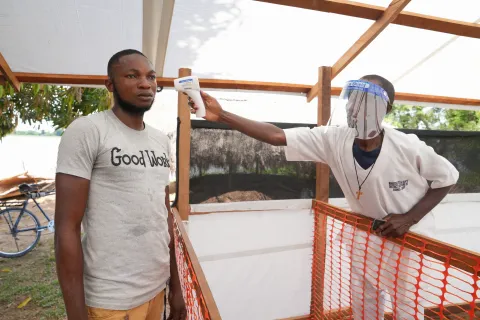
Community health workers improve epidemic surveillance in CAR
In partnership with the Mastercard Foundation, UNICEF in the Central African Republic is helping the Ministry of Health and Population build a strong system to respond to the mpox outbreak and other potential epidemics.

- English
- Français
At 27, Nicole Bazou knows every corner of Mbaïki, her hometown in the Central African Republic (CAR). Twice a week, she slips on her reflective vest, picks up the notebook where she records details of the households she visits, and sets off along the narrow footpaths of the Tipoyeur neighbourhood. There, she serves as a volunteer community health worker.
“I teach people how to prevent the spread of mpox. I also check for suspected cases,” she explains. “Last year, there was only one case, and the patient recovered. It may not seem like much, but if my work has saved even one life, it’s worth it.”
Nicole is one of 70 community health volunteers working in Mbaïki, the capital of the Lobaye prefecture in the south-west of the CAR. According to district health authorities, nearly 800 volunteers are deployed across the entire prefecture. They were trained under a mpox prevention programme led by UNICEF with the Ministry of Health and Population, in partnership with the Mastercard Foundation.

The launch of the mpox vaccination campaign in Mbaïki in January 2025, led by the Minister of Health and Population, marked another important milestone. The vaccine was administered to frontline health workers and to close contacts of people who tested positive.
A strategy combining large-scale community sensitization—both at grassroots level and in health facilities—alongside the training of community health workers, is beginning to show promising results.
At Mbaïki Hospital, supervisor Elisée Voudas points to a tent erected in a secluded area of the compound, set up as an isolation unit for suspected mpox cases.
“The good news is that we haven’t recorded a single case in several weeks,” he says. “As you can see, the isolation ward is empty.”
Yet the partners leading the response remain vigilant. From 21 to 23 January 2026, UNICEF and the Ministry of Health and Population organized a training seminar focused on the importance of mental health during public health emergencies, with particular attention to the mpox outbreak. Medical superintendents from hospitals in all affected districts took part in the workshop.
Meanwhile, community health workers like Nicole Bazou and health professionals such as Dr. Christian Timoro remain alert for any sign of a resurgence. For now, they take cautious comfort in the fact that no new cases are being detected.
UNICEF does not endorse any company, brand, organization, product or service.