A birth certificate. Merlin, acknowledged in CAR
Thanks to a foster family and UNICEF’s support, Merlin, a 3-year old Chadian refugee, gets a birth certificate and can, at last, go to school.

- English
- Français
Few months ago, Fidele Koptar and Prudence, a couple from the Central African Republic with a big heart living in the village of Bemal, opened their home to Merlin, a young unaccompanied boy from Chad.
In 2013, when war broke out, Fidel Koptar ran away from CAR and I settled in Chad. There, he found security, as well as friendship, with a man called Dounde. Ten years later, in 2023, Fidele returned to CAR. In the meantime, the security situation deteriorated in Chad and that very year Dounde fled Chad because of armed conflict. Fidele welcomed him with open arms in his home in Bemal. Dounde didn’t come alone. His wife and their three-year-old son Merlin came with him.
Few months later, as the security situation improved in Chad, the couple returned to their homeland. But Merlin was feeling very much at ease and didn’t want to leave. In Bemal, he found a second family.
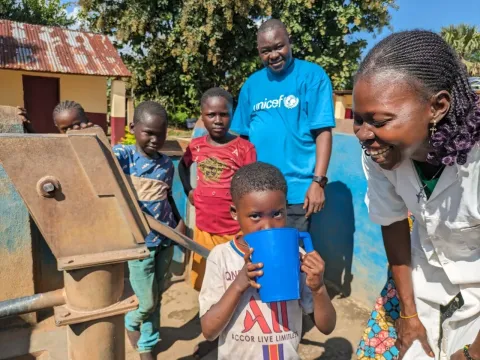
From the beginning, he felt at home. He plays at the UNICEF Child-Friendly Space and considers Davila as her sister
Merlin’s parents accepted. Merlin remained with them. Fidele and his wife, Prudence, a new mission began: to offer him a stable, legal and protected future. As it is the case with many children displaced by conflicts, Merlin doesn’t have a birth certificate.
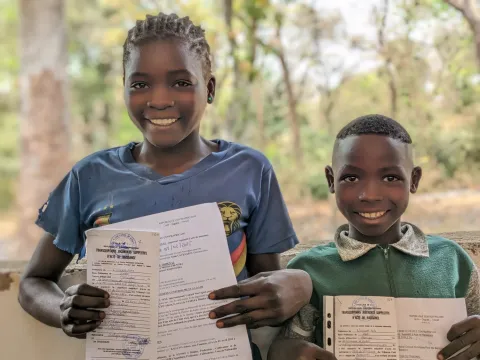
This document is important to have a legal recognition in society. Not having this document becomes a hindrance for their schooling, health care and a legal recognition in society. With support from UNICEF and its local partner Caritas Bossangoa, as well as the UNICEF Spanish Committee, Fidel and Prudence were able to receive crucial administrative support to obtain the supplementary judgement, which is a transcription of the birth certificate.
Thousands of children in CAR never received a birth certificate or lost it during the crisis. Tomorrow its absence will block them from having a certificate of citizenship, indispensable for an identity card or even enjoy their right to vote in an election.
In May 2024, at a ceremony organised by the town council, UNICEF handed 6 000 documents of birth certificates and supplementary judgements to the local authorities of the Prefecture of Lim-Pende, as part of a programme of cooperation CAR-UNICEF 2023-2027. This programme aims at assuring a free birth certificate to every child, aged between 0 and 6 months. And for the ones, like Merlin, who are beyond that age-range or are born abroad, the law foresees the possibility of an administrative appeal via the supplementary judgements.
Even if he is born in Chad, he has the right to a birth certificate, like any other child living in CAR.

Today, Fidele is proud to have been able to offer to an undocumented child a true chance.
Merlin shall join the kindergarten school and begin his educational journey, with an official identity and a loving family by his side.
The story of Fidele, Prudence and Merlin is a poignant testimony of the strength of family unity as well as of the positive impact that actions of solidarity towards the most vulnerable children. We are reminded that, even in the more trying moments, love, compassion and mutual aid make all the difference.
In 2024, in a synergy of action with the government of the Central African Republic, UNICEF supported the birth registration of 40,232 children (39% of girls), of which 9,755 were supplementary judgements (37% of girls) for the cases of late birth certificate regularizations.