Community Engagement Platforms for Education in the Central African Republic Provide an Inspiring Model for a South-South Cooperation with a Government Delegation from Chad
The south-south exchange between the two neighbouring countries, supported by Education Cannot Wait, enables sharing of insights that promote education and learning for children in the central African region.

- English
- Français
BANGUI, 9 June 2025 – The Ministry of Education in the Central African Republic (CAR) showcased its work this week to counterparts from neighbouring Chad, as part of a south-south cooperation to find solutions to get millions more children in education and learning. The community engagement and innovative localization approaches showcased during the week were made possible thanks to the support of Education Cannot Wait (ECW) – the global fund for education in emergencies and protracted crises in the United Nations – in partnership with UNICEF.
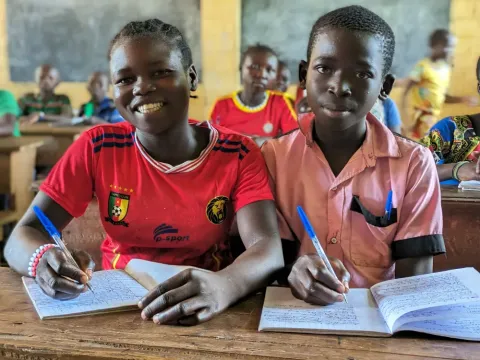
In CAR, fewer than one in three children (27 per cent) complete primary school, and nearly two-thirds of children (63 per cent) do not attend school regularly. The CAR Ministry of Education has identified the engagement of local communities as a key strategy to encourage families to enrol their children and help them stay in school.
“At a time when our education systems are facing multiple challenges, both structural and cyclical, it is imperative to reaffirm the central role of communities in building inclusive, equitable and sustainable schools,” said the Minister of State in charge of Education in CAR, Aurélien-Simplice Kongbelet-Zingas at the opening of the workshop. The five-person delegation from Chad came to exchange experiences and to see first-hand how communities are proving catalytic to reducing school drop-out rates.
The flagship community engagement initiative in CAR uses the ‘Kundukwa’ platforms. What began as a pilot in 20 villages and is now being scaled up to 250 villages after showing strong results. The community engagement approach has facilitated awareness-raising on the right to education for all children, including children with disabilities. It has also led to greater levels of enrolment and retention of children in school, especially girls and vulnerable children, and has positioned communities as protagonists of their own development.
“Kundukwa is an exciting and innovative initiative grounded in the central African region. Local and community actors are vital partners to promote accessible and inclusive quality education for all in a context where education resources are stretched thin,” said Abdoulaye Seye, UNICEF Representative ai in the Central African Republic. “The fact that this initiative is attracting interest from neighbouring countries shows the value of south-south cooperation as we seek local solutions for common problems.”
The visit was facilitated by ECW, which supports the community engagement initiative as part of its multi-year programming in both countries. CAR is near the mid-point of a four-year programme with an investment of US$40 million, while Chad has recently seen a US$20 million grant approved for a three-year period. In CAR, the ECW programme is being implemented through a partnership with the Ministry by UNICEF, the Norwegian Refugee Council and Plan International.
“Localisation is at the heart of Education Cannot Wait's investments to genuinely and truly empower the communities we serve,” said Yasmine Sherif, Executive Director of ECW. “We know that community engagement is the only path to local ownership. That is precisely what makes a real difference for children’s enrolment, retention and learning outcomes. Our investment in CAR is a clear illustration of this. As the aid sector navigates a challenging and complex international context, we must redouble our efforts to empower and support such local initiatives and scale up what works, including through stronger support to south-south collaboration.”
This week’s three-day workshop came after discussions on the sidelines of the African Union-UNICEF continental education conference in Mauritania in late-2024. Both countries face similar issues of displacement, insecurity and large numbers of children out of school.
“The context in Chad is very similar to that of CAR, with a high percentage of community teachers and schools,” said the Assistant Secretary-General of the Ministry of National Education and Civic Promotion in Chad, Lol Ali Choua. “The similarity of challenges and opportunities in the contexts of Chad and CAR can lead to fruitful collaboration and mutual support built on the exchange of experiences on this topic of community engagement.”
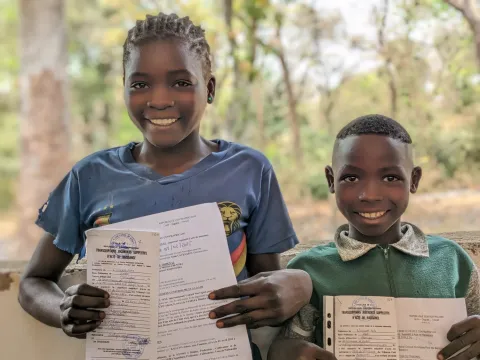
The community engagement work in CAR is one key pillar of the ECW programme, which is already achieving strong results and which is key to help a growing number of people to take charge of their social and intellectual development, so that they see themselves as active agents of their own progress and that of their community and children. In all, 238 classrooms and 67 preschool areas have been built, and more than 1,500 children that were out of school have been enrolled and given accelerated learning opportunities. Nearly 80,000 school kits have been distributed to children, including more than 36,000 girls. Almost 17,000 children have benefited from support in obtaining birth certificates, which are needed for school exams.1,000 teachers and volunteer parents have received teacher training and are receiving teaching kits, and more than 300 school latrines have been built.
The workshop finished with agreement on a roadmap to scale-up the community engagement work in both countries, and to encourage other donor partners to support education in the two countries.
Media contacts
À propos de l’UNICEF
L’UNICEF travaille dans certains des endroits les plus inhospitaliers du monde pour atteindre les enfants les plus défavorisés. Dans 190 pays et territoires, nous travaillons pour chaque enfant, chaque jour, afin de construire un monde meilleur pour tous.
Pour en savoir plus sur l’UNICEF et son action, veuillez consulter le site : www.unicef.org
Suivez-nous sur Twitter et Facebook