When Play Heals Invisible Wounds
In Cameroon’s Far North, play and creativity help children heal from the trauma of conflict, restoring hope and resilience through psychosocial support and community engagement
- English
- Français
In Igawa, in Cameroon’s Far North, children who have experienced war are rediscovering joy through psychosocial activities. Drawing, games, and laughter become tools for healing, supported by the commitment of the European Union, UNICEF, IOM, and their partners. Every burst of laughter is a victory over fear and a step toward peace.
Under the gentle afternoon sun in Igawa, in the locality of Mémé, laughter echoes beneath a tree. Around an improvised table, children draw houses, cars, and dreams. A few meters away, others engage in group games organized by facilitators. These moments may seem ordinary, but for these children, they are extraordinary: they mark the beginning of healing.
These children have endured the unimaginable. Many fled attacks by armed groups. Others were associated with Boko Haram before passing through the Disarmament, Demobilization, and Reintegration (DDR) center. Many have witnessed what no child should ever see: violence, loss, forced displacement. Their memories are heavy, their nights often haunted.

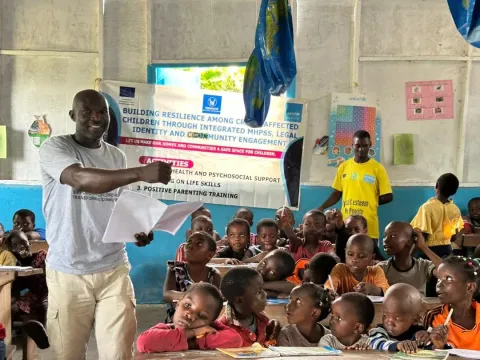
“These psychosocial activities help children forget the stress they’ve experienced and accept themselves, to play together so that peace can finally reign in the community,” explains Céline, a social worker with ARDHU. Around her, facilitators guide children through creative and recreational activities: drawing, games, dancing. Play kits provided by the project become bridges back to childhood: building cardboard houses, imagining cars, inventing stories.
The results are visible. “When you look at these children’s behavior, you see that they can smile, play, act as if nothing happened,” Céline says. Parents also testify: at home, their children repeat the games they learned, laugh more, and help with daily chores. Teachers notice renewed enthusiasm for school.
The project, supported by UNICEF and its partners, goes beyond these moments of relaxation. These sessions are just one part of a broader initiative implemented by UNICEF and IOM, alongside civil society organizations. It aims to provide vocational training, psychosocial support, legal documents, and safe spaces for children and women victims of violence. More than 1,350 children are involved in these actions. In a region with 453,661 displaced people (including 385,421 children) and 239 confirmed grave violations in 2023, the joint efforts of partners seek to reopen paths to safety, dignity, and a future. 7,000 former associates have been identified, and 2,883 are undergoing rehabilitation at the DDR center in Meri. The goal is to prevent re-recruitment and strengthen community resilience.
These psychosocial activities help children forget the stress they’ve experienced and accept themselves, to play together so that peace can finally reign in the community.

Yet the road remains challenging. Logistical hurdles, coordination with authorities, and fragile security complicate implementation. But hope persists. Children aged 5 to 13 flock to these activities, driven by the desire to play, feel safe, and dream. “When we ask these children what they want to do, they say they want to help others, become teachers… That gives us so much hope,” says Céline. In every session, a child dares to raise their hand and share their dream: to be a caregiver, a teacher, a craftsman. Amid the games, dreams resurface.
These rediscovered smiles prove that even after war, peace can be reborn, sometimes through a simple game. Behind these joyful moments lies a collective commitment: thanks to funding from the European Union and the efforts of UNICEF, IOM, and their implementing partners, these children regain not only the joy of play but also the hope for a future. Every drawing, every burst of laughter is a victory over fear, a step toward resilience and rebuilding a life of dignity.