Shared responsibility for wise and impactful investment by UNICEF and EU Humanitarian Aid
Almost a decade into the crisis in the Northwest and Southwest regions, the cost to children’s futures continues to mount.


The protracted crisis in the Northwest and Southwest regions of Cameroon, particularly in the Bafut Fondom, has deeply scarred communities. Almost a decade into the crisis, the cost to children’s futures continues to mount. More than 80 per cent of schools in Bafut have been shut down, leaving an entire generation of children without safe access to learning.
“Even my children who live in the palace, which is considered to be a safe ground, have been victims of this devastating crisis. Schools have already been shattered by the war. Children now cross rivers and walk long distances to attend school, if they dare. Along the way, they risk attacks, crossfire, or even the trauma of seeing violence up close.”
Bafut is not alone. The crisis cuts across the Northwest and Southwest regions. According to UNICEF Cameroon’s 2024 Humanitarian Situation Report, 41 per cent of schools in the regions are non-operational, with the Northwest carrying the heaviest burden. In 2024 alone, 43 attacks on education were recorded, 36 in the Northwest and 7 in the Southwest. Despite these dark realities, there are glimmers of light. Communities, partners, and traditional leaders have not given up, and neither has UNICEF, with the support of the European Union through EU Humanitarian Aid.

David Kerespars, Head of Office for EU Humanitarian Aid in Cameroon, visited the region to witness firsthand the impact of EU-funded interventions implemented by UNICEF and partners. Following his meeting with Fon Abumbi II, Kerespars shared:
"The Fon told us clearly, 80% of the schools are closed. We are committed to investing in education in areas affected by crisis. Together with UNICEF, our partners, and the Government of Cameroon, we are working tirelessly to ensure every child has access to safe, quality education."

The partnership has led to a multisectoral approach, integrating Education, Child Protection, and Water, Sanitation and Hygiene (WASH) to meet the holistic needs of children in crisis zones.
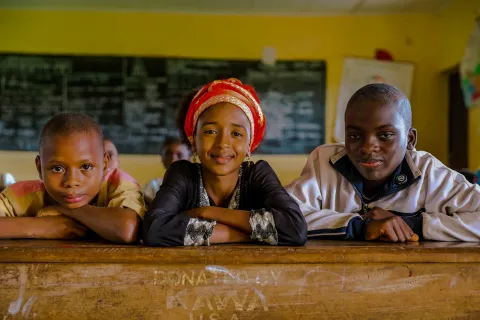
“During my visit to the Northwest Region, I saw temporary learning spaces, simple structures, but filled with life. Smiles on the faces of children, dedicated facilitators, and basic materials enabling them to learn literacy, numeracy, and life skills. Despite the challenges, children were happy to be back in school. It was striking. It was hopeful.”
His testimony affirms what many have come to believe: that education in emergencies is more than learning, it is protection, it is healing, it is dignity. It is indeed lifesaving. For Fon Abumbi II, the arrival of UNICEF and partners signalled a turning point.
"UNICEF was the first organisation to come here, even when it was dangerous. They proposed education with confidence. It has not been easy. But now, many of our children are benefiting from this new, modern form of education and at no cost."
This commitment is seen across the Northwest and Southwest. As Cluster Lead for Education, WASH, and Child Protection, UNICEF has been a lifeline for children in areas where education has been consistently under attack.
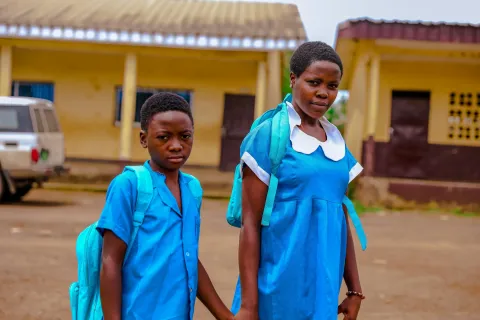
Working in close collaboration with the Ministry of Basic Education, UNICEF has organised remedial classes for children whose academic performance falls behind due to the crisis. Over 400 teachers have been trained to integrate psychosocial support into lessons, ensuring learning goes together with emotional recovery. More than 15,000 children have received learning materials, including school bags, books, pens, and other essential supplies to reignite their academic journey.
In addition to education, the intervention also supports child protection systems, including referral pathways, life skills sessions, and recreational activities aimed at restoring a sense of normalcy and connection. Crucially, UNICEF has also helped register 4,507 children for birth certificates, a vital step in securing their legal identity and access to services.

In the WASH sector, UNICEF and its partners have constructed latrines and carried out hygiene promotion campaigns, equipping children with the knowledge and tools to stay healthy, especially in temporary school environments.
"School is not just for the future. It is protection today. Education helps prevent early marriage and keeps boys from being recruited into armed groups. It offers children a safe space, a community, and a reason to dream again.”
Still, the needs remain urgent. The UNICEF Cameroon Humanitarian Action for Children (HAC) Appeal for 2025 prioritizes multisectoral responses in hard-to-reach areas, strengthened localization, and youth engagement, grounded in a humanitarian-development-peace nexus approach.
UNICEF aims to address both immediate and long-term vulnerabilities, with a focus on education, nutrition, WASH, child protection, and health.
“Just like UNICEF is delivering in Bafut. We look forward to seeing more of these initiatives in other communities still caught in darkness. We may have suffered, but we are not forgotten.”
The crisis is far from over, but stories like Bafut’s remind us of that humanitarian action, when guided by empathy, trust, and partnership, can create hope. UNICEF’s 2025 Humanitarian Action for Children appeal underscores the urgency to scale up such responses, especially in areas where children are still waiting. Waiting for school bells to ring again, for safe water to flow, and for the chance to simply be children.
From Bafut to the farthest corners of the North-West and South-West, the message is clear: education must not wait. Hope must not wait. And with joint action, no child will be left behind. Education is a multiplier. It is a lifesaving, protective intervention that keeps children physically and mentally safe during a crisis.