“I Can Reach School Faster Now”: How Assistive Devices Are Restoring Dignity and Learning
Access to assistive devices is enabling Princewill to move independently, regain confidence, and continue his education.

Every morning, before the sun rises over the hills of Mulang in Cameroon's Northwest region, sixteen-year-old Princewill Etunxi is already awake. He washes dishes. He fetches water. He helps his aunt with household chores. And then, when everything is done, he prepares himself for the journey that used to feel impossible: the walk to school G.P.S Mulang.
Princewill did not always live in Bamenda. He grew up in Oshie, a village in the Njikwa Sub-division in Momo Division, Northwest region, where the ongoing crisis forced him to flee his home and move to live with his aunt. The displacement disrupted his life and education, adding yet another layer of difficulty to an already challenging childhood
But for Princewill, getting to school has never been easy.
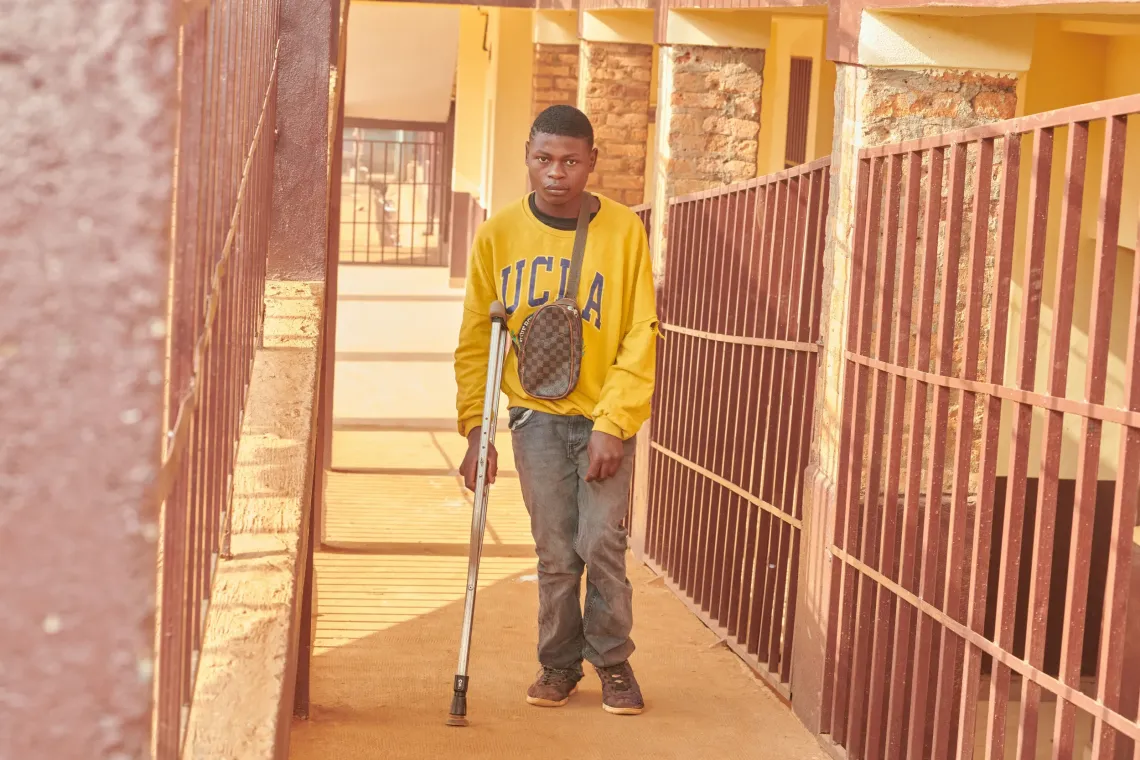
Born with a physical disability affecting his left leg and one arm, Princewill has a history of this disability affecting his education. For as long as he can remember, movement has meant pain. Walking has meant exhaustion. And the simple distance between his home and his school, Government Primary School Mulang has felt like a mountain he had to climb every single day. Running, playing football, or joining his peers in games simple joys of childhood were out of reach.
“When they are playing football, I cannot play with them, my leg is paining me.”
Growing Up with Barriers
Princewill’s disability affects not only how he moves, but how he participates in school and everyday life. After losing his mother at a young age, Princewill was left in the care of relatives with limited means. Without access to specialized medical care, rehabilitation, or assistive devices, his disability became an even greater barrier to his education. Simple tasks walking to school, moving between classrooms, or sitting comfortably during lessons often require extra effort and endurance.
At school, the obstacles are not only physical. Princewill also faces stigma and discrimination from peers who do not understand his condition.
“Some boys insult me, it makes me feel bad.”
These experiences affect his confidence and sense of belonging, making it harder for him to fully engage in learning. Yet, despite these barriers, Princewill’s desire to learn has never faded.

“I always want to go to school, and become a teacher”
In the classroom, he works hard to keep up with his classmates, even when the school environment is not adapted to his needs. Narrow pathways, crowded classrooms, and a lack of inclusive learning tools make participation more difficult for him. Still, he raises his hand, completes his exercises, and refuses to give up.
English is his favorite subject, taught by Madam Rose, a teacher who recognizes his potential and encourages him to participate. Her support has helped Princewill remain motivated, showing how inclusive attitudes can make a difference for children with disabilities.