Bintou: Using Music to Create Spaces Where Every Child Belongs
Newly trained through UNICEF’s I Am Music programme, Bintou is bringing music-based learning and protection opportunities to children in her community.

- English
- Français
In Kolofata, Bintou works with children and young people. After attending a UNICEF training in Maroua, she is returning home with new tools to make music a space for learning, self-expression and protection.
Through a song, a rhythm, or a few notes played together, children can learn much more than music. They can learn to listen, cooperate, express themselves and find their place within a group.
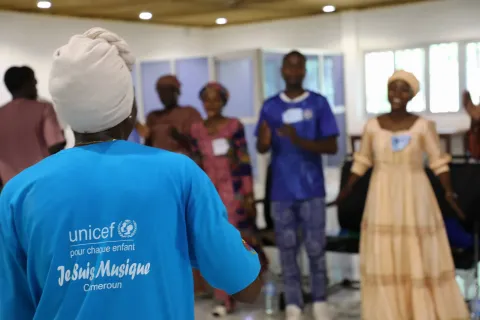
From 16 to 18 June 2026, Bintou participated in a training for music educators held at the Cameroon Institution for Children (ICE) in Maroua as part of UNICEF’s “I Am Music” programme, under the Disarmament, Demobilization and Reintegration (DDR) project. The training brought together 31 participants from several localities across Cameroon’s Far North Region.

When Music Becomes a Space for Growth
Over three days, participants were introduced to the El Sistema methodology, adapted to the Cameroonian context to promote collective, inclusive and non-competitive learning. They also explored simple techniques in singing, rhythm and group coordination, alongside the use of accessible musical instruments.
For Bintou, the experience changed the way she views music. “Before this training, I mainly saw music as a means of expression. Today, I understand that it can also help children learn, listen to one another and live together.”
The training also covered child rights and protection from gender-based violence, including sexual violence. Participants were sensitized to their role in creating safe environments for children and young people.
“We are not only here to teach music to children. We must also make sure they are safe and respected,” Bintou explains.

From Training to Action
Back in Kolofata, Bintou is now preparing to put these lessons into practice. Together with the other participants, she will contribute to establishing music nuclei, designed as collective, inclusive and sustainable learning spaces within communities.
“What I have learned, I now want to pass on to the children in my community. I want to create a space where they can sing, play, express themselves and learn together in an environment where they feel heard and valued.”
Her journey reflects the ambition of “I Am Music”: to strengthen the capacities of those who work with children so that music can contribute to their development, inclusion and protection.
For Bintou, the next step is clear: to share what she has learned and make music a space where every child can learn, express themselves and find their place.
This initiative is supported by the generous financial contributions of the people of Germany and the European Union.