Mondulkiri High School Youth Lead Composting Drive to Tackle Climate Challenges
Students from ethnic minority communities turn food waste into compost, cutting costs for families while building climate skills through UNICEF-supported life skills and youth volunteer programmes.

- English
- Khmer
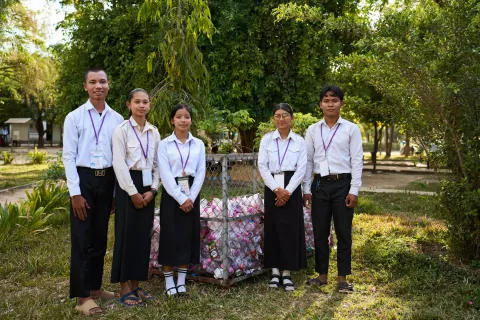
Senmonorom, Mondulkiri, 4 December 2025 — In the courtyard of a provincial high school, three students crouch beside a basket of dark soil. Kloas Hian, 18, Thal Komhong, 16, and Kraeut Malyza, 17, sift compost made from food scraps and dry leaves, then sprinkle with water over it. Today, they are visiting another school to show peers how waste can become fertilizer.
What looks like a simple demonstration is the result of months of learning. The hands-on activity is part of Cambodia's Volunteer for My Community (VMC) programme, which continues UNICEF-supported Local Life Skills Education (LLSE) efforts in upper primary and lower secondary schools. Both focus on climate change and equip students with practical skills to design and lead projects tackling real challenges. LLSE uses problem-based learning; VMC applies project-based learning—giving youth the tools to turn ideas into action.
All three are agriculture students at Mondulkiri General and Technical High School. They come from ethnic minority communities where farming supports most families. Climate change has made that work harder. Longer dry seasons followed by sudden floods have reduced yields and increased costs. Many farmers turn to chemical fertilizers and pesticides, which damage soil and threaten health.
“Pesticide poisoning is a big problem,” Malyza explains. “Our soil is still healthy because of the forest cover, but we need to protect it. We teach simple steps so students can go home and show their parents. It’s cheap—the solution is in their backyard.”
The student project "Organic Fertilizer Grows in the Northeast" started with five members but now has three core leaders. They drafted a proposal, researched composting techniques, and planned demonstrations. Last month, they presented their work to 160 students from schools across the province, showing how families can save money and protect soil by making compost at home.
The students credit their teacher, Mr. Sen Samnin, for introducing them to life skills and VMC through UNICEF-supported training. With support from UNICEF through Gender Thematic Funding, the Ministry of Education, Youth and Sport is scaling up LLSE and VMC nationwide. The programmes help students apply academic learning to real-life challenges while promoting equal participation for girls and boys.
The team’s method is simple: start compost with two to three common ingredients—kitchen scraps like vegetable peels and leftover rice, combined with dry yard waste such as leaves and twigs. Families need only a bucket or pit; compost is ready when it looks like soil. The savings are significant. Chemical fertilizer costs $20–$40 per 50 kg bag, and a household garden may use one to three bags per year. Homemade compost is free, saving families up to $60–$80 annually while protecting soil and health.
Hian has seen the impact firsthand. Sometimes students stop me at the school gate or in the market,” she says. “They tell me their family started composting and their vegetables are growing better.”
Through LLSE and VMC, the students practiced communication by explaining ideas clearly, collaboration through teamwork, and problem-solving by turning waste into a resource. Presenting in front of large groups built confidence—especially for girls leading in public spaces.
“The project taught me that small actions, when done consistently, can create real change,” Hian says.
Komhong, the youngest of the group, brings curiosity to everything he does. Interested in climate-resilient farming, he used AI tools for research and dreams of building robots to support agriculture. His approach shows how local solutions can connect with global technology to tackle climate challenges.
School principal Mr. Kem Channara, an educator for over 25 years, adds: “VMC expresses sincere thanks to UNICEF for its support in contributing to soft skill development through project-based learning activities.”
Across Mondulkiri and two other northeastern provinces, LLSE and VMC have reached thousands of students, with over half being girls—helping them build confidence and practical skills for climate resilience. Change is already visible. Younger students ask questions about ingredients, timings, and costs. Some return the next week with photos and stories: a compost heap behind the house, banana peels mixed with dried leaves, a family garden that looks healthier after the rains.
As Mondulkiri faces another unpredictable season, these youth leaders hope their work will inspire families to adopt composting and explore climate-resilient seeds—small steps that can make a big difference for food security and the future.