UNICEF Solar Water Supply Upgrades: Climate-Smart Energy for Children’s Care
How solar power and clean water changed a rural health centre in Cambodia—and what happens when 42,000 more people get the same life-saving upgrades at six health care facilities (four hospitals and two health centers) across rural areas of the country.

- English
- Khmer
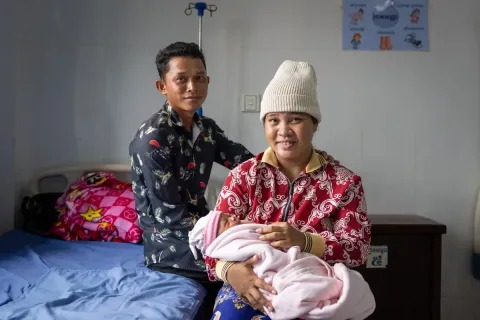
25 June 2025, Sambo, Kratie — The motorcycle ride from Pros Saloy’s village to Srae Chis Health Centre takes half a day through rutted roads and forest paths. Two weeks after giving birth to her daughter Sreynit, the 28-year-old mother makes this journey again — but this time for a check-up, not an emergency.
Two years ago, Saloy gave birth to her second child in this same building. The lights went out mid-delivery, forcing midwife Meng Sokhen to work by the glow of a phone torch. There was no clean water to wash the baby. The smell of overflowing toilets filled the air.
“Everything is different now,” says Saloy, a Kraol ethnic minority mother who speaks little Khmer. She gestures to the bright walls and running taps. “Much, much better than before.”
What happened between those two births shows what is possible when governments and partners fix systems together, not one problem at a time.
In rural Cambodia, reaching healthcare can mean crossing flooded streams or dusty roads — only to find the centre itself struggling. Until recently, arriving at Srae Chis meant unreliable power, foul-smelling water, and toilets that often failed.
A national assessment of water, sanitation and hygiene in health care facilities revealed significant shortcomings — although 96 per cent had improved water sources, only 38 per cent maintained year-round water supply. Just 7 per cent met basic sanitation standards, and only 2 per cent had proper cleaning services.1
Srae Chis battled every one of those problems. Burst pipes flooded toilets; the septic tank overflowed; well water was bitter and smelt of chemicals. Staff resorted to pumping river water 150 metres away — until the river dried up each dry season or turned to yellow mud during the rains. When electricity failed, staff worked in darkness.

Health-centre director Chan Rachna remembers a night he will never forget.
“A five-year-old came in struggling to breathe. The oxygen machine needed electricity. The power was out,” he says quietly. “We waited for it to come back on. It didn’t. I had to borrow an ambulance from another health centre to transfer that kid to provincial referral hospital. That time cost us dearly.”
In 2024, UNICEF, with support from the Republic of Korea (RoK) and the Australian Department of Foreign Affairs and Trade (DFAT), decided to try a new approach: addressing water and power challenges together.
Through UNICEF, RoK funding installed piped networks, proper toilets, hand-washing facilities, and a constructed wetland to treat wastewater. DFAT financed thirty solar panels generating up to eight kilowatts of power — enough to keep the entire facility running day and night.
Now the two systems power each other. Solar energy drives the pumps; clean water flows steadily; lights never fail.
“Now, with the light, I can see clearly,” says midwife Sokhen. “I feel confident delivering babies, and I don’t have to worry about the heat. I can give better care.”
Before the upgrades, the centre saw an average of five patients on a busy day, nearly all emergencies. Three months after the solar went in, fifteen to twenty people arrive daily — many for regular check-ups. Electricity costs dropped from more than 400,000 riels (about US$100) a month to under 40,000 riels.
Nurse Sang Heng, 38, recalls delivering a baby by phone light during a blackout. “We didn’t have the basics,” he says. “Now, we have.”
The success at Srae Chis proves a simple idea: when basic systems work together, everything works better. The facility moved from being broken and unreliable to providing year-round clean water, proper sanitation and cleaning services — things that only 2 to 7 per cent of Cambodia’s health centres currently provide.1 Patient visits have tripled, and staff retention has improved.
With continued funding from the Republic of Korea in 2025, UNICEF is preparing to replicate the model at six larger facilities across rural Cambodia — four hospitals and two health centres — bringing reliable power and clean water to over 42,000 people, including over 5,000 persons with disabilities who urgently need safe healthcare.
If solar energy and clean water can transform care at a small centre, their impact at hospitals with operating rooms and intensive care units will be even greater. One hospital in Preah Vihear province, Choam Khsan, will receive the full upgrade — including advanced nature-based wastewater treatment, LED lighting, and wall fans.
For mothers like Saloy, these upgrades mean safety. “I’ll tell my friends to have their babies here,” she says, adjusting Sreynit’s tiny red hat. Two years ago, that would have been unthinkable.
Thanks to support from the Republic of Korea and Australia through UNICEF, children like Sreynit are now born into clean, well-lit rooms — and cared for by health workers who finally have what they need to keep every child safe.