Climate action starts with young people
Young leaders in Siem Reap get creative to raise funds, empower climate action in their school and community, and build skills for life.
- English
- Khmer
10 March 2026, Siem Reap – When a group of Grade 11 students from Siem Reap set out to raise money for a community clean-up project, they had to get creative to get people’s attention.
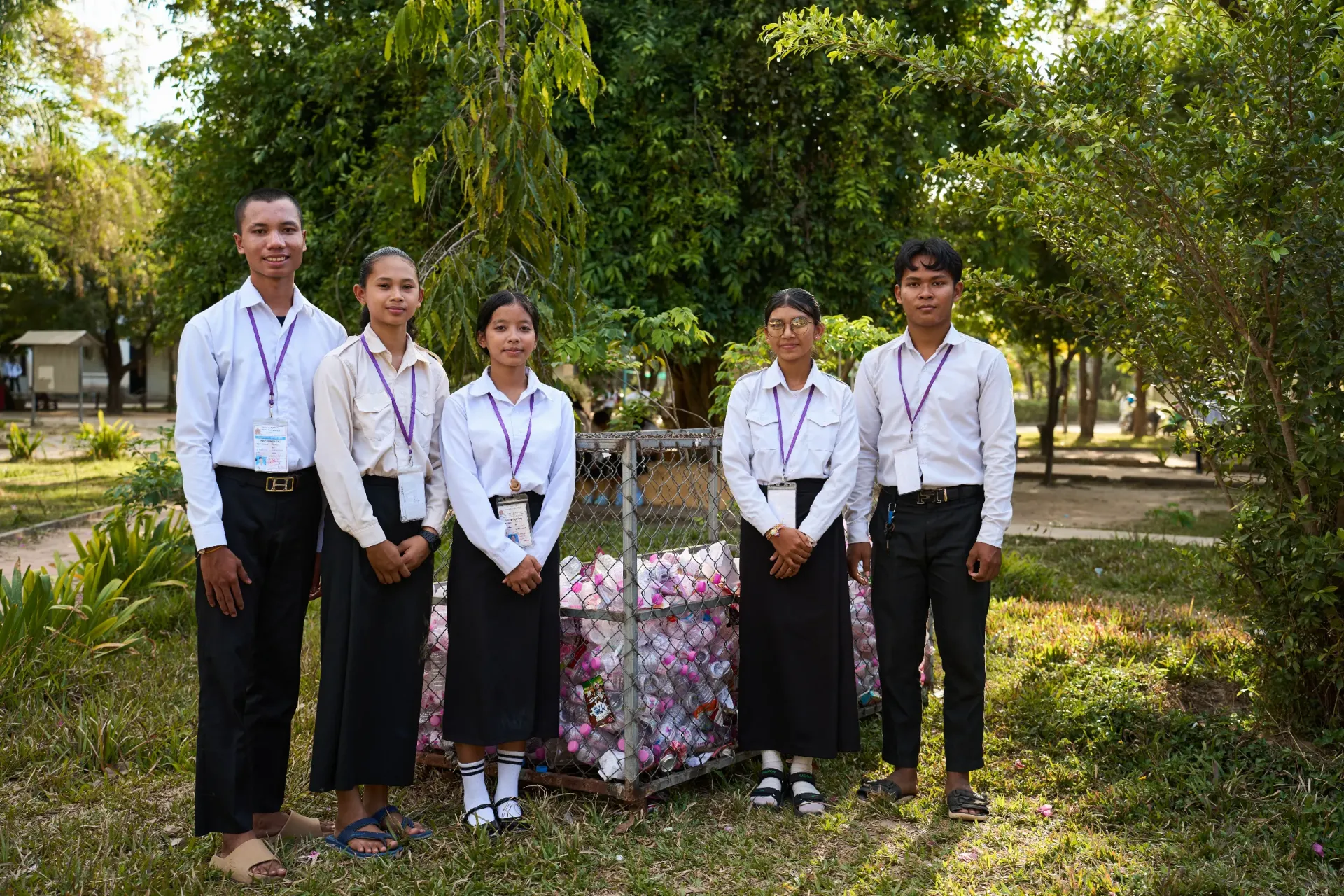
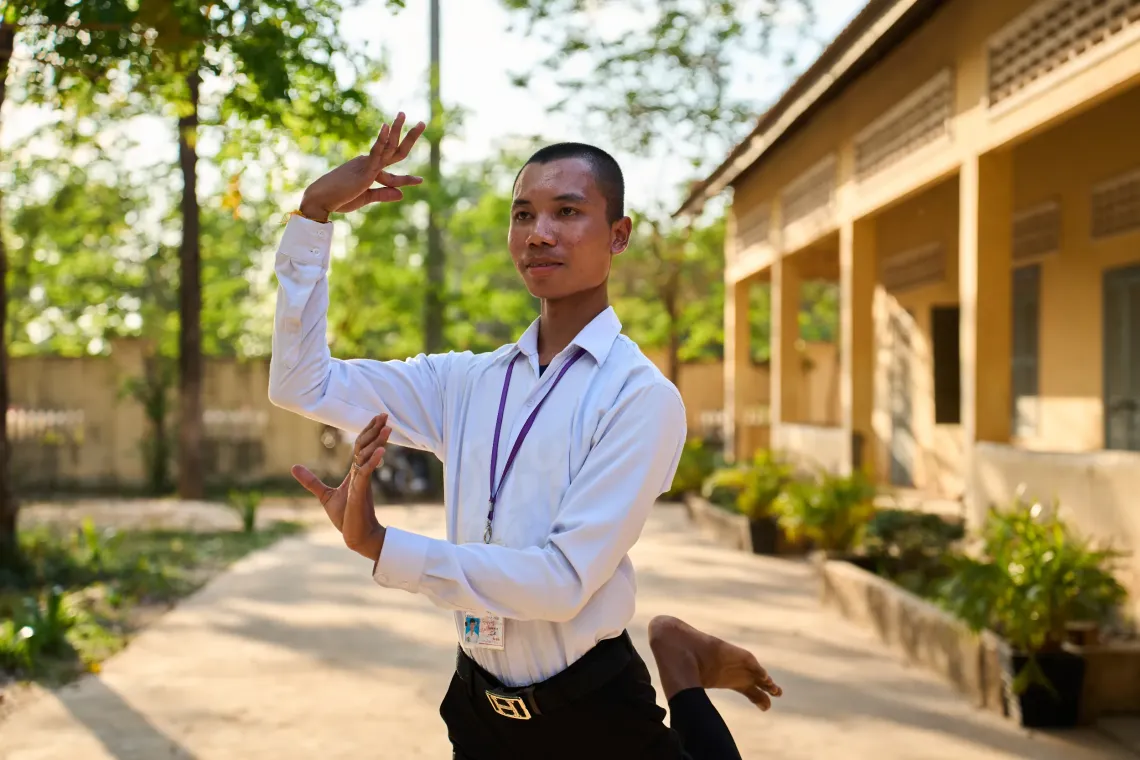
“We caught their interest using art,” says 17-year-old Pkay. Together with his teammates, they planned and performed a traditional Khmer play during a village festival held at a nearby pagoda, impressing the audience with traditional stories, songs, and dance. During the performance, they made a call for donations, sharing their plan to address long-standing trash and environmental problems in the school and surrounding village.
“We announced that we would take all the money to help develop the community. Before, we had only raised a small amount. But when we went into the community, it all added up because so many people supported us, and we reached 1 million riel [US$250].”
Their province is home to the pride of Cambodia and one of the world’s most admired religious monuments, Angkor Wat, which attracts millions of tourists every year. A waste incinerator, the students said, could help keep their village’s environment clean, inspire more people to take climate action, and ensure that tourists go home with the best possible impression of the country.
“Our goal is to build it on the grounds of the pagoda in Samrong village, because during festivals there is trash everywhere and it’s hard for the monks to sweep it all up,” says Pkay. “There’s nowhere to burn it, and our people don't really understand how to dispose of trash properly.”
Their fundraising efforts over the past year are part of a new extracurricular subject being offered at the school. With support from UNICEF to the Ministry of Education, Youth and Sport, the Volunteer for My Community (VMC) initiative empowers upper secondary students to design and lead projects addressing challenges such as climate change, mental health, and child marriage prevention, while equipping students with transferrable 21st-century skills like leadership, critical thinking, creativity, collaboration, entrepreneurship, and digital literacy. Building on skills developed through the local life skills education (LLSE) subject at lower secondary, participating in VMC gives young people, especially adolescent girls, the chance to get out of the classroom and take active roles in their communities, including engaging with and mobilising resources from local government.
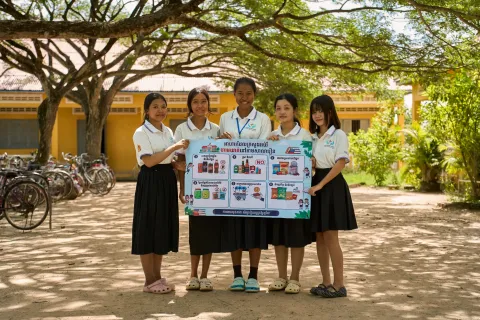
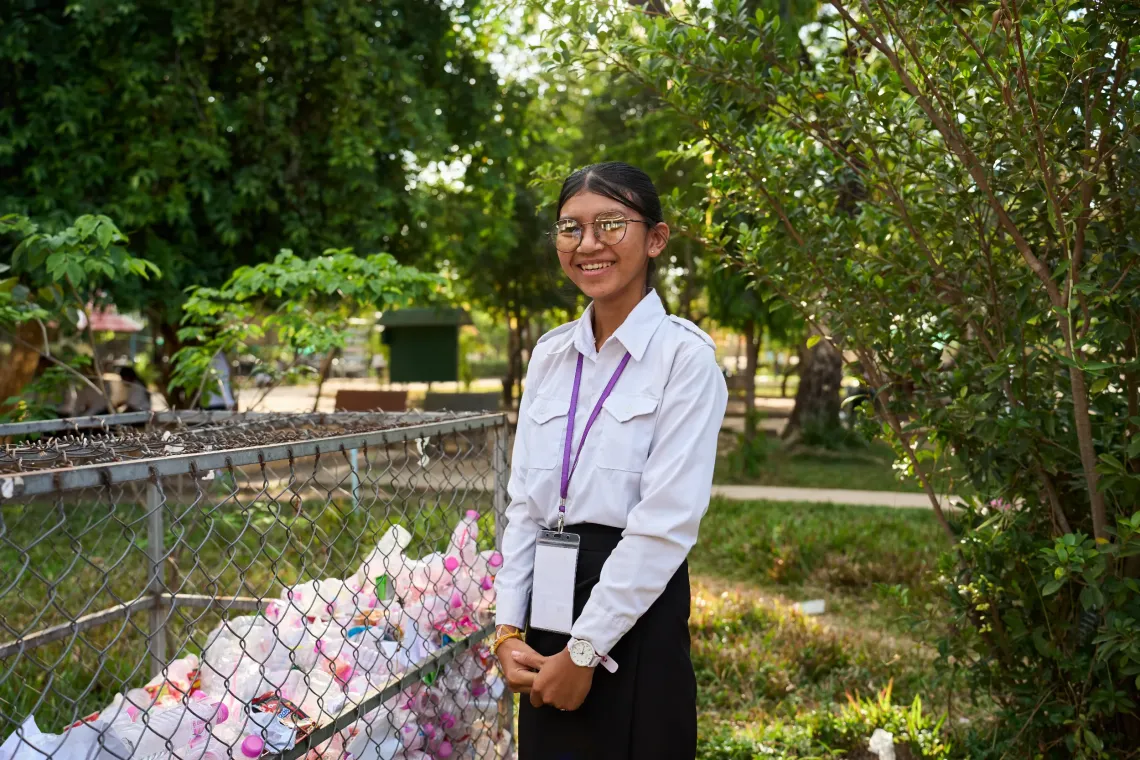
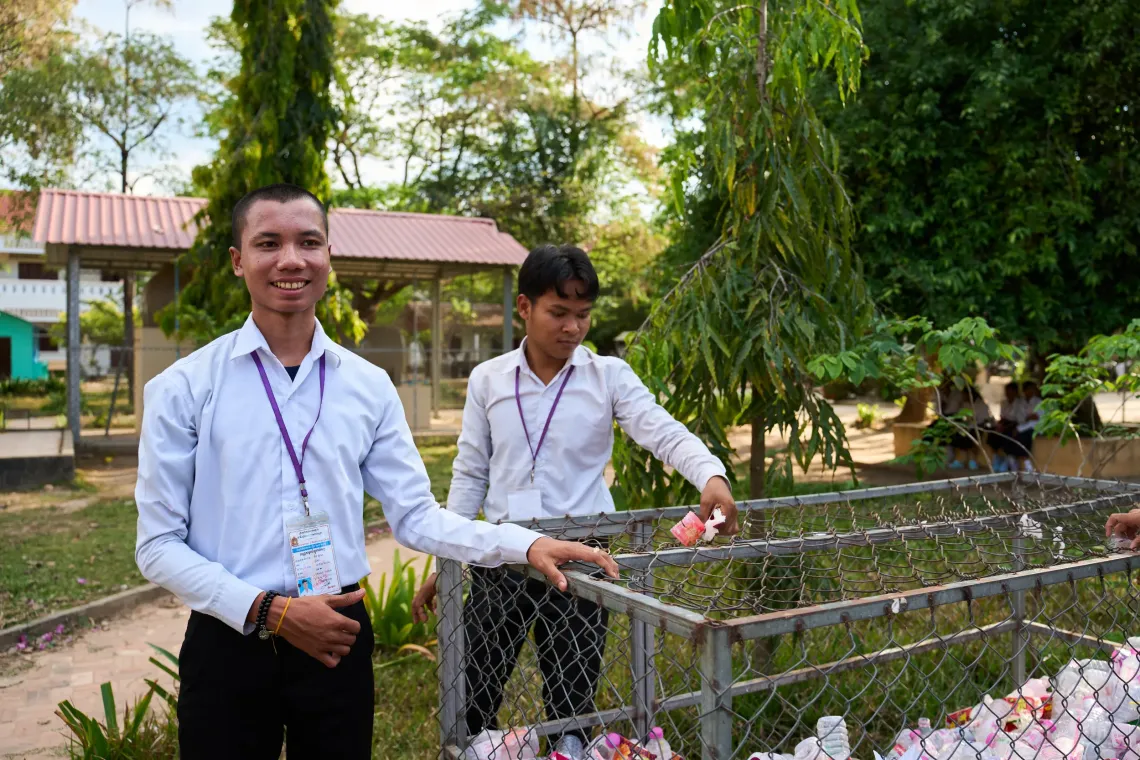
Pkay and this team haven’t reached their fundraising target yet, but steady efforts and advocacy since 2025 have already taken them a long way. The US$250 raised so far has gone towards installing solar powered lights in the school compound and on the road, a couple of trash bins, and more than 100 metres of fencing around the school. They’ve also set up a plastic recycling station, advocated for students to clean up the school environment, and are planning to repair the school’s trash incinerator, too.
At the beginning, having to present their project proposal and ask for support from the community and authorities was intimidating, says Pkay. “It felt a bit difficult, because we wondered: would people really agree with us 100 per cent or not?”
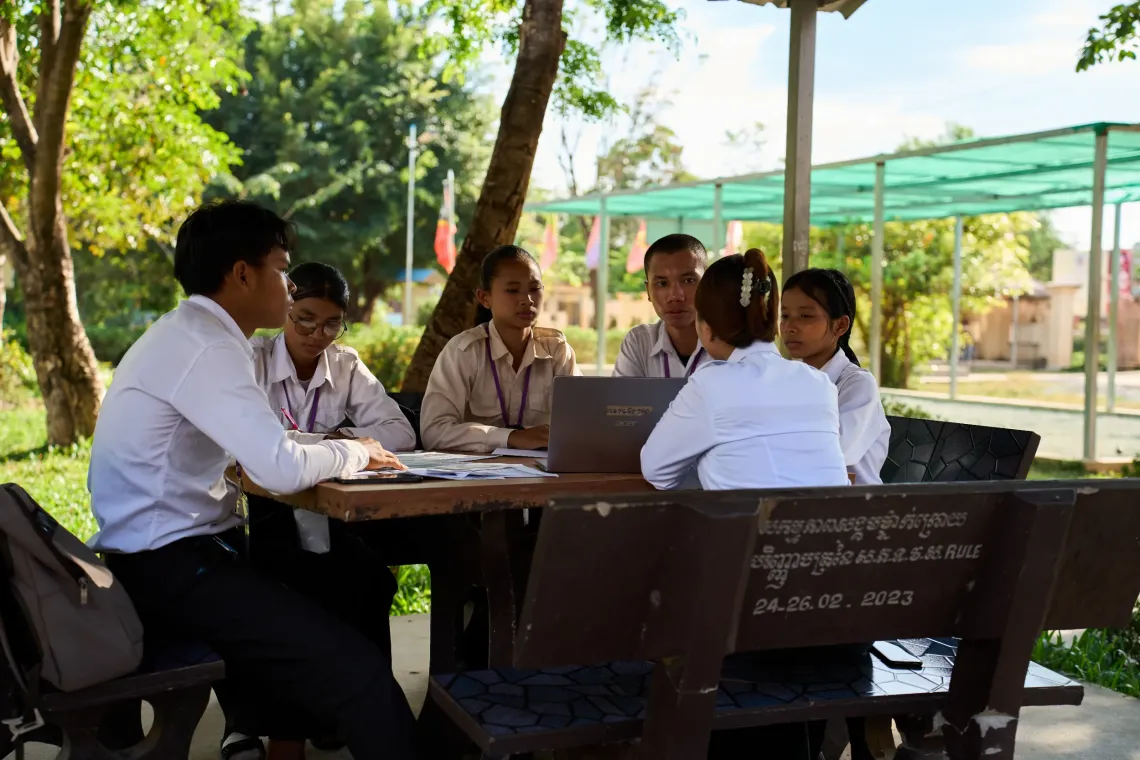
Their teacher, Kong Somoeun, advised them to start small and work step-by-step. The VMC approach gets adolescents to do their own research, connect climate change concepts to their own community, and work together to generate feasible solutions to real problems they see around them.
“I told them that climate change is a broad topic, that they should do research using Google and AI to help,” says Somoeun, who attended UNICEF-supported trainings on facilitating VMC. “They couldn’t describe everything happening globally, so I told them to focus on what they could actually do within the school.”
They practiced their public speaking skills during morning school assemblies and flag ceremonies, presenting their research and breaking down their identified problems and solutions before asking for small contributions. Only later did they work up the courage to approach local community leaders, including the village and commune chief, and an NGO, which provided materials like pens, paper, and a loudspeaker to support community advocacy efforts.
“We learned from others, gained new experiences, and we are much braver now when it comes to speaking,” says 16-year-old Ratha, a member of Pkay’s team. “We want to continue until we succeed. We won't give up.”
Climate change and climate-related disasters are some of the most pressing issues facing children and young people in Cambodia today. Climate risks from extreme weather like flooding, drought, and heatwaves disproportionately impact children by increasing school absenteeism and dropout rates, weakening learning outcomes, and negatively affecting children’s well-being, mental health, protection, and overall sense of security. In Cambodia, nearly 2 million children live in areas where extreme weather and environmental dangers are becoming part of daily life, yet lack access to essential and lifesaving services (CCRI).
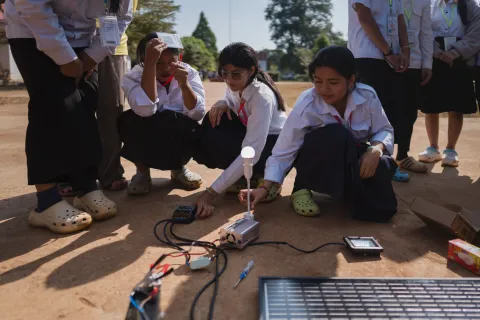
Thanks to funding from the Canadian Government and the Australian Government through the Australian NGO Cooperation Programme, the VMC and LLSE programmes was scaled up to reach 987 schools across 10 provinces in 2025. With support from UNICEF, more than 3,800 teachers and education officials have been trained on the two approaches, helping 150,000 students gain skills and knowledge to become changemakers for their communities. By engaging in projects like waste management, reforestation through tree planting, and the promotion of renewable energy, students not only learn to cope with the challenges posed by extreme weather but also actively contribute to local solutions.
For many of the students, it would have been the first-time using technology to do online research and put together a slide presentation.
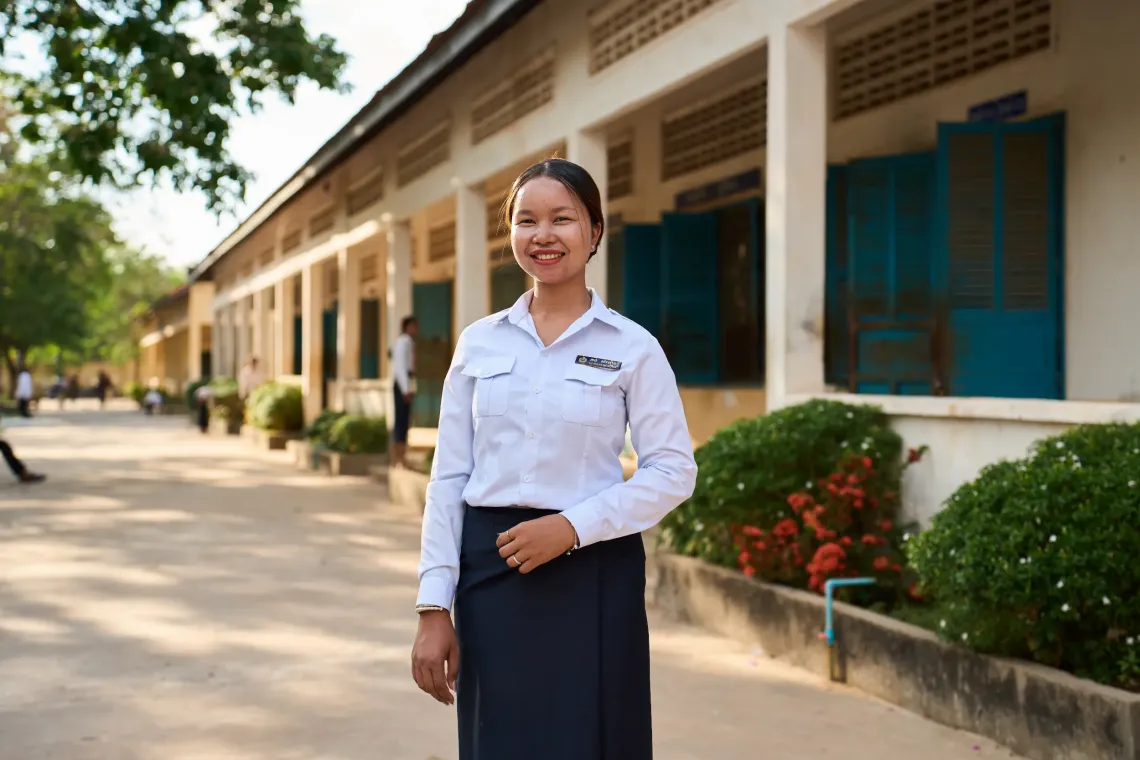
“I didn't know how to use a computer at all before, but now I can use one much better,” says Ratha.
“The hardest part was the technology,” adds Somoeun. “You can’t just teach computer skills in one day.”
Many students in Cambodia’s remote areas depend on school facilities to access technology. But with only one high school in the whole district – meaning it takes some students an hour to commute to school – a computer lab full of broken computers, and no projector until last year, building digital skills took time and effort.
“The students involved in this project only know a little bit about technology because they live so far away,” she says. “Some are so far it’s like traveling to another province.”
For girls in Cambodia, these challenges can be even greater. Social and gender norms continue to limit girls’ opportunities to participate in their communities and develop essential digital skills. Some of these barriers begin at home.
“At first, my parents didn’t really agree,” says Ratha. “They asked, “If you go and do that alone, aren’t you afraid?” I said I wasn't afraid. As long as we are brave, it’s fine. After that, once they understood how I felt and what I wanted to do, they let me do it. My mom always pushes me to study hard and to be brave so that I can speak up.”
Today, the school grounds are noticeably cleaner, and the recycling station is filled with used plastic bottles collected by students. The team’s next goal is to expand their efforts beyond the school and encourage more people in the wider community to take action.
“I am proud that we could do it through our own motivation,” says Pkay. “And if we do it again this year, I hope we can do even better. We have ideas now and we can handle big projects like this.”
These are skills they can use for life.
“If we don't do things like this, we won't have courage,” he says. “We would only have fear.”