Young coders shine at national Game Jam
These nine-year-old girls learned tech skills like coding, design, and problem-solving from a monk. Their confidence and bravery then exceeded expectations in front of 600 people in Phnom Penh.

- English
- Khmer
10 March 2026, Siem Reap – Up on a stage in front of 600 people, 9-year-olds Panhapich and Menchu didn’t really feel nervous.
“For me, I felt happy and excited,” says Pich, Grade 4. “I didn’t feel nervous because I had prepared myself. I rehearsed, and I set my mind to be calm.”
“I led the team and told them to work hard to cooperate together,” says classmate Menchu. “And the teacher coached us constantly until we were ready.”
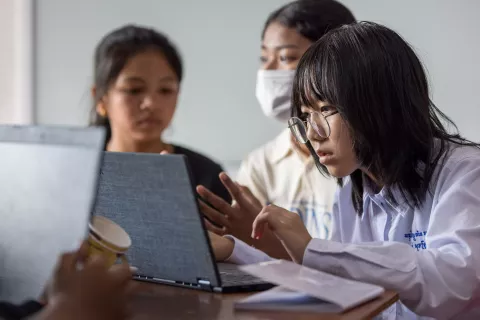
Last December, their team of five, calling themselves Girl Digital, travelled from Siem Reap to Phnom Penh to present a game they designed and created from scratch for Cambodia’s national Game Jam, a competition that brought together more than 600 students from 14 schools around the country to pitch their original video game in front of a jury of experts. The event, co-hosted by UNICEF and the Ministry of Education, Youth and Sport (MoEYS), was the culmination of six weeks of hard work, the girls studying in their free time to learn tech skills like coding, design, and problem-solving.
At only nine years old, the girls were some of the youngest to compete.

“My mother encouraged me and said that whether I lose or win, it’s okay because we worked hard to our full ability,” says Pich, who until six months ago only knew basic computer functions like switching it on and off. “Because sometimes we win, sometimes we lose.”
“When I saw them go up, I thought they would do well because they had practiced a lot and they had a lot of understanding,” says the Venerable Pheap Piseth, a monk who teaches ICT at the school and who guided the students to their achievement. Beyond teaching technical skills, he says he passes on lessons from his monkhood about morality, behaviour, and mental health to empower his students through their learning. “So I thought we shouldn’t be too scared, it’s okay, because we knew their ability beforehand.”
Uplifted by this attitude and the supportive mentors around them, the team exceeded their own expectations – they ended up winning the encouragement award in recognition of their resilience, confidence, and bravery.
“Seeing them achieve success, as well as seeing their faces on social media, I felt proud,” he says.
Cambodia is one of eight countries participating in UNICEF’s Game Changers Coalition, a programme that helps young people develop Science, Technology, Engineering, Arts, and Mathematics (STEAM) skills through video game creation, with a special focus on girls. It’s a global collaboration between UNICEF and the gaming and technology industry—including Bitget, the Micron Foundation, and Video Games Europe—that reimagines a more inclusive and diverse future of the sector. The initiative was built to dismantle the structural barriers that prevent girls and women gaining access to technology fields, while embracing innovative learning approaches like learning through play.
The country is taking this challenge seriously. At the first-ever global UNICEF Game Jam in 2025, four out of the seven winning teams came from Cambodia. With commitment from the MoEYS, annual national Game Jams now draw hundreds of girls to test new ideas, build skills and confidence, and imagine new futures in tech.
In Cambodia, girls continue to be underrepresented in STEAM. But for the country’s youngest learners, the stereotype that teaches girls that STEAM subjects are only for boys is already changing.
“Generally, I don’t think like that, because computers can be used by both boys and girls,” says Girl Digital team leader Menchu. “There’s no ‘not for boys’ or ‘not for girls’. I want to tell younger girls to study hard, don’t give up, and even if they think that thing is for boys, we can still learn it too.”
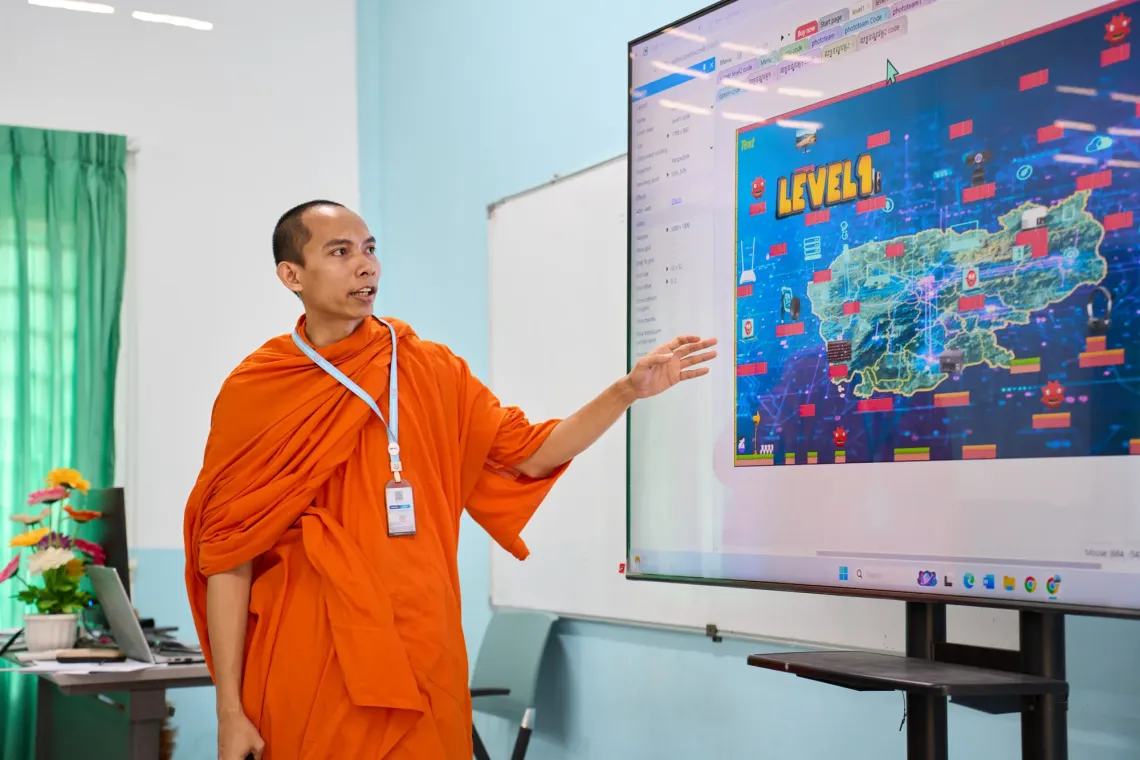
Over 65 per cent of participants at the Game Jam were girls. At Pich and Menchu’s school in Siem Reap, most of the students who signed up for the Game Changers extracurricular class were girls, says Venerable Pheap Piseth. He says the bigger surprise for the children was that the class involved learning about games.
“When they first heard about the national competition, the students were actually quite surprised,” he says. “They said, ‘Wait, we’re actually being taught how to make games?’ At that point, they didn’t yet understand the purpose of gaming or the value it could offer. However, once they started the class, I explained that games aren’t inherently bad. I showed them that if they learn these skills, they can earn a living and even use it to develop solutions to real-world problems.”
The curriculum encourages students to design games that draw on personal experiences and issues affecting their communities, demonstrating the role of creative tech in equipping young people to become active problem-solvers and digital creators. Girl Digital’s game helps children learn different parts of a computer, both hardware and software, concepts which they presented during their pitch.

Venerable Pheap Piseth sees the value of starting early.
“I always explain to them that if they learn these skills when they are young, technology will help them find good career opportunities in the future,” he says. “I told them that if they put in the effort and practice regularly, then the work they start today will provide results in the future. They’ll have skills when they finish middle school and high school, and when they enter university, they’ll be proficient enough to pursue bachelor’s degrees or higher in fields like STEM and IT.”
That lesson is sticking.
“When I grow up, I want to be a computer teacher,” says Menchu. “So I can help future generations understand more about computers.”