Three hours on the ground to save lives
UNICEF applies localization to serve internally displaced persons and host communities in Arbinda, northeastern Burkina Faso

- Français
- English
Aminata Oubri, a 22-year-old young woman, lives one of the happiest days of her life this Monday 5 August 2024. Around 3 a.m., she gave birth to twin girls and they were both healthy. “Everything went well. The mother did not suffer, and the babies are doing well,” says Martine Poda, the midwife.
The babies' birth falls on the day UNICEF had a rare opportunity to deploy to Arbinda, in the Sahel region, northeastern Burkina Faso. The United Nations Humanitarian Air Service (UNHAS) operated by the World Food Program (WFP) offered UNICEF three hours on the ground to visit an area that no staff member has visited for the past three years.
With the insecurity crisis that has plagued Burkina Faso for more than five years now, access to Arbinda remains almost impossible by road. UNHAS serves the area with helicopters dropping off passengers and taking off immediately afterwards. But on Monday, they offered the possibility of dropping off UN staff and picking them up after three hours.
“Congratulations! We are so happy with the birth of these babies. They are very pretty,” says Daouda Sanou, water, hygiene and sanitation (WASH) specialist stationed at the UNICEF office in the Sahel regional capital of Dori, who took advantage of the airlift to come and assess the work of the local NGO SERACOM, that partners with UNICEF in the area.

The child-centered multi-sector services integrated package makes localization more efficient
With localization, an adaptive programming strategy to improve access to vulnerable children and families in crisis-affected regions, UNICEF supports local community capacities to ensure the delivery of a child-centered multi-sector services integrated package, particularly in areas with significant security challenges.
SERACOM was identified as a strategic partner in the context of localization and based on the capacity building received, the NGO is now able to carry out multi-sectoral assessments when they received displacement alerts.
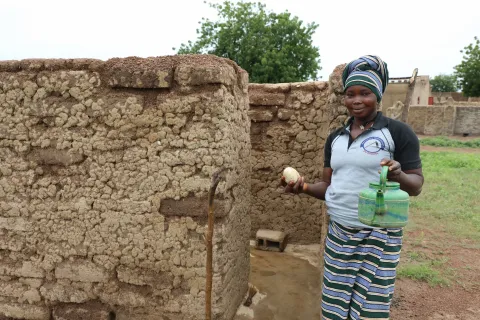
Due to insecurity, Aminata Oubri was displaced last February from her village of Djamo to find refuge in Arbinda. When her twins were born, she received from SERACOM hygiene and dignity kits mainly composed of buckets, basins, children's potty, panties, tights, soap, loincloths, kettles, cans, and torches. Thanks to medical supplies provided by UNICEF, the young woman had an assisted delivery and received quality care at the health center.
In Burkina Faso, 2 million people are displaced, 58 per cent of whom are children, with increasing numbers of people settling in urban centers and more secured areas and tapping into host communities’ very limited resources and services. The government of Burkina Faso, UNICEF and partners provide them with vital items and services whenever and wherever possible.
The town of Arbinda is home to 27,000 internally displaced people, the majority are women and children who fled their villages with almost nothing and they need essential supplies to start a new life. To mitigate the risk of attacks, internally displaced people are served in small groups or via door-to-door distribution.
This morning, the partner NGO completed a distribution of hygiene kits to 300 households. “For safety reasons, it is not recommended to bring together many people and make large distributions. You need to make small batches to easily manage a great number of beneficiaries. Distribution have already been carried-out in other sectors and today, we must serve the households which had not yet received,” specifies Sanou.

Localization, very adapted to the context of Burkina Faso, requires putting communities at the centre of services targeting children, transferring knowledge and capacities to local actors, in order to make communities more resilient. To this end, UNICEF maintains agile, flexible, risk-adapted programming to meet the needs of the most vulnerable.
In Arbinda, the partner NGO SERACOM installed water supply systems, tanks and latrines in schools, health centers and within communities to strengthen access to basic social services for host and displaced families.
“This year, I welcomed two displaced households from Bossé and Borel. We live in harmony, and we have no problems,” explains Souleymane Badilou, a farmer in his fifties. In his neighborhood, UNICEF built community latrines to reduce the risk of open defecation. “These latrines are for all the families who are here. You will use them and maintain them well, keep them clean to fight flies, mosquitoes and diseases,” advises Sanou.

Supply convoys are not regular, jeopardizing children’s lives
Two-year old Aminata Sawadogo seems to be in very bad shape. She presents symptoms of malnutrition, with swollen feet and cheeks. When Sanou put the MUAC around her arm, the cursor is on red, indicating that the girl is suffering from severe acute malnutrition, which could cost her life if she is not treated.
Arbinda is land-locked, and its access is made even more challenging due to insecurity, and its population face food insecurity and children suffer from malnutrition. “Supply convoys from Burkina Faso’s capital Ouagadougou can take six months. And when emergency food supplies arrive here, they are sometimes the only meals available even for adults,” underlines Arbinda’s health doctor Abdoul Guelile.
With a solar fridge provided by UNICEF, vaccines against preventable diseases are well preserved. However, the depot shelves are not stocked. Ready-to-use therapeutic foods to treat severe acute malnutrition are out of stock, endangering the lives of children. Little Aminata will have therapeutic milk and will be closely monitored by the doctor and the community health worker who assists him.

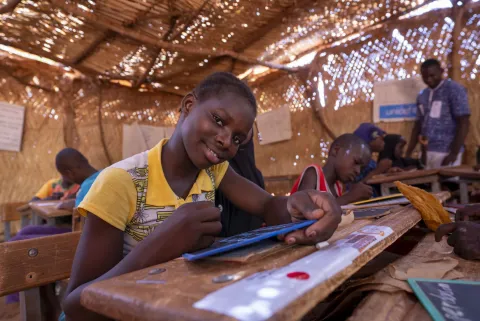
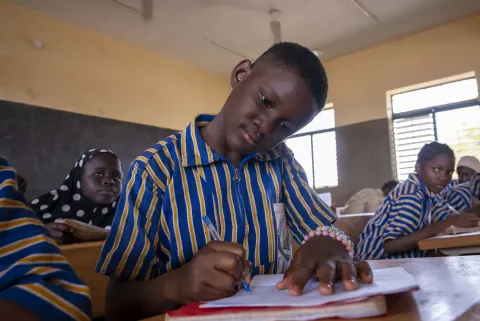
In Arbinda, UNICEF and the Ministry of Education (MENAPLN) continue to provide displaced children with access to education, thanks to the Radio Education Programme (PER). In a school near the health centre, children of different levels are grouped in the same classroom, with some sitting on the floor. “We have 64 learners including 33 girls, and they are near all displaced children. Others come to take lessons. Radio is used to reach most children and even adults,” the teacher explains.
“My name is Moira Santa, and I am 12 years old. I come from the village of Bougma, and I have been in this class for eight months. Now I can write my name and I know how to count,” says a girl standing in the middle of the classroom.

It is a serious challenge to deliver humanitarian supplies to hard-to-reach areas like Arbinda. Vital life-saving items are often conveyed by helicopter, which could increase the costs of humanitarian operations.
“UNICEF needs flexible funds that are always available in order to exploit windows of opportunity like this one, to save the lives of thousands of children in Burkina Faso,” advocates Sanou.