Savings Groups and Community Leadership Sustain Sanitation in Gado
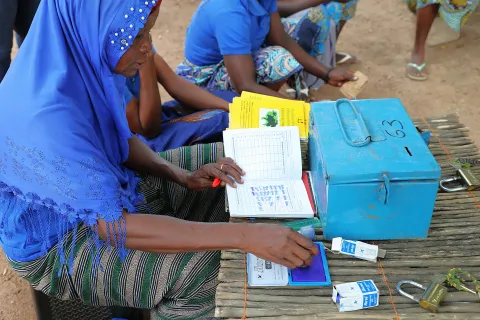
In Gado, Village Savings and Loan Associations (VSLAs) and community leaders are helping households improve sanitation and sustain good hygiene practices.

- Français
- English
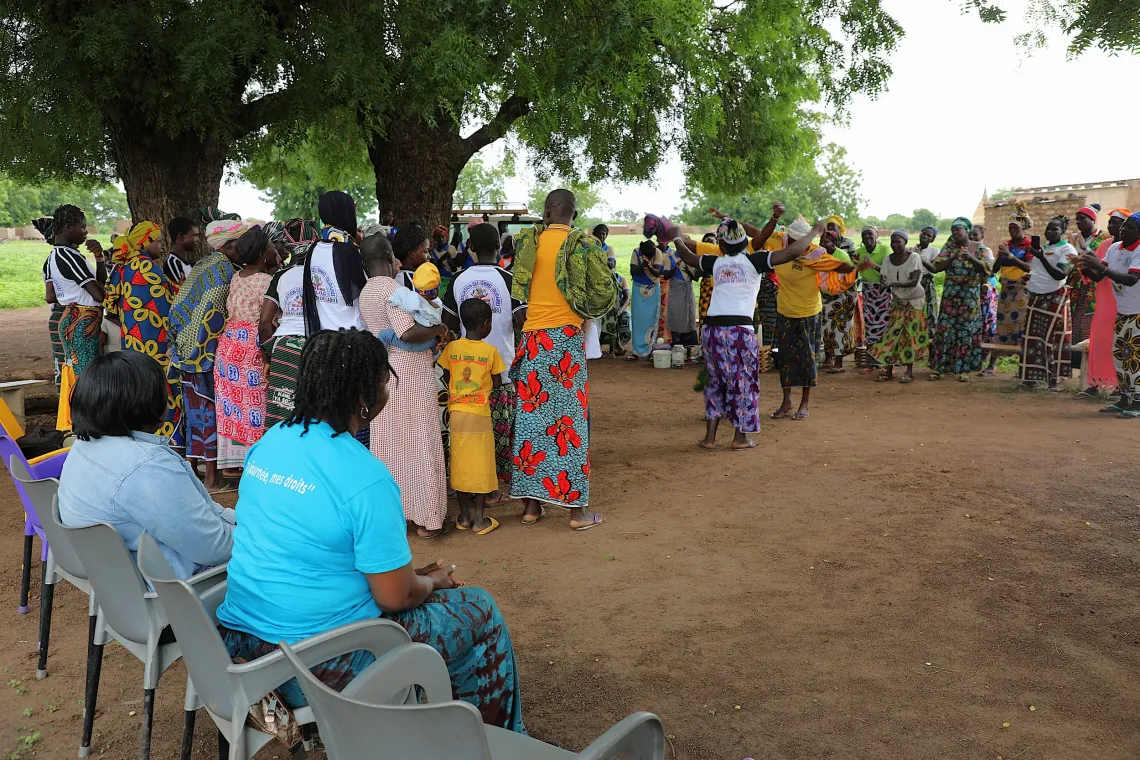
The village square is lively today. In the shade of a giant neem tree, women wearing the uniforms of their savings groups listen attentively to a community facilitator. Nearby, men and young people gathered around the village chief also follow the discussion. The Association for Peace and Solidarity (APS), a Burkinabè non-governmental organization supported by UNICEF, has organized the meeting to discuss Village Savings and Loan Associations (VSLAs) and their contribution to sanitation in the village.
After listening to other women speak, Nathalie Birba, a 28-year-old mother of four, stands to share her experience:
“The triggering of Community-Led Total Sanitation (CLTS) has been transformative for our village. It has improved our quality of life and opened the door for us women to engage in savings and credit activities for our personal development and for the benefit of the entire community,” Nathalie says convincingly.

Nathalie recalls a community gathering in Gado village square two and a half years earlier, when residents described the village’s poor sanitation conditions.
“We were very ashamed. We felt as though the APS team had come to humiliate us. Yet it was the reality, and they were right,” Nathalie recalls.
The Community-Led Total Sanitation (CLTS) triggering process prompted residents to take action. In the following weeks, households began building latrines according to their means. Within two weeks, Nathalie’s husband had dug a pit and covered it with a concrete slab to make it more durable. He built the walls with stabilized earth bricks and plastered the area around the slab to prevent rainwater from seeping into the pit.
By contributing each week to her savings group, Nathalie was able to access a loan to help her husband buy cement to reinforce the latrine floor and interior plastering. The loan also enabled her to purchase kettles and soap to maintain the latrine and support household hygiene.

Abou Ido, a member of the Village Sanitation Committee (VSC), helps raise awareness and encourages residents to build household latrines and practise good hygiene. He is pleased with the changes he has seen.
“In Gado, every household now has a latrine, and the women are highly enterprising. The savings training has empowered them to the point where they are now indispensable in maintaining household hygiene practices. Even better, they can contribute significantly to meeting the essential needs of their families,” he says.

Badimbié Ido, 82, represents the village chief. He recalls how residents came together one week after the CLTS triggering event in Gado. The sacred drum sounded, calling villagers to gather under the large tree used for public meetings.
At that meeting, the village chief referred to the sanitation conditions residents had described during the CLTS triggering event. He gave every household one month to build a latrine, with a penalty of one goat for those who did not comply.
“It was a matter of dignity!” exclaims the chief’s representative. “What we experienced ourselves during that major awareness-raising session with APS did not allow us to remain inactive. That is why the chief personally committed himself, together with the villagers, to ending open defecation and other unhealthy practices that brought dishonour to the village.”

Within a month, most Gado residents had access to a latrine. Those who still lacked one were mainly older people unable to dig the pits themselves. The following week, the chief asked village youth to help all older residents obtain a latrine.
Gado’s experience shows how community leadership and women’s access to savings and loans can support improvements in sanitation. The village chief mobilized residents to end open defecation and organized help for households unable to build latrines themselves. Savings groups established after the CLTS intervention enabled women to finance latrine improvements, buy hygiene supplies and contribute to their families’ well-being.
Together, these efforts have helped Gado sustain access to basic sanitation services while strengthening women’s participation in community life and decision-making.
Begré Zongo of APS has seen how residents’ commitment to CLTS and women’s savings groups reinforce each other. He says these efforts have helped keep the village clean while supporting local income-generating activities.
“We made the right decision when we trained women in the savings and credit system. Today, women are unquestionably the pillars of sanitation and also the financial backbone of households,” he says confidently.

Under the ASWA III Programme, UNICEF implemented CLTS in 67 villages across Burkina Faso’s Nando Region. Five of these villages, including Gado, piloted an approach that combines CLTS with Village Savings and Loan Associations whose members are predominantly women.
The growing role of women in Gado reflects ASWA III’s focus on gender transformative approaches. This programme priority seeks to improve social norms and promote inclusive, sustainable water, sanitation and hygiene (WASH) services for all.