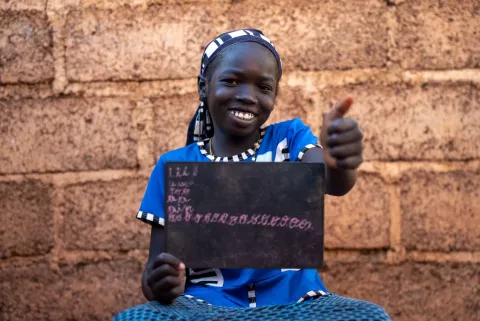
Risnata, the Child Who Got Her Smile Back
The Journey of Resilience of a Girl Broken by Violence

- Français
- English
She is only 14 years old but Risnata has already endured hardships that few people could imagine. She lived peacefully in her native village of Tawalbougou with her parents and siblings, and dreamed of a promising future, only to see her hope suddenly shattered. One day, the unthinkable happened.
"Armed men came to my house. They executed three members of my family before my eyes, including my older brother, in unspeakable violence," recounts Risnata.
Four years ago, Risnata was in her second year of primary school when the security situation in her village gradually worsened. Constant attacks and threats from armed groups spread fear and chaos. Her school was forced to close.
Risnata was no longer the same. Fear had consumed her and left her emotionally paralyzed. She stopped speaking. She avoided eye contact.
"It was a brutal shock for me. Since that day, I have suffered from anxiety and panic attacks. I would frequently faint," she says.
Agriculture and livestock farming were the main sources of income for Risnata’s parents, allowing them to provide for their children’s needs and pay for their education. Feeling powerless in the face of her distress, her parents sent her to live with her aunt in Fada N’Gourma, 40 km from her village. Her mother, Sawadogo Zeinabou, joined her there a year later.

It was in Fada N’Gourma that she caught the attention of a member of the Community Child Protection Unit (CCPE) that referred her to a Child-Friendly Space (CFS), a place where professionals work for the well-being of adolescents and young people affected by the crisis.
"I really liked the Child-Friendly Space in Sector 1 of Fada. I made many friends there. I learned to speak, sing, dance, and water trees," says Risnata.
This marked the beginning of a long journey to healing. Through individual and group psychosocial support activities implemented within the Child-Friendly Space by UNICEF’s partner organizations, Children Believe and the Todima Association, Risnata gradually learned to rebuild herself.

Mr. Ouédraogo Aboubacar, the psychologist supporting her, recounts:
"At first, she was hesitant, keeping to herself, watching the other children play without ever joining in. But little by little, she started to interact again."
Affectionate facilitators, a compassionate psychologist, and the love of her aunt and mother created a safe and protective environment around Risnata, allowing her to regain confidence.
As the days went by, the shadows of her past seemed to fade.
"Risnata rediscovered the joy of laughing, playing, and dreaming. She participated in group activities, drew, sang, and started to speak. Her anxiety attacks disappeared, and she could sleep peacefully again," explains Dr. Ouédraogo.
Upon arrival, Risnata received a WASH dignity kit containing a mat, a blanket, sanitary pads, soap, toothpaste, and other essentials.

The 14-year-old adolescent benefited from a program funded by UNICEF, the German Cooperation and Denmark, aiming to provide quality prevention, protection and education services to children affected by security and humanitarian crises. Thanks to this program, multisectoral results have been achieved, including the issuance of civil status documents, the reintegration of out-of-school children and menstrual hygiene management, among others.
The Child-Friendly Space she attends is a refuge for many children like her. Since its creation in January 2020, it has identified and supported 12,055 children, including 6,330 girls.
To implement this program, UNICEF and the Ministry of Humanitarian Action and National Solidarity trained key actors and humanitarian partners on child protection in emergency situations.
"I am proud to have helped Risnata and all these displaced and vulnerable children. We are working to bring back smiles on the faces of children in distress due to the security crisis. I feel useful and valued," says Yacouba Belem, Child Protection Officer at UNICEF's office in Fada NGourma.

Today, Risnata is a confident adolescent girl, standing tall with her eyes set on the future. Her once-lost smile now brightens her face again.
Her mother, Sawadogo Zeinabou, is moved when she expresses her gratitude:
"I sincerely thank everyone who has helped our daughter until now. May God bless you and make this project thrive."
With her mother’s guidance, Risnata has learned thread-making and is also being taught how to weave traditional cloth. Bundles of 10 threads are sold for 500 CFA francs (0.84 USD), generating a 50% profit of 250 francs (0.42 USD). The family now earns a living from sales of threads and traditional cloth, and Risnata is happy to be gradually overcoming the trauma she endured.
"My dream is to become a great seamstress one day so I can help my mother," she says with a smile.

Risnata's story is one of resilience and strength of a child broken by violence but saved by love, solidarity, and perseverance. Thanks to the support from UNICEF, the German Cooperation and Denmark, as well as community workers’ dedication, she and many other children are gradually finding their way back to the light.

In Burkina Faso, nearly two million people are internally displaced due to insecurity, including 58% children.
"UNICEF calls on partners and donors to contribute to the well-being of children in Burkina Faso," Yacouba Belem advocates.